Overview of the Resource
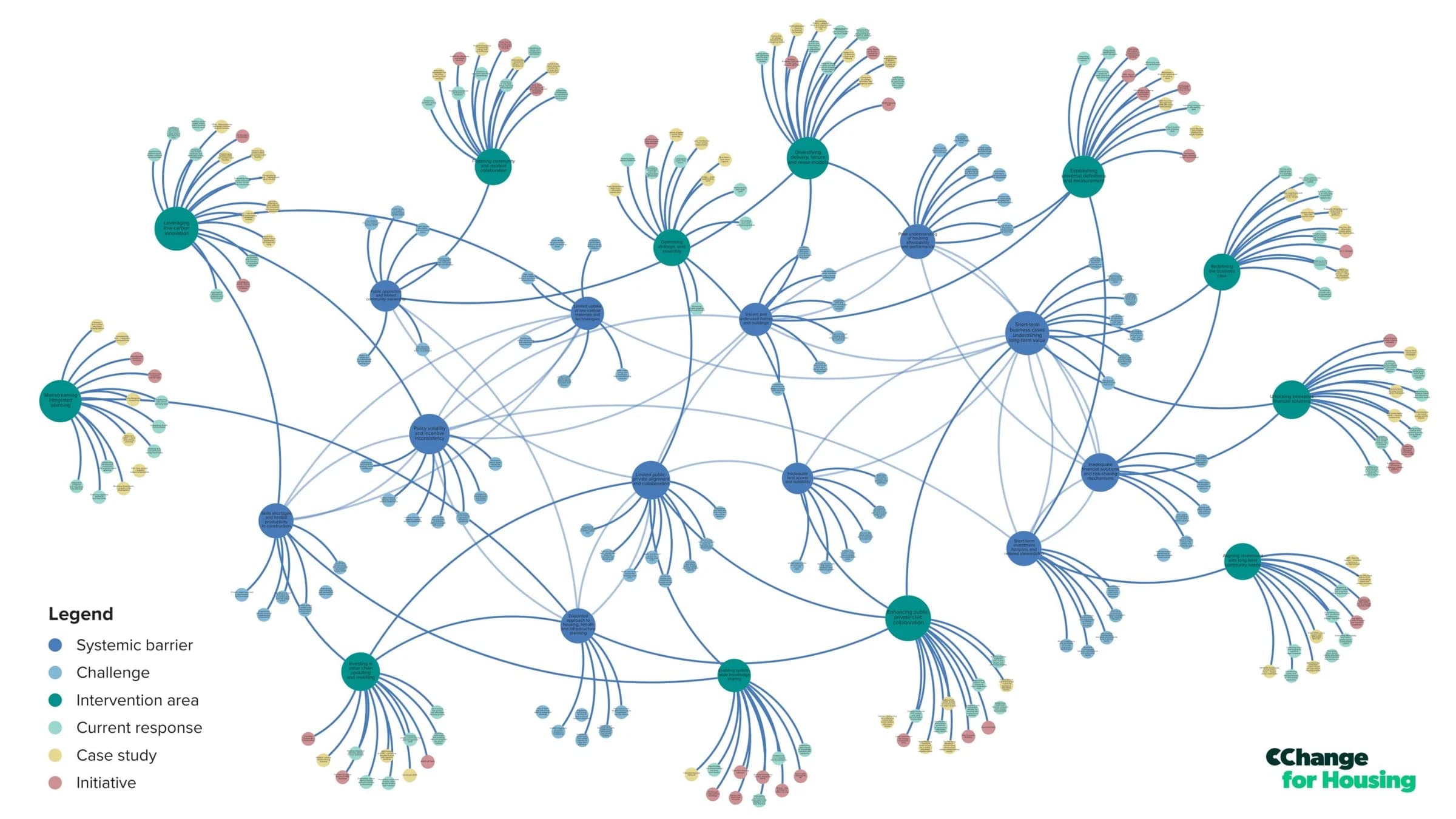
C Change for Housing on Kumu is a public, interactive systems map created by Urban Land Institute Europe (ULI Europe) through its C Change for Housing programme. Hosted on the Kumu platform, the map visualises the complex housing system across Europe, highlighting the twin challenges of affordability and decarbonisation and identifying leverage points for systemic change.
Core Mission and Focus
The map’s stated mission is “Accelerating decarbonisation of current and future affordable housing in Europe.” It analyses how affordable housing contributes to over one‑third of Europe’s energy‑related emissions and outlines 12 high‑impact intervention areas designed to reduce carbon footprints while improving access to housing.
Structure and Content Sections
The map is organised into six main sections: How to use the map, Background and purpose, Systemic barriers, Intervention areas, Case studies and initiatives, and Provide feedback. It details 12 systemic barriers—such as inadequate land access, policy volatility, and skills shortages—and pairs them with 12 corresponding intervention levers, including strategic land assembly, public‑private‑civic collaboration, and innovative financing solutions.
Data‑Rich Case Studies
A extensive catalogue of European case studies illustrates practical applications of the interventions. Examples include ABZ sustainability bonds, Barcelona’s rent‑protection scheme, Berlinovo modular micro‑apartments, Home.Earth retrofits, Net Zero Neighbourhoods, and the Sostre Cívic – La Bertrana project. These illustrate diverse models of financing, construction, and governance that contribute to low‑carbon, affordable outcomes.
Stakeholder Network and Initiatives
The map connects users to a broad network of initiatives such as Cities4Co‑housing Network, ECLTN, HouseEurope!, Housing Europe, MOBA Housing SCE, Sustainable Housing for All, TASH, New European Bauhaus, and SHAPE‑EU. These alliances support collaboration across investment, development, finance, policy, and the third sector.
Interactive Features and Navigation
Users can explore multiple view modes—showing the entire map, focusing on barriers and interventions, or highlighting current responses. Elements are colour‑coded by type (barrier, challenge, intervention, case study, initiative) and provide pop‑over details. Interactive controls allow filtering, styling, and scaling based on field data, facilitating deep analysis of system dynamics.
Target Audience and Engagement Model
The primary audience comprises European stakeholders involved in housing, finance, policy, and related sectors who need to understand systemic interdependencies. The “Provide feedback” section invites users to submit corrections, additional case studies, or initiatives via a Qualtrics form, positioning the map as an evolving, collaborative resource.
Current Status and Accessibility
The map is publicly accessible, with edit functions restricted to ULI Europe. It remains live and is intended for ongoing use, supporting strategy development, policy discussion, and coordinated action toward sustainable, affordable housing across Europe.