Overview of the Research Paper
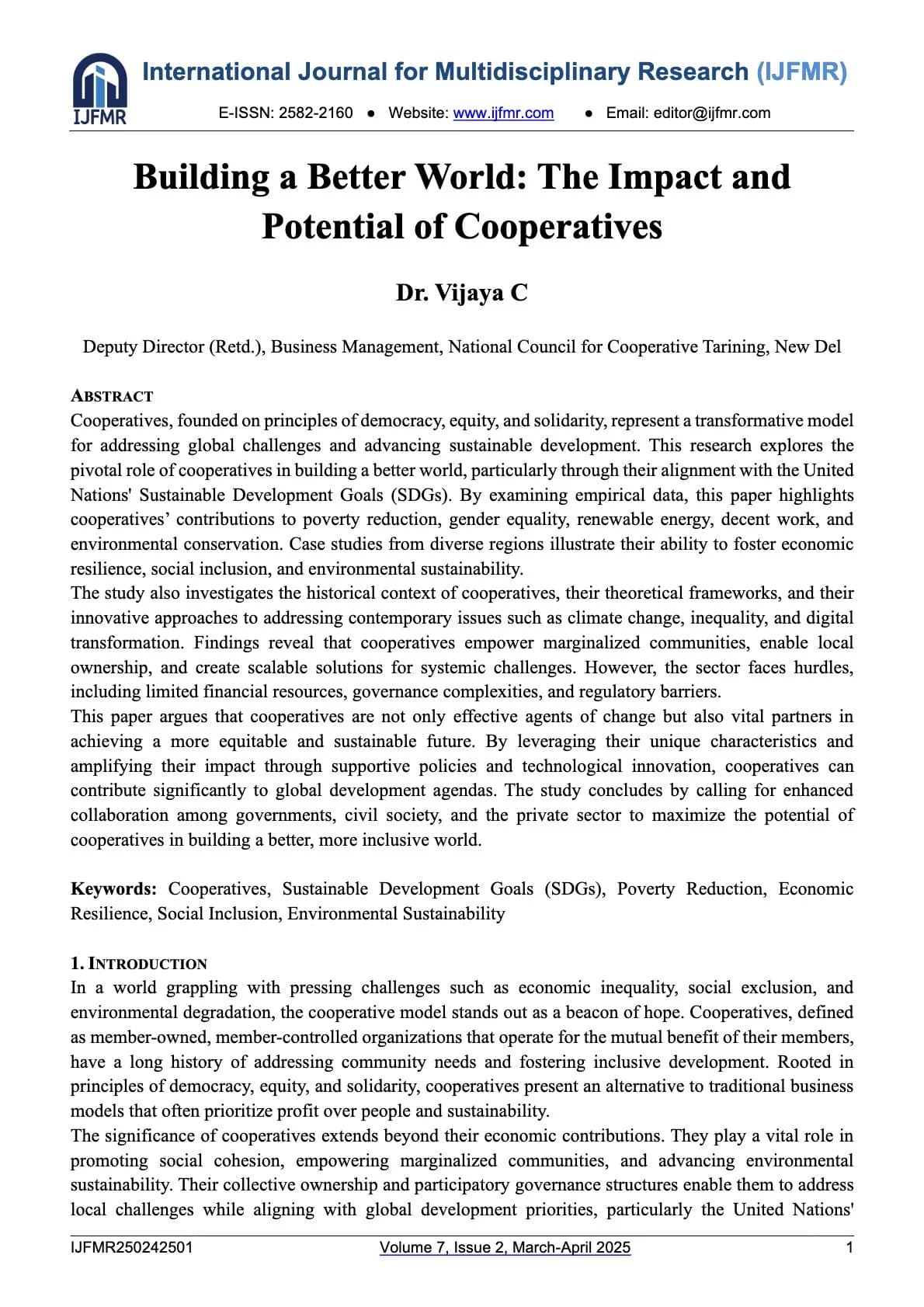
The article “Building a Better World: The Impact and Potential of Cooperatives” is a peer‑reviewed research paper published by the International Journal for Multidisciplinary Research (IJFMR). The author, Dr Vijaya C, is a Deputy Director (Retired) in Business Management at the National Council for Cooperative Training in New Delhi, indicating expertise in cooperative education and policy. The paper, dated March 2025, examines how cooperatives contribute to the United Nations Sustainable Development Goals, with a particular emphasis on poverty reduction, gender equity, renewable energy and digital platform innovation.
Cooperative Principles and Sustainable Development
The study outlines five core cooperative principles—democratic control, member‑economic participation, autonomy, education, and concern for community—and links each to specific SDG targets. Empirical evidence shows cooperatives improve social inclusion and environmental stewardship, thereby offering a model for sustainable community development across Europe.
Relevance to Sustainable Housing
A dedicated section on “Sustainable Communities (SDG 11)” highlights housing cooperatives as a vehicle for affordable, eco‑friendly dwellings. Data from the United Nations Cooperative Alliance indicate that cooperative housing reduces rental costs by 20‑40 % compared to market rates, while fostering communal decision‑making on energy efficiency, waste reduction and shared green spaces. The paper cites examples from the United Kingdom, where cooperative housing associations have achieved up to 30 % lower carbon footprints through collective retro‑fitting programmes.
Key Quantitative Findings
- Cooperatives worldwide serve over 1 billion members, representing roughly 3 % of global employment.
- In Europe, cooperative enterprises generate €2.5 trillion in annual turnover, with the housing sector accounting for €150 billion.
- The Mondragon Corporation (Spain) maintains an unemployment rate of 13.3 % during the 2008 crisis, compared with the national average of 24.8 %.
- The Amul dairy cooperative (India) processes 22 million litres of milk per day, illustrating scalability that European housing cooperatives could emulate for utilities management.
Innovative Practices for European Housing Cooperatives
The paper identifies three emerging innovations applicable to pan‑European audiences:
- Hybrid Cooperative Models – combining profit‑generating activities with social housing to attract impact investment while retaining democratic governance.
- Digital Platforms for Member Engagement – online voting, virtual meetings and blockchain‑based transparency tools that streamline decision‑making across trans‑national cooperative networks.
- Circular Economy Approaches – shared ownership of renewable energy installations, community tool libraries and material‑reuse schemes that lower construction and operating costs.
Policy Recommendations Aligned with European Priorities
The author recommends:
- Strengthening legal frameworks that recognise housing cooperatives as distinct entities, facilitating access to low‑interest loans and tax incentives.
- Expanding public‑private partnership programmes that fund retro‑fit projects, targeting a 25 % reduction in residential energy consumption by 2030.
- Supporting cooperative education curricula in European universities to build managerial expertise for large‑scale housing projects.
Conclusions for Sustainable Housing Stakeholders
The research confirms that cooperatives deliver measurable economic, social and environmental benefits that align with European Union Green Deal objectives. By leveraging democratic ownership, scalable financing and innovative digital tools, housing cooperatives can provide affordable, low‑carbon homes while empowering residents to participate in governance. The evidence presented encourages policymakers, urban planners and community organisations to integrate cooperative models into national housing strategies as a proven pathway toward a more sustainable and inclusive built environment.