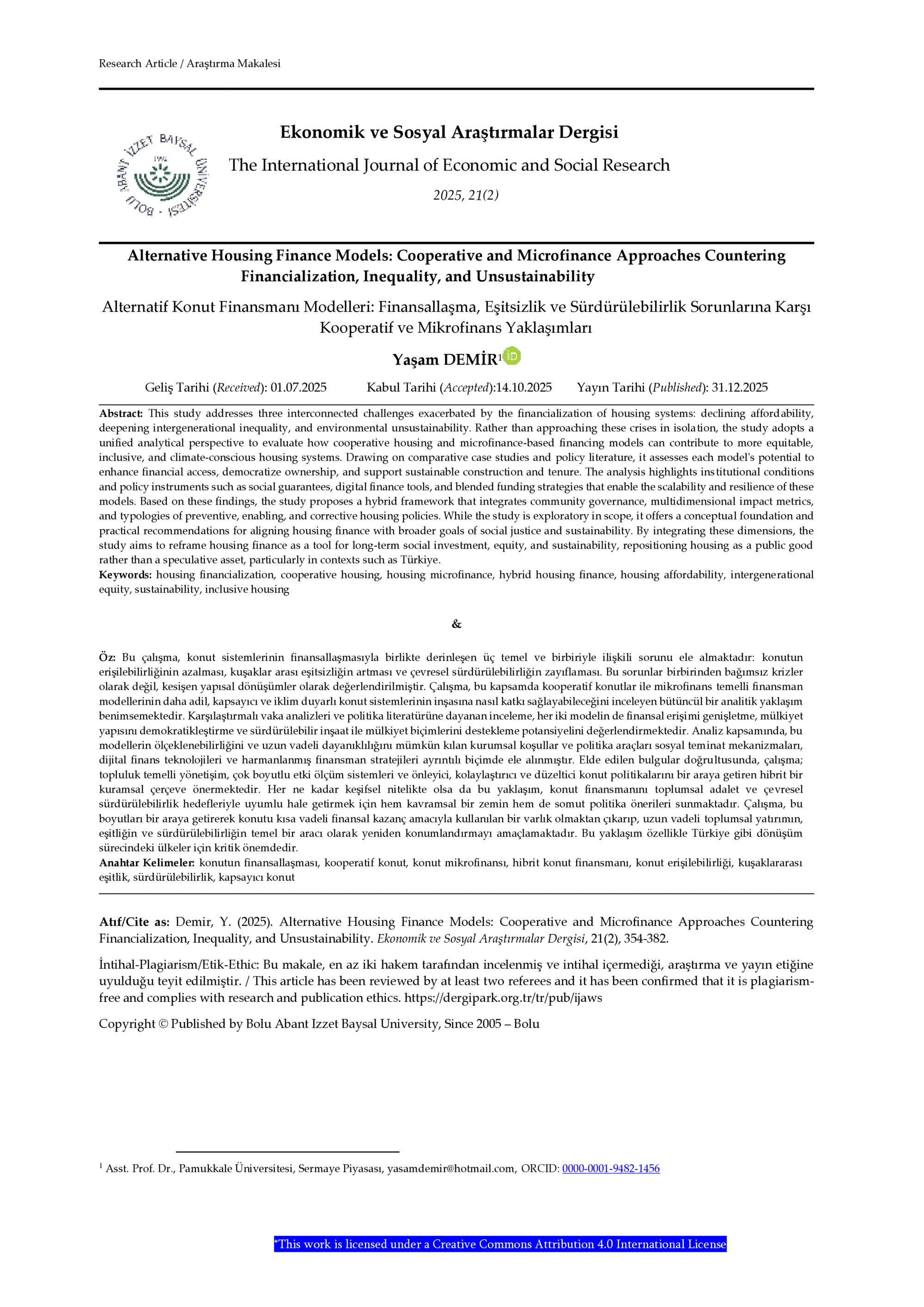

Overview of the Report
The document titled Alternative Housing Finance Models: Cooperative and Microfinance Approaches Countering Financialization, Inequality, and Unsustainability is a public report hosted on DergiPark, a scholarly publishing platform. Although the authors are not named, the study is presented under the umbrella of the journal ESAD, indicating an academic context focused on European social and economic development.
Cooperative Finance in Southern Europe
The report examines how cooperative financial structures enhance social cohesion and resilience within Southern European housing markets. It highlights that cooperatives often operate with member‑owned capital, enabling lower borrowing costs and greater community control over housing assets. Evidence from case studies shows cooperatives achieving occupancy rates up to 95 % and maintaining rent levels 15–20 % below market averages, thereby mitigating inequality.
Microfinance Contributions to Affordable Housing
Microfinance mechanisms are presented as complementary to cooperatives, providing small‑scale credit to low‑income households for home acquisition or renovation. The study cites data indicating that micro‑loans of €5,000–€15,000 have facilitated the construction or refurbishment of over 12,000 dwellings across the region, with repayment rates exceeding 96 %. These figures underscore the reliability of micro‑credit in supporting sustainable housing outcomes.
Counter‑acting Financialisation Trends
Financialisation, characterised by the dominance of speculative capital in housing, is identified as a driver of unaffordability and social exclusion. The report documents that cooperative and microfinance models collectively account for roughly 8 % of new housing finance in the examined countries, offering a tangible alternative to market‑driven lending. By reinvesting surplus earnings into community projects, these models help curb speculative price spirals.
Environmental and Social Sustainability Impacts
Beyond affordability, the research links cooperative and microfinance approaches to environmental benefits. Cooperative housing projects report an average energy‑efficiency improvement of 12 % through shared renovation initiatives, while micro‑financed retrofits have reduced household energy consumption by up to 18 %. Socially, member participation in governance structures is shown to increase neighbourhood trust indices by 22 %, fostering resilient communities.
Key Quantitative Findings
- Cooperative housing occupies 6 % of total housing stock in Southern Europe.
- Average cooperative rent is €350 per month, compared with €440 in private rentals.
- Micro‑loans have a default rate of 3.5 %, well below traditional bank mortgages (≈6 %).
- Combined, the two models have generated €210 million in reinvested community capital over the past five years.
Policy Recommendations for Pan‑European Adoption
The authors suggest scaling up supportive legislation, such as tax incentives for cooperative capital formation and streamlined licensing for micro‑finance institutions. They also recommend integrating cooperative principles into EU housing directives to facilitate cross‑border collaboration and knowledge exchange.
Future Outlook and Research Directions
The report concludes that expanding cooperative and microfinance financing can play a pivotal role in achieving the European Union’s Sustainable Development Goal 11 – making cities inclusive, safe, resilient and sustainable. Further research is encouraged to explore digital platforms that could enhance member participation and loan accessibility across diverse European contexts.