Overview of the Resource
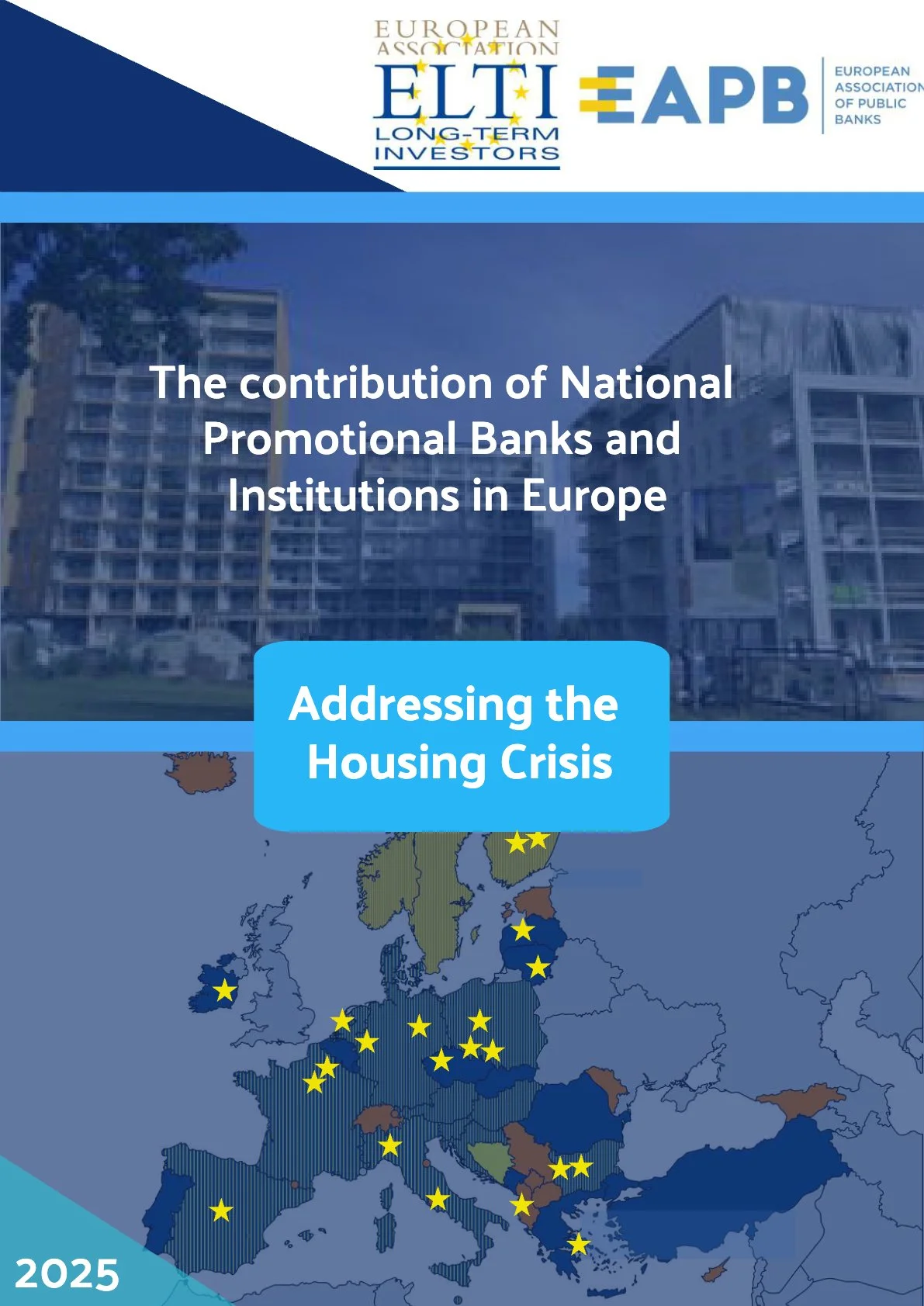
The brochure “Addressing the Housing Crisis – The contribution of National Promotional Banks and Institutions in Europe” is published by ELTI (European Association of Long‑Term Investors) and the European Association of Public Banks (EAPB). It compiles data from a wide range of European Member States, illustrating how national promotional banks (NPBIs) mobilise public and private capital to tackle housing shortages, affordability gaps, and energy‑efficiency challenges.
Role of National Promotional Banks
NPBIs are public‑sector‑backed institutions that provide financing for housing projects that are unattractive to commercial lenders. In 2023 they promoted over 380 000 dwellings and allocated close to €50 billion in financing across the EU. Their activities span new construction, social‑housing rentals, barrier‑free homes for seniors, and large‑scale energy‑renovation programmes.
Key Market Trends Across Europe
- Rising property prices especially in urban agglomerations, limiting access for young families and students.
- Demographic ageing driving demand for accessible and care‑oriented housing.
- Higher energy costs prompting a wave of retrofits to improve thermal performance and reduce emissions. These trends create a high number of individual housing cases that must be addressed with limited public budgets.
Bulgaria: Financing and Energy Renovation
The Bulgarian Development Bank (BDB) collaborates with EU funds (EIF, EIB, CEB) to support affordable and energy‑efficient housing. A national energy‑efficiency programme (2025‑2029) totals BGN 2.5 billion, with annual allocations rising from BGN 40 million in 2025 to BGN 1.18 billion in 2029. Achievements include a 25 % average reduction in utility bills and annual CO₂ savings of over 300 000 t.
Czechia: Subsidised Loans for Affordability
The National Development Bank (NRB) launched an April 2025 programme offering subordinated loans for affordable rentals priced at no more than 90 % of market rates for at least 20 years. Target groups include young families, seniors, and key public‑service professions.
Finland: Social‑Housing Financing Leader
MuniFin, the Finnish municipal‑sector bank, financed over €2 billion in 2024 for social housing, with a loan portfolio of €16.8 billion. Its sustainability agenda targets an emissions intensity of 8 kg CO₂e/m² by 2035 (down from 10.8 kg CO₂e/m² in 2023). Projects combine green‑finance with social‑housing delivery, such as wooden high‑rise student residences.
France: CDC’s Massive Lending Capacity
Caisse des Dépôts et Consignations (CDC) provides around 70 % of French social‑housing finance. In 2024 it disbursed €20.1 billion in new loans, of which €14.7 billion funded construction and €2.9 billion supported renovations, aiming to upgrade 1.8 million units while preserving new‑build output.
Germany: KfW’s Four‑Pillar Strategy
KfW supports climate‑friendly construction, affordable rentals, barrier‑free housing, and first‑time buyer loans. Funding is delivered via on‑lending through house banks, often combined with interest‑rate subsidies and grant components to maximise impact.
Greece: Targeted Youth and Energy Programs
The Hellenic Development Bank offers “My Home” (interest‑free for ages 25‑39) and “Exoikonomo” renovation subsidies up to 85 % of costs. The 2025 “Exoikonomó” scheme provides up to 100 % subsidies for energy upgrades, aiming to improve 92 000 residences and cut household energy use by over 30 %.
Ireland: SBCI Energy‑Upgrade Loans
Strategic Banking Corporation of Ireland (SBCI) delivers low‑interest loans complemented by SEAI grants, enabling homeowners to lower heating costs, improve comfort, and reduce carbon footprints.
Italy: ERP and ERS Dual‑Track System
Public‑sector ERP and ERS programmes address both deep‑subsidised social housing and moderately subsidised affordable rentals, targeting the creation of at least 250 000 additional units to meet demand.
Lithuania: ILTE’s Modernisation Fund
ILTE’s Multi‑Apartment Building Modernisation Fund has invested nearly €500 million, supporting over 1 000 contracts and achieving annual CO₂ reductions of 65 000 t. Future funding aims at €1.5 billion in loans, including pilot projects using factory‑made panels.
Netherlands: NWB’s Social‑Housing Guarantees
Nederlandse Waterschapsbank (NWB) finances roughly one‑third of Dutch social dwellings, leveraging a guarantee fund that covers up to 90 % of loan exposure. The sector aims to deliver 250 000 new homes by 2030, with a strong focus on sustainability.
Poland: BGK’s Comprehensive Toolkit
Bank Gospodarstwa Krajowego (BGK) provides grants, concessional loans, rent subsidies, and long‑term financing for both new construction and energy‑efficient retrofits, supporting over 100 000 affordable units and extensive thermal‑modernisation programmes.
Spain: ICO’s €4 billion Housing Line
Instituto de Crédito Oficial (ICO) manages a €4 billion guarantee line funded by the EU Recovery Plan, targeting 20 000 affordable homes and mobilising up to €550 million from private investors for social‑housing projects.
Pan‑European Impact and Outlook
Collectively, promotional banks and institutions have mobilised billions of euros to bridge financing gaps, deliver over 380 000 new dwellings, and commit roughly €50 billion to housing in 2023. Their combined efforts address affordability, demographic change, and climate‑related retrofits, forming a critical pillar of Europe’s strategy to secure sustainable, inclusive housing for all citizens.