Context
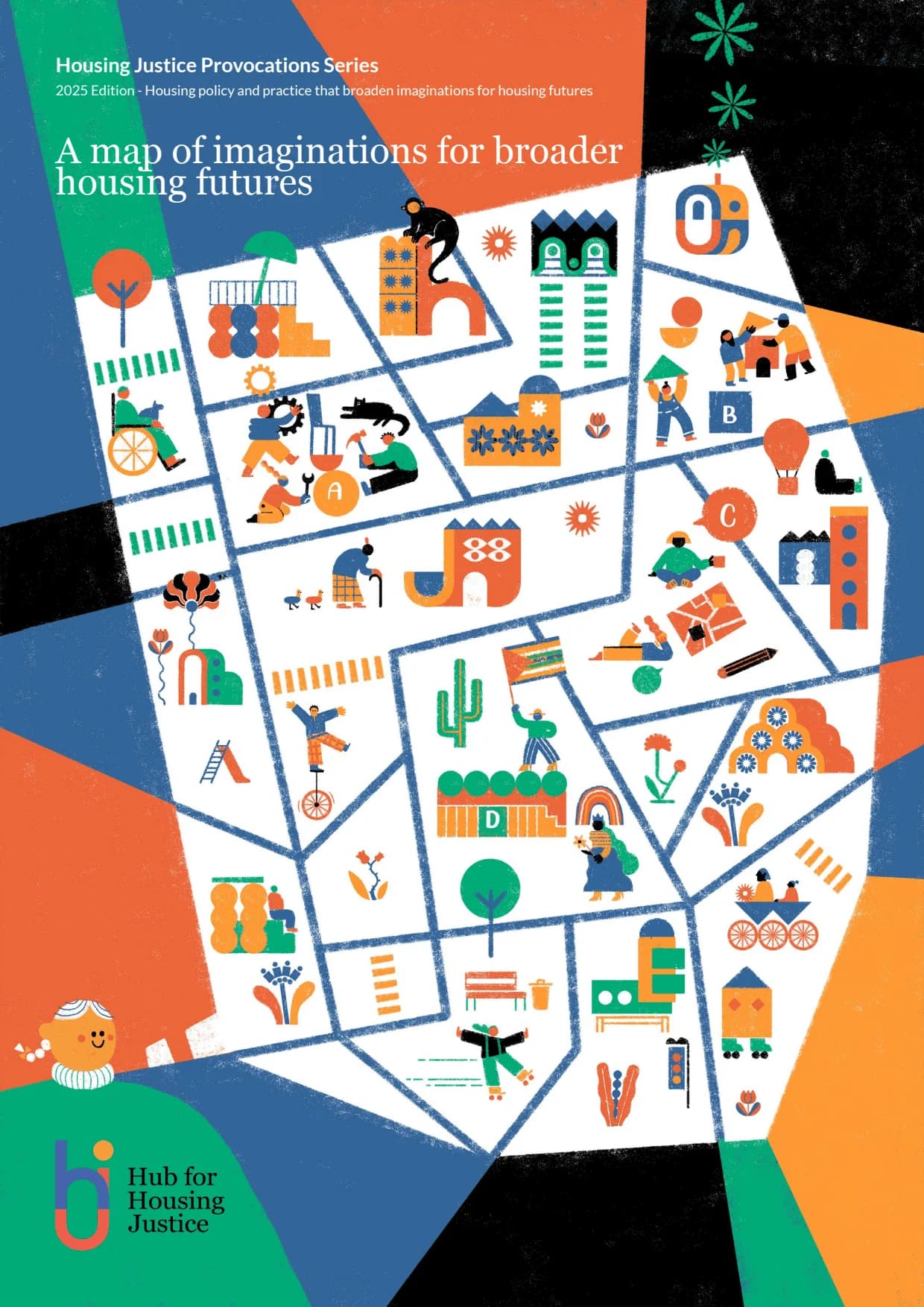
The resource “A map of imaginations for broader housing futures” is a map-format publication produced by the Hub for Housing Justice as part of its Housing Justice Provocations Series. The Hub for Housing Justice is described as a collaborative initiative led by civil society networks and research organisations, with the series edited by the Hub’s Secretariat hosted by the International Institute for Environment and Development (IIED). The page lists design and illustrations by Ottavia Pasta, while specific individual authors are not named for the map itself.
Purpose and framing
The publication situates “housing imaginations” within competing dominant urban visions: on one side, “global city” narratives shaped by neoliberal ideology, private investment, technology, and “world-class” redevelopment that can sanitise cities and displace low-income residents; on the other, dystopian trajectories linked to climate inaction, resource commodification, and intensifying inequality and violence. Against the claim that “there is no alternative” to market-led housing delivery, the map presents a non-exhaustive atlas of practices that “rehearse” reparative, pluralistic, and emancipatory housing futures.
Four pathways for broader housing futures
The map organises initiatives into four pathways. “Repairing” focuses on responses to intersecting crises, violence, risk, and displacement, including squatting, upgrading existing structures, creating refuge, and solidarity-based collaborations in housing production. “Collectivising” highlights models that challenge housing futures grounded in individual property ownership, including cooperatives, community land trusts, special planning zones, and other commoning approaches that prioritise housing’s social value. “Co-producing knowledge and practices” centres collective mapping, civic media, enumeration, planning, and co-design as a counterpoint to commodified data and exclusionary smart-city frameworks. “Queering spatial arrangements” gathers examples that challenge patriarchal and heteronormative housing models, including queer housing, cooperatives for older people, and diverse household arrangements.
Repairing examples and claims
One entry describes the occupation of the Nitel building in central Lagos, Nigeria, as an example of repurposing abandoned buildings to secure well-located housing collectively. The initiative is linked to Media4Change, described as a collective led by young members of the Nigerian Slum/Informal Settlement Federation, using media production and training to document state violence and develop counter-narratives. Other repairing entries include Housing Support Centres in South Africa (linked to the Enhanced People’s Housing Process) as a mechanism for technical and administrative support for incremental, community-driven building, and tactical urbanism approaches that use short-term, people-led interventions in public space to support longer-term change and inclusivity.
Collectivising and collaborative housing in Europe
The “Collectivising” pathway includes an entry on collaborative and co-housing initiatives across Europe, describing co-housing as a way to build more resilient, equitable, and sustainable living environments through collective decision-making and shared management. It frames co-housing as supporting housing adequacy principles including affordability, accessibility, acceptability, and adaptability, and contrasts it with speculative, profit-driven housing. It also lists a range of European collaborative housing variants, including Denmark’s “Bofællesskab”, Sweden’s “Kollektivhus”, “Baugruppen” (Germany and Austria), “Genossenschaften” (Switzerland, Austria, Germany), France’s “Habitat Participatif”, the “Miethäusersyndikat” model (Germany with variants in Austria and the Netherlands), and Community Land Trusts (England, Belgium, France), alongside Spain’s “Cooperativas en cesión de uso”.
Co-producing knowledge: scale of community data
The map describes the “Know Your City” initiative associated with Slum Dwellers International (SDI) as community-led data production at scale, stating that critical information has been collected in over 5,000 slums across more than 18 countries in the global South. It presents enumeration and profiling as a way to make visible conditions in informal settlements and to counter “grey” or “empty” areas in official data that can reinforce narratives of illegality and criminalisation, especially as informal settlement urbanisation is described as potentially housing more than 3 billion people over the next 30 years.
🌈 Queering spatial arrangements and inclusive housing models
In the “Queering” pathway, the Intersectional City House in Vienna is presented as a support structure for intersectional coexistence, emerging from anti-racist and queer activism and described as negotiating an unlimited lease period in exchange for resident-led renovations. The text highlights principles such as rent distribution by financial capacity and spatial arrangements that encourage communal living. Additional examples include Oak Lawn Place in Dallas (84 units for LGBTQIA+ seniors aged 55+ and aimed at low- and middle-income residents) and “Carpe Diem”, a cooperative led by senior women with shared facilities and an explicit circular/green economy orientation.
Production context and contributors
The resource is positioned as an outcome of working-group exchanges held during the first half of 2025 around propositions in a housing justice framework. The page lists multiple working-group participants and contributors across universities and organisations (including Architecture Sans Frontières UK, the Institute for Housing and Urban Development Studies, IIED, Habitat International Coalition, the Global Platform for the Right to the City, Development Action Group, urbaMonde, and the Sierra Leone Urban Research Centre), indicating the map draws on a broad set of practitioner and research perspectives relevant to housing justice and sustainable housing futures.