Resource context
The peer‑reviewed research paper “Living smaller: acceptance, effects and structural factors in the EU” is published by Buildings & Cities and authored by Matthias Lehner, Jessika Luth Richter, Halliki Kreinin, Pia Mamut, Edina Vadovics, Josefine Henman, Oksana Mont, and Doris Fuchs. It examines limiting per‑capita living space (downsizing and/or sharing) as a housing sufficiency strategy to cut environmental impacts in EU member states.
Why housing size matters for climate targets
The article situates “living smaller” within the need to reduce resource use and emissions from buildings. It notes that household energy consumption represented 27% of final energy consumption in the EU (2021), and that over 60% of household energy use was for space heating. Against this backdrop, average living space per person in Europe increased by 16% between 2000 and 2018, reinforcing concerns that efficiency improvements alone may be insufficient without sufficiency measures that curb demand for floor area.
Study design and evidence base
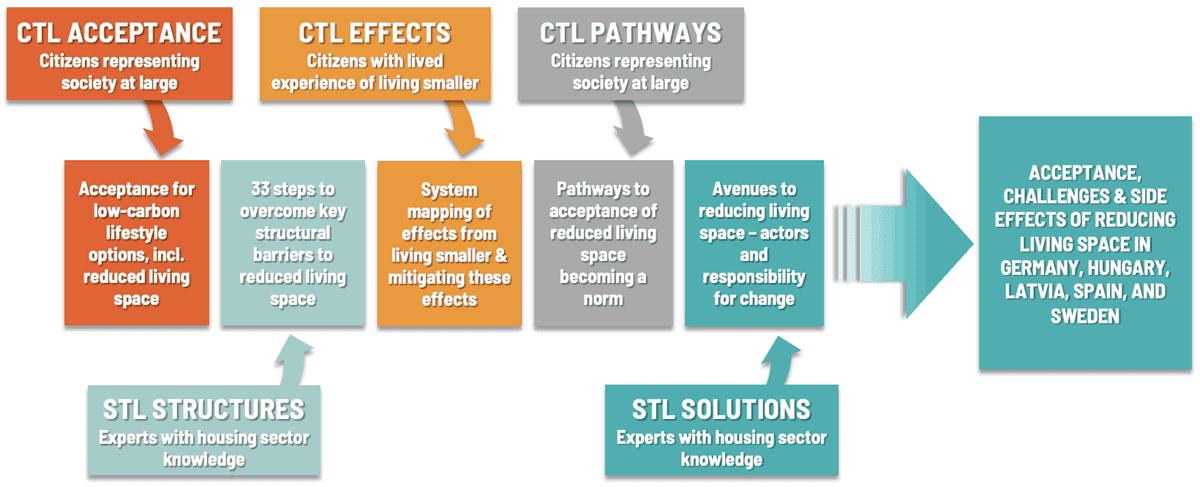
Findings draw on extensive qualitative material from “thinking labs” conducted as part of the EU Horizon 2020 project EU 1.5° Lifestyles. Between September 2022 and February 2024, interactive workshops were held in five case countries: Germany, Hungary, Latvia, Spain, and Sweden. The process included multiple rounds of citizen thinking labs (focused on acceptance, lived effects, and pathways) and stakeholder thinking labs (focused on structural barriers and solutions), engaging citizens alongside stakeholders from civil society, academia, business, policy, media, and other sectors.
Acceptance levels and main barriers
In the acceptance exercises, “giving up excess square metres” and “choosing shared housing” were among the least favoured low‑carbon housing options. Average approval was 29% for giving up excess space and 21% for choosing shared housing (with variation by country). Reported barriers include the perceived complexity and risk of housing markets (especially in urban areas), concerns about loss of privacy and personal freedom (and fear of conflict), and social norms that link a “good home” to ownership, autonomy, and spaciousness. Historical experiences also matter; in Hungary, negative associations with forced sharing during the Soviet era were cited as shaping attitudes.
Motivations that can support downsizing or sharing
Among participants who had already reduced living space, motivations clustered around value‑based, practical, economic, and structural factors. Value‑based motives included reducing environmental impacts and perceiving excess space as ethically problematic. Practical drivers included changes in family composition (e.g., separation or children moving out), preference for more central locations, and reducing time spent on maintenance. Economic pressures such as rising rents, overheads, or mortgages also played a role, alongside structural constraints where smaller units were more accessible within dense urban housing markets.
Experienced effects: trade‑offs and potential benefits
Reported downsides included reduced ability to host visitors, additional costs for accommodating guests elsewhere, storage constraints affecting furniture and clothing, and even changes in food routines (e.g., less capacity to buy in bulk). Participants also described reduced privacy, noise, confinement, worsened mood, and increased conflicts in shared settings, as well as constraints on hobbies (such as playing instruments or gardening). At the same time, many reported positive effects: forced decluttering, more deliberate purchasing, more sharing with neighbours, less time spent cleaning and maintaining homes, and more time for leisure and personal care. Moving to more central areas improved proximity to services and infrastructure, with some participants reporting better local engagement and using shared/public spaces more for socializing and studying.
Enablers and policy directions highlighted
Across labs, acceptance increased when participants discussed supportive societal changes. Suggested enablers include a more flexible housing market (e.g., exchange platforms and fewer administrative barriers), high‑quality shared amenities and public/common spaces that compensate for reduced private space, and cost savings that make smaller living attractive. Stakeholders and experts also discussed interventions such as strengthening rental options, modular and flexible housing arrangements, better data on housing stock, use of vacant dwellings, matchmaking services for exchanges, and higher real‑estate taxation for larger properties. The paper stresses that “soft” infrastructure—community building, governance for shared living, and conflict counselling—can be as important as planning and building regulation, alongside measures that protect low‑income and otherwise vulnerable households so that smaller living is a choice rather than a necessity.