Resource context (publisher and authors)
This resource is a POLITICO article by Aitor Hernández-Morales and Giovanna Coi, published as part of “The Home Front”, a special report on housing in Europe from POLITICO’s Global Policy Lab: Living Cities. It reports on how shortages of affordable housing are becoming a visible political issue across multiple European cities and countries, with public anger translating into protests and political pressure.
A Europe-wide political pressure point
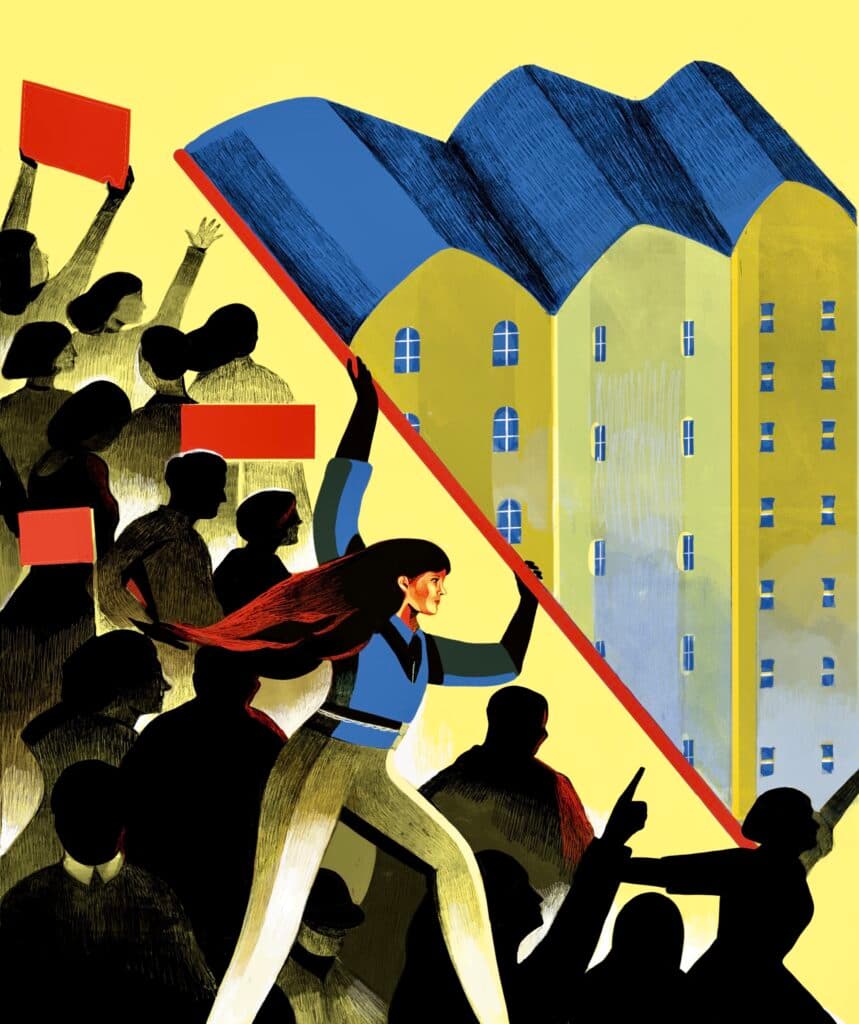
The article describes affordable housing as a “long-simmering political frustration” now “boiling over” across Europe. It cites examples from Lisbon to Łódź and reports that protests have taken place in cities including Lisbon, Amsterdam and Milan, where demonstrators denounce the lack of affordable homes. In Dublin, the piece links social tension and riots to claims that limited public housing was being allocated to foreigners, showing how housing scarcity can intersect with broader political narratives.
What the data and stakeholders say
The article points to a poll conducted around the European Parliament elections in which European mayors identified housing as one of the most important issues facing their constituencies. It also provides a spending benchmark: Europeans spend nearly 20% of their disposable household income on housing on average, alongside a perception that homes are becoming harder to find. Sorcha Edwards, secretary-general of Housing Europe (representing public, cooperative and social housing providers), is quoted arguing that the crisis has been building for years and has intensified politically as it affects not only low-income groups but also middle-class households.
How policy shifts helped create today’s shortage
According to the article, many European countries invested in affordable housing in the post-war period but reduced attention to it from the 1980s onward, as neoliberal, small-government approaches led to spending cuts. It reports that municipal councils that previously built housing stopped new construction and sold off existing stock, while the private sector did not fill the resulting gap. The article also notes recent economic conditions that worsen supply constraints, including inflation and rising mortgage costs that have contributed to stagnation in private-sector construction.
Local drivers and market pressures
The piece emphasizes that the housing crisis has different characteristics depending on the city. In tourist-heavy areas, it highlights additional pressure from short-term rental platforms such as Airbnb, which can reduce long-term rental availability. It frames the common underlying factor as public authorities stepping back from active housing provision, leaving markets unable to deliver sufficient affordable supply. 🇩🇰 Denmark’s non-profit housing finance model Denmark is presented as a country with stronger structural tools. The article explains that public housing associations operate on a not-for-profit basis and that two-thirds of rent is paid into a national building fund, used since 1967 to finance new homes and refurbish existing stock. The fund also supports health, employment and social initiatives in disadvantaged areas. It reports that about 965,000 people (around one-sixth of Denmark’s population) lived in social housing as of 2022, and that the sector comprises nearly 600,000 homes (about one-fifth of the national building stock). For publicly owned homes built after 2000, rent per person per square meter is reported as 40% cheaper than market prices. 🇨🇭 Switzerland’s cooperative housing and affordability effects Switzerland is highlighted for its nonprofit housing cooperatives (Genossenschaften), described as aiming to provide affordable, sustainable and community living. Nationally, the article reports cooperative rentals are on average 15% cheaper than comparable rentals, with potentially larger differences in high-demand areas. In Zurich specifically, it reports that nearly 18% of flats are cooperative and that cooperative rents are on average 45% cheaper than for-profit equivalents, alongside about 7% municipally owned homes. The article also describes cooperative governance features such as democratic organization and occupancy regulations to support social mix.
Constraints on scaling and the time lag of investment
Despite these models, the article notes limits to rapid improvement. In Zurich, it reports that new construction has not kept pace with immigration-driven demand, with new-tenant rents rising 30% since 2016; cooperatives are described as struggling to expand due to land scarcity and high land prices, leading growth mainly through replacement of existing buildings with larger ones. More broadly, it cites examples of significant public spending (including up to €5 billion investment in Dublin) while stressing that even when funds are allocated, housing takes time to build.