Overview of the Study and Its Origin
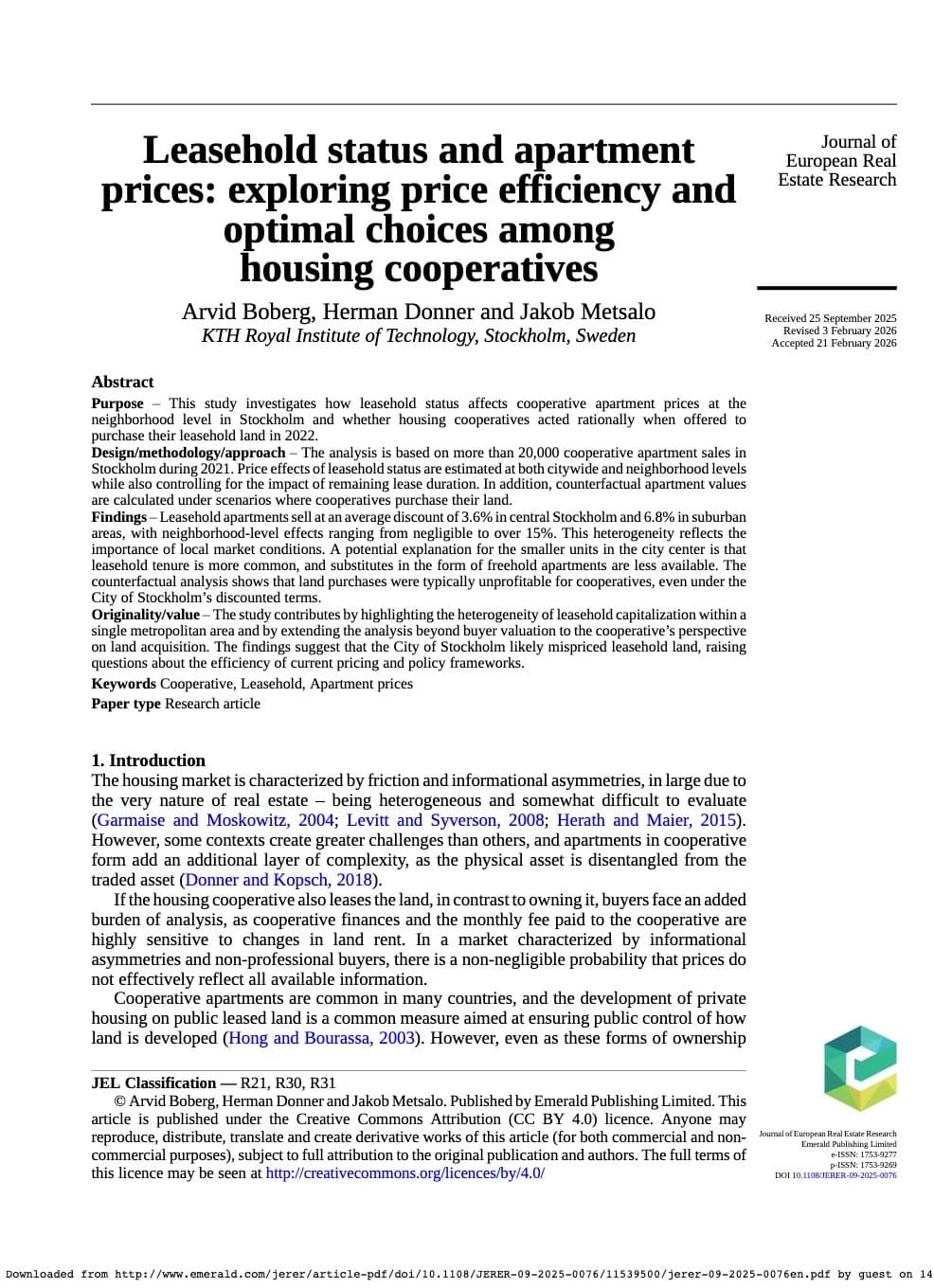
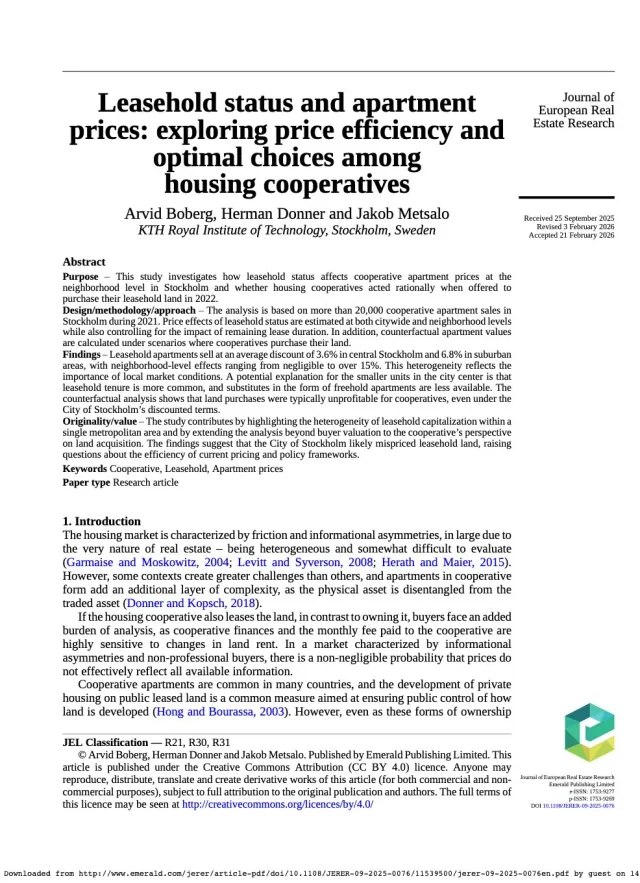
The research paper, titled “Leaselease status and apartment prices: exploring price efficiency and optimal choices among housing cooperatives,” is authored by Arvid Boberg, Herman Donner, and Jakob Metsalo from the KTH Royal Institute of Technology in Stockholm, Sweden. It appears in the Journal of European Real Estate Research, a peer‑reviewed outlet that publishes work on real‑estate economics across Europe. The authors investigate how leasehold tenure influences cooperative apartment values and whether cooperatives acted rationally when offered the chance to purchase their leasehold land in 2022.
Key Research Questions and Methodology
The paper addresses two main questions: (1) the magnitude of price discounts associated with leasehold status at city‑wide and neighborhood levels in Stockholm, and (2) the profitability of land‑purchase options for housing cooperatives under the City of Stockholm’s discounted terms. Using a dataset of over 20,000 cooperative apartment sales from 2021, the authors apply hedonic price regressions to isolate the effect of leasehold status while controlling for size, rooms, floor, monthly fees, age, distance to water, and remaining lease duration. Counterfactual scenarios are built by estimating the value gain if leasehold apartments were converted to freehold, then subtracting the purchase price and financing costs.
Main Findings on Price Discounts
- Leasehold apartments sell at an average discount of 3.6 % in central Stockholm and 6.8 % in suburban areas.
- Across the whole dataset the estimated discount rises to 7.4 %, with neighborhood‑level effects ranging from negligible to over 15 %.
- The discount is larger where leasehold units are less common, indicating that local market conditions and availability of freehold substitutes shape pricing.
- Monthly cooperative fees are higher for leasehold units (average 3,636 SEK) than for freehold units (average 2,925 SEK), reflecting the cost of lease payments passed to owners.
Assessment of Land‑Purchase Rationality
The City of Stockholm offered cooperatives the chance to buy their land at 85 % of the 2022 assessed value (approximately 60 % of market value). Scenario analysis shows:
- In the city centre, a purchase would be profitable only if interest rates are ≤ 2.5 %; in the suburbs the break‑even rate is ≈ 3.5 %.
- Market interest rates in 2022 fluctuated between 2.14 % and 4.59 %, meaning many cooperatives faced financing costs above the break‑even level.
- Consequently, the majority of cooperatives did not purchase their land, a decision that appears financially rational given the modest value uplift and higher financing costs.
Implications for Sustainable Housing Policy
The study highlights the heterogeneity of leasehold capitalization within a single metropolitan area, suggesting that blanket policy measures may misprice leasehold land. Mispricing can affect housing affordability and the long‑term sustainability of cooperative housing, as higher lease fees increase monthly costs for residents and may discourage investment in energy‑efficient upgrades. The finding that cooperatives often act rationally under current pricing conditions underscores the need for transparent, market‑based land valuations and stable, predictable lease terms to support sustainable housing development across Europe.
Take‑away Data Points
- 20,640 observations after cleaning, with 6,678 leasehold units.
- Average sales price: 5.66 million SEK (freehold) vs. 3.92 million SEK (leasehold).
- Leasehold discount: 3.6 % (city centre), 6.8 % (suburbs), 7.4 % (overall).
- Monthly fee difference: +711 SEK for leasehold owners.
- Purchase profitability hinges on interest rates ≤ 2.5 % (centre), ≤ 3.5 % (suburbs).
Conclusion for Pan‑European Readers
For stakeholders interested in sustainable housing, the paper provides robust evidence that leasehold tenure reduces apartment values and raises monthly fees, with the effect varying significantly across neighborhoods. The analysis of land‑purchase options demonstrates that financial incentives must align with realistic financing conditions to encourage cooperatives to acquire land, which could improve long‑term affordability and enable greener retrofits. Policymakers across Europe can draw on these findings to design more efficient leasehold frameworks, improve price transparency, and support the sustainability of cooperative housing models.