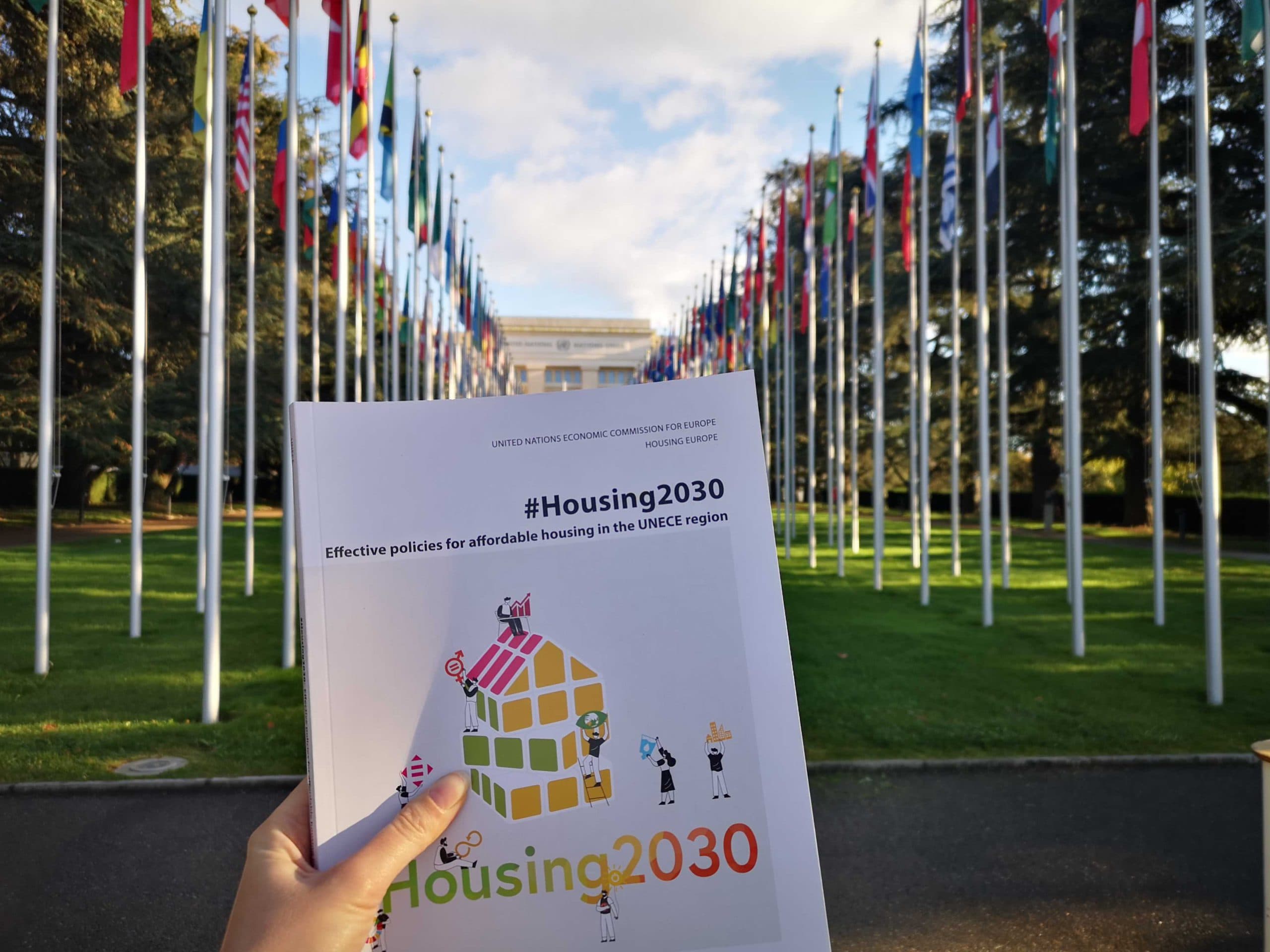
Resource context
This resource is the Housing2030 website (housing2030.org), published by Housing2030, which presents two Europe-focused initiatives addressing housing inequality and affordability: #Housing2030 and EqualHouse. The page credits the joint leadership of Elena Szolgayova (Ministry of Transport and Construction, Slovak Republic) and David Orr (former President of Housing Europe), and names a management committee including Gulnara Roll (UNECE), Sorcha Edwards (Housing Europe) and Amie Figueiredo (UN-Habitat). Drafting is attributed to Dr Julie Lawson (RMIT University) in cooperation with authors including Professor Holger Wallbaum (Chalmers University of Technology) and Michelle Norris (University College Dublin / Irish Housing Finance Agency), alongside additional contributors mentioned on the page.
Why housing policy is framed as urgent
The site argues that the need for effective affordable housing policy is anchored in international policy goals, including the UN Sustainable Development Goals’ ambition of “decent, adequate, affordable and healthy housing for all” by 2030, the Geneva UN Charter for Sustainable Housing (2015), and the Urban Agenda for the EU Housing Partnership. It describes COVID-19 as amplifying the urgency by exposing uneven access to safe, secure and affordable homes and disparities in the ability to live, work, learn and play in well-resourced neighbourhoods.
What #Housing2030 sets out to deliver
#Housing2030 is presented as a practical, policy-oriented initiative aimed at improving affordable housing outcomes while also helping address climate change and supporting social and economic recovery. Rather than offering a single “blueprint”, it positions itself as a flexible “tool kit” that can be adapted to different member states and regions. The page defines affordable housing through three levers: strategic land policy, purposeful investment, and good governance.
Key policy areas and implementation approach
The resource states that the practical report draws on experience from “over 50 countries” and focuses on four areas: land policy and planning strategies; funding; financing instruments; and good governance and regulation, alongside environmental and energy standards to support a more sustainable future. It notes the use of clear illustrations and links to contacts and resources, emphasising implementation and identification of what constitutes best practice.
Institutions and scale of collaboration
Housing2030 is described as a joint international initiative bringing together housing experts from “over 56 governments” through UNECE and UN-Habitat, and “43,000 affordable housing providers and neighbourhood developers” represented by Housing Europe. The site situates the initiative alongside related evidence and workstreams, including UNECE country profiles and good practice guides, joint UNECE–UN-Habitat reports on Sustainable Housing and Urban Development and SDG 11, and growing OECD attention to affordable housing. It also references Housing Europe’s Housing Partnership and State of Housing Report.
EqualHouse: research on housing inequality
EqualHouse is presented as an EU-funded research project designed to integrate “all dimensions of housing inequality” into a single comprehensive study. The page highlights a transdisciplinary and transnational approach, bringing together academics from multiple European countries, policymakers, affordable housing and homeless service providers, and households. It describes the goal as producing comprehensive insights and robust guidance to policymakers at all levels across Europe.
Topics EqualHouse intends to examine
The initiative lists a set of research and policy themes: interactions between income, wealth and housing inequalities; financial and fiscal influences; subsidies, regulation, land and services to make housing affordable; socially innovative and community-led solutions; acute housing inequalities affecting refugees and migrants; unsustainable housing and energy poverty; and links between labour markets and housing. It states an ambition to co-create innovative policy tools through the European Community for Housing Equality and describes EqualHouse as continuing momentum from #Housing2030’s earlier collaboration involving “more than 100” social and affordable housing providers, researchers, cities and policymakers.
What the website offers as a knowledge hub
Overall, housing2030.org positions itself as a central platform that combines policy guidance, practical tools, and research narratives on housing affordability, inequality, governance, and sustainability. It frames housing as a cross-cutting issue connected to climate and social inclusion, and emphasises multi-actor collaboration to build capacity for policies intended to improve affordability and sustainability across Europe.