Overview of the Working Paper
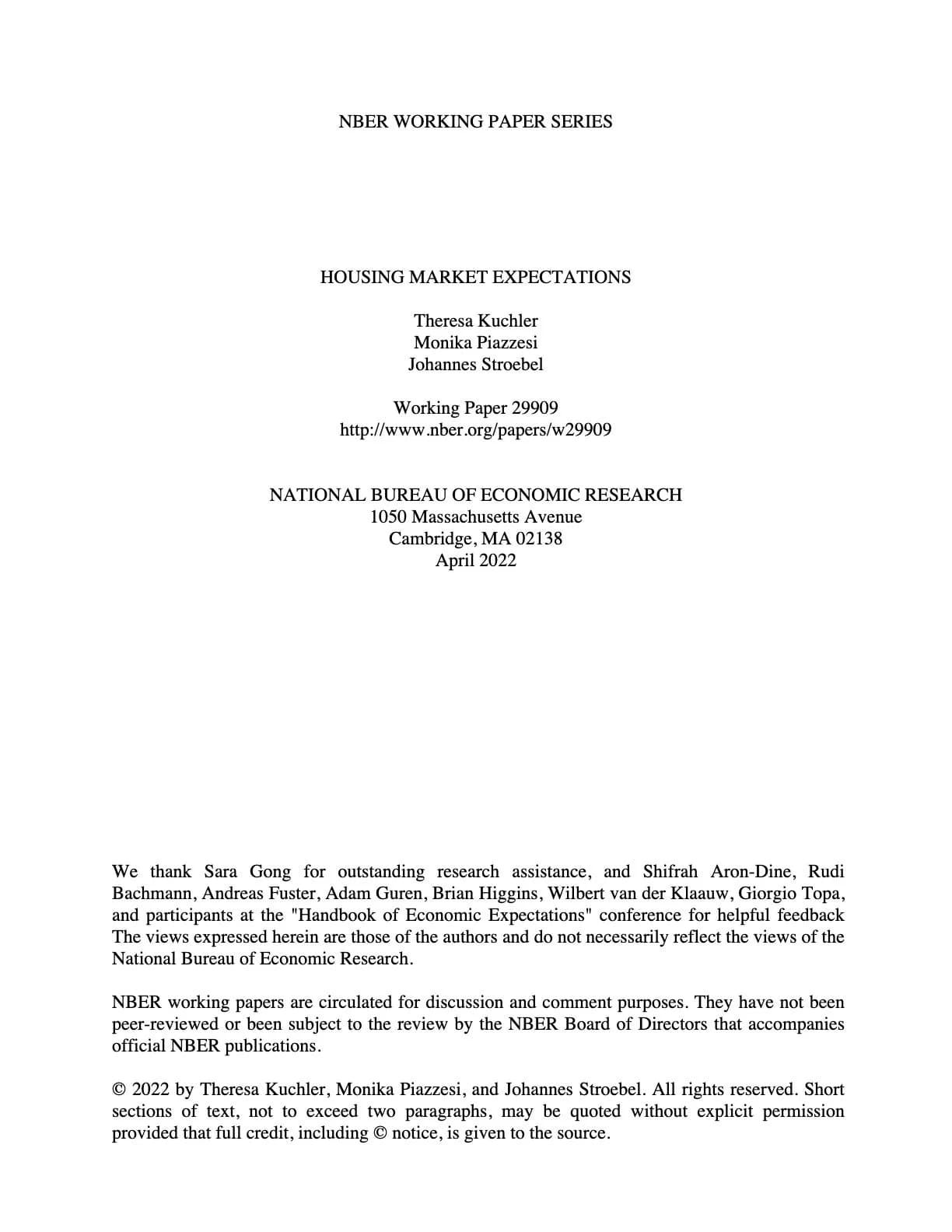
The NBER Working Paper 29909, titled “Housing Market Expectations”, is a scholarly analysis authored by Theresa Kuchler, Monika Piazzesi and Johannes Stroebel. All three researchers are senior academics at leading U.S. institutions: Kuchler and Stroebel are based at New York University’s Stern School of Business, while Piazzesi holds a professorship at Stanford University’s Department of Economics. The paper is published by the National Bureau of Economic Research (NBER), a respected non‑profit research organisation that disseminates working papers to inform policy and academic debate.
Scope of the Literature Review
The authors review an extensive body of empirical work on how households form expectations about future house‑price movements and how those expectations influence individual decisions and aggregate market outcomes. Surveys examined include the Michigan Surveys of Consumers, the New York Fed Survey of Consumer Expectations (SCE), the Fannie Mae National Housing Survey, the NAHB/Wells Fargo Housing Market Index, and numerous professional‑expert surveys such as those conducted by Zillow and the Wall Street Journal. The review highlights that expectations are strongly shaped by recent price changes, personal and local experiences, and information obtained from social networks.
Key Empirical Findings
- Recent house‑price changes are a primary driver of both short‑run and long‑run expectations, yet households under‑react in the short term and over‑react in the long term.
- Personal exposure matters: renters, who observe rent payments, tend to forecast higher future price growth than owners, while also exhibiting greater dispersion in their forecasts.
- Social contagion is documented through Facebook‑linked experiments: friends’ recent price experiences significantly affect an individual’s optimism about local housing markets.
- Demographic controls (age, education, numeracy) explain only a modest share of forecast variance (around 6‑10 %).
- Uncertainty about house‑price expectations correlates with lower incomes, lower education and higher local unemployment, mirroring patterns observed for inflation and income expectations.
Mechanisms of Expectation Formation
The paper distinguishes three complementary mechanisms:
- Extrapolation – households project recent price trends forward, often mis‑weighting serial correlation.
- Personal Experience – lifetime and geographically local price histories receive disproportionate attention, leading to heterogeneous beliefs.
- Social Interactions – peer discussions and online networks transmit optimism or pessimism, amplifying belief dispersion.
Implications for Sustainable Housing Policy
Understanding expectation dynamics is crucial for designing policies that promote sustainable housing markets across Europe. Over‑optimistic price forecasts can fuel speculative buying, inflating prices and encouraging over‑building, which may conflict with environmental targets. Conversely, heightened uncertainty can suppress demand, reducing investment in energy‑efficient retrofits. The authors suggest that improving the quality and accessibility of transparent housing data, and encouraging balanced information channels, could moderate extreme expectations and support more measured, sustainability‑oriented investment decisions.
Recommendations for Future Research
The authors call for:
- Expanded cross‑national survey programmes to capture heterogeneous expectations within the European context.
- Integration of social‑network data to quantify peer effects more precisely.
- Development of models that jointly consider expectations about house prices, inflation, interest rates and climate‑related policy signals, given their intertwined impact on sustainable housing choices.
- Investigation of higher‑order moments of belief distributions (variance, skewness) to better understand risk perceptions that influence green‑housing adoption.
Access and Further Reading
The working paper is publicly available on the NBER website and can be consulted for detailed tables, regression specifications and a comprehensive bibliography of the housing‑expectations literature.