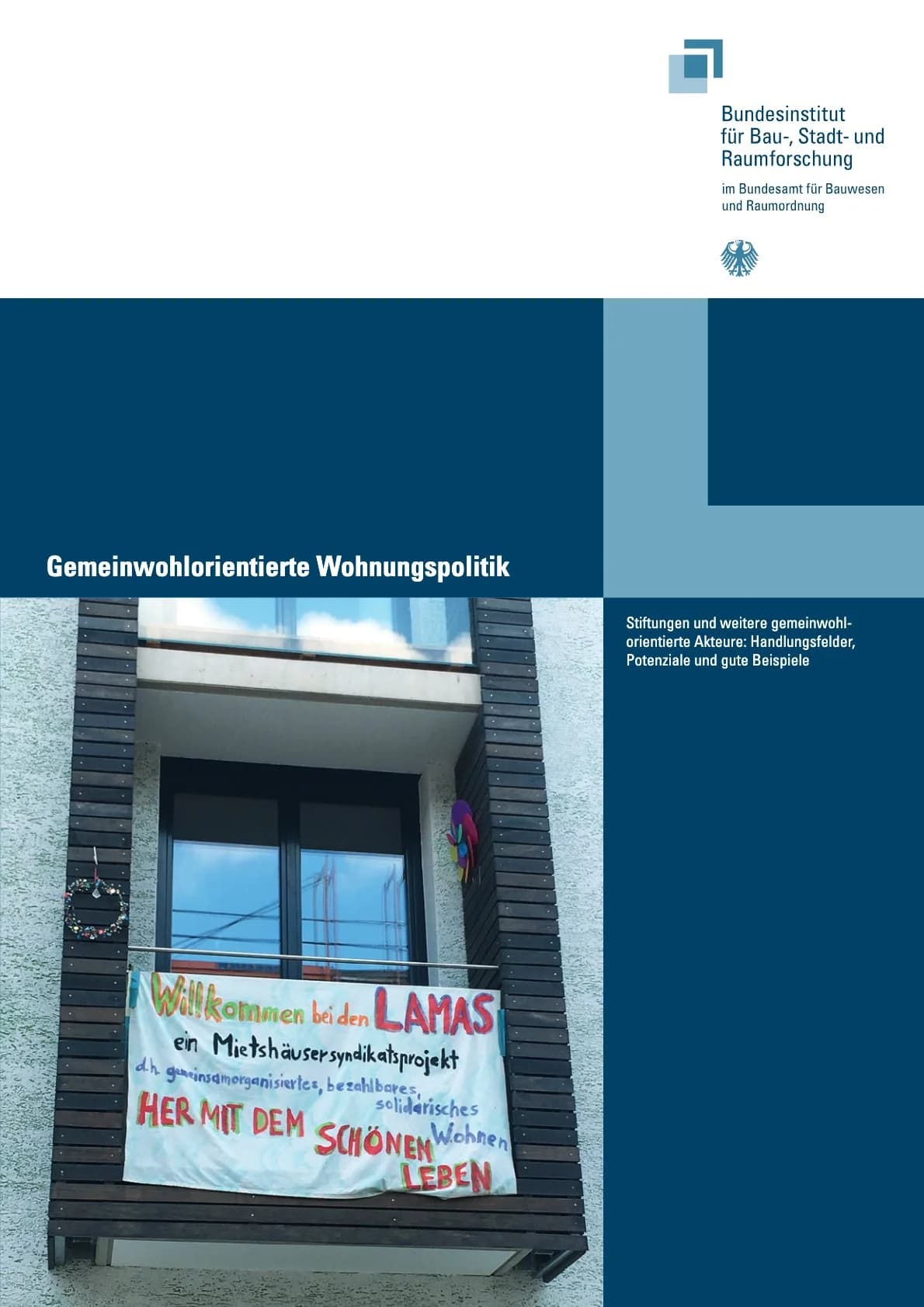
Overview of the Study
The report “Gemeinwohlorientierte Wohnungspolitik – eine Studie” is a research project commissioned by the Federal Ministry of the Interior, Building and Community (BMI) and executed by the Federal Institute for Research on Building, Urban Affairs and Spatial Development (BBSR). It was published in 2019 and edited by Mathias Metzmacher (BBSR) and Barbara Crome (BMI). The study investigates the role of foundations and other common‑good‑oriented actors in Germany’s housing market, analysing their business models, target groups, financing mechanisms and cooperation with public bodies.
Research Scope and Methodology
The BBSR screened 212 German foundations with a housing‑related purpose, gathered detailed data on 150 of them, and conducted an online survey with 51 foundations (≈30 % response rate). Complementary expert interviews (five foundation experts) and a workshop provided qualitative insights. The study also examined 31 further actors (consulting organisations, umbrella networks, house projects) and compared German findings with examples from Austria, Switzerland, Italy, the United Kingdom and Belgium.
Key Quantitative Findings – Foundations
Only 1 % of all German foundations (212) address housing directly. Among those, 45 % focus on care‑oriented housing for seniors or people with disabilities, 32 % on affordable housing for economically disadvantaged groups, and smaller shares serve students, mixed‑generation projects or niche target groups. The median annual expenditure of German foundations is €26 600; 76 % hold real estate in their assets, but most (≈80 %) own up to 200 units. The largest foundation, the Joseph‑Stiftung, manages about 5 000 units in northern Bavaria.
Financing and Business Models
Foundations mainly finance operations from rental income and endowment returns. About 38 % use earnings for upkeep and modernization, 12 % for new construction, and 24 % for land acquisition and lease‑back arrangements. Mission‑investing is emerging: younger foundations such as the Edith Maryon and trias foundations acquire or develop properties to keep them out of speculative markets. Funding sources include grants, donations, debt (e.g., KfW loans), and, increasingly, low‑interest, interest‑free loans from private individuals.
Cooperation with Public and Social Actors
Over two‑thirds of surveyed foundations have collaborated with municipalities, social service providers or churches in the past five years. Typical cooperation includes joint development of housing concepts, use of public land under long‑term lease, and participation in municipal housing‑allocation processes. Only a minority (≈15 %) are formally integrated into local housing networks or policy instruments, indicating room for deeper institutional linkage.
Other Common‑Good Housing Actors
The study identifies 31 additional actors: umbrella organisations (e.g., Mietshäuser Syndikat), consulting networks (FORUM, Global Ecovillage Network), and house‑project collectives. Mietshäuser Syndikat operates a “solidarity” model where a central GmbH holds a share in every project‑GmbH, preventing resale without consent. Approximately 490 units are owned by the network, mainly in repurposed historic buildings. Community Land Trusts (CLTs) in the UK and Switzerland exemplify land‑based models that secure long‑term affordability.
European Comparative Insights
Case studies from Italy (Cenni di Cambiamento in Milan), Switzerland (Hunziker Areal in Zürich) and the UK (St Clement’s CLT in London) illustrate diverse governance structures but share common goals: removal of land from speculation, mixed‑use development, and strong tenant participation. The Austrian and Belgian examples show similar emphasis on cooperative ownership and public‑private partnerships.
Recommendations for Policy Makers
The authors advise:
- Strengthen legal frameworks for non‑profit housing, including clearer tax treatment for housing‑related foundations.
- Expand municipal tools such as land‑grant schemes, long‑term lease‑rights and preferential procurement to support common‑good actors.
- Facilitate financing through mission‑oriented funds, low‑interest credit lines and support for interest‑free private loans.
- Promote knowledge transfer via networks, conferences and best‑practice publications.
- Encourage cooperation between foundations, the Mietshäuser Syndikat, CLTs and local authorities to scale impact.
Outlook and Impact Potential
Although foundations currently represent a modest share of the German housing stock, their long‑term asset stewardship, targeted social missions and growing willingness to engage in mission‑investing position them as strategic partners for sustainable, inclusive housing. Combined with the innovative models of other common‑good actors, these mechanisms can contribute significantly to Europe’s goal of expanding affordable, eco‑friendly homes while limiting market speculation.