Context and Origin of the Roadmap
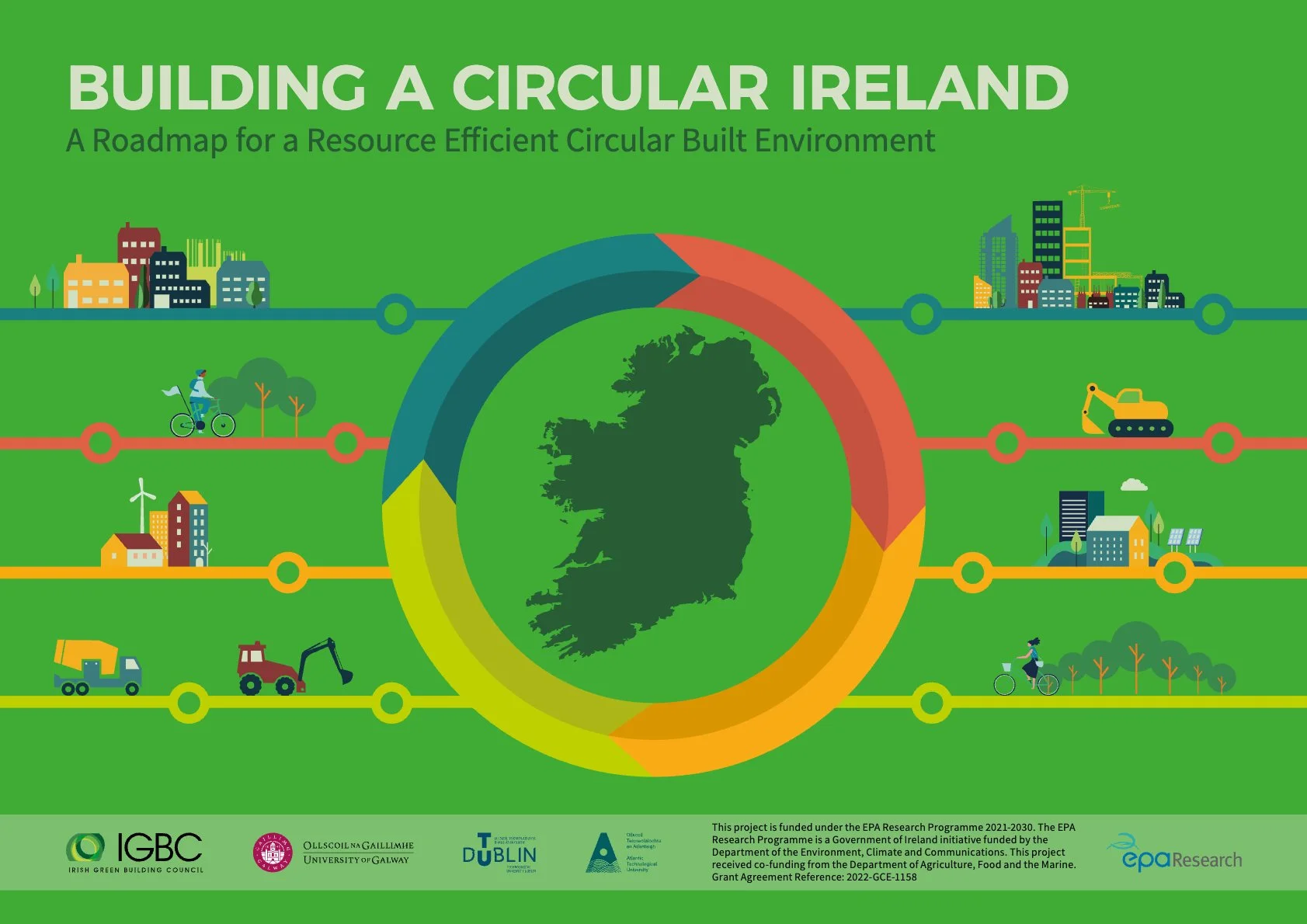
The Irish Green Building Council (IGBC) produced “Building a Circular Ireland – A Roadmap for a Resource Efficient Circular Built Environment” as part of the EPA Research Programme 2021‑2030. The project received co‑funding from the Department of Agriculture, Food and the Marine and was developed with the University of Galway, Technological University Dublin and Atlantic Technological University. Over 225 stakeholders participated through workshops, focus groups and expert interviews, ensuring a broad industry perspective on circular construction in Ireland.
Core Vision for a Circular Built Environment
The roadmap outlines six strategic sections: Value our existing building stock, Plan for resource efficiency, Design for circularity, Close the materials loop, Change the business model and Enable the circular transition. It aims to shift the sector from a linear “take‑make‑waste” model to one where materials are retained, reused and recycled, supporting Ireland’s net‑zero carbon targets and European Green Deal objectives.
Key Statistics on Construction Impacts
Construction accounts for 37 % of Ireland’s national emissions, with 14 % from embodied carbon and 23 % from operational carbon. Annually, 8.3 million tonnes of construction and demolition waste are generated, 35 % of the country’s material footprint derives from the sector, and 97 % of material inputs are virgin resources. Concrete makes up 75 % of material mass and 41 % of associated CO₂e emissions, while metals, though only 7 % of mass, contribute 36 % of emissions.
Reducing Vacancy and Under‑use
The roadmap targets a 10 % initial reduction in vacant properties, followed by a 50‑75 % reduction in under‑use by 2040. Policies will incentivise adaptive reuse, intensify occupancy and support multi‑use developments, addressing the 7.74 % residential vacancy rate recorded in 2022.
Resource Efficiency and Material Savings
Interim 2030 targets include a 10‑25 % reduction in resource use below baseline levels and a minimum of 15 % recycled material in new buildings. By 2040, the ambition is for all buildings to adopt design for adaptability/deconstruction, achieving 40‑50 % improvement in resource efficiency and ensuring 100 % of deconstructed materials are reused or recycled.
Design for Circularity and Innovation
The document recommends lean design, Design for Adaptability (DfA) and Design for Deconstruction (DfD) across projects larger than 5,000 m². It calls for digital product passports, BIM integration and material‑level data to enable traceability, facilitating repair, refurbishment and end‑of‑life reuse. Pilot projects such as the Circular Pavilion in Amsterdam illustrate practical applications of modular, disassemblable construction.
Bio‑economy and Biobased Materials
A dedicated bio‑economy strategy will promote Irish timber, hemp, straw and other agricultural by‑products. Targets include establishing supply chains for agri‑based materials, setting minimum bio‑based material use, and achieving 100 % of materials from deconstruction entering non‑toxic closed‑loop supply chains by 2040.
Business Model Transformation
Extended Producer Responsibility (EPR) schemes and Product‑as‑a‑Service (PaaS) models are advocated to retain ownership of materials, fund end‑of‑life management and encourage circular product design. By 2030, EPR schemes should cover a variety of construction materials, with PaaS models becoming widely supported by government and industry.
Enabling Policies, Procurement and Skills
The roadmap calls for regulatory sandboxes, streamlined certification, and mandatory circular procurement criteria in public contracts. It proposes upskilling programmes for designers, contractors and planners, integrating circularity indicators (EU Level(s) 2.1‑2.4) and ISO 20887 standards. Investment of €30 million per annum is earmarked for bio‑economy development, digital infrastructure and demonstration projects.
Overall Impact and Outlook
If fully implemented, the roadmap projects a substantial reduction in carbon emissions, material consumption and waste generation, while creating new economic opportunities in circular construction. It aligns Ireland’s built environment with EU sustainability targets and offers a replicable model for other European nations seeking to transition to sustainable, resource‑efficient housing.