Overview of the Study
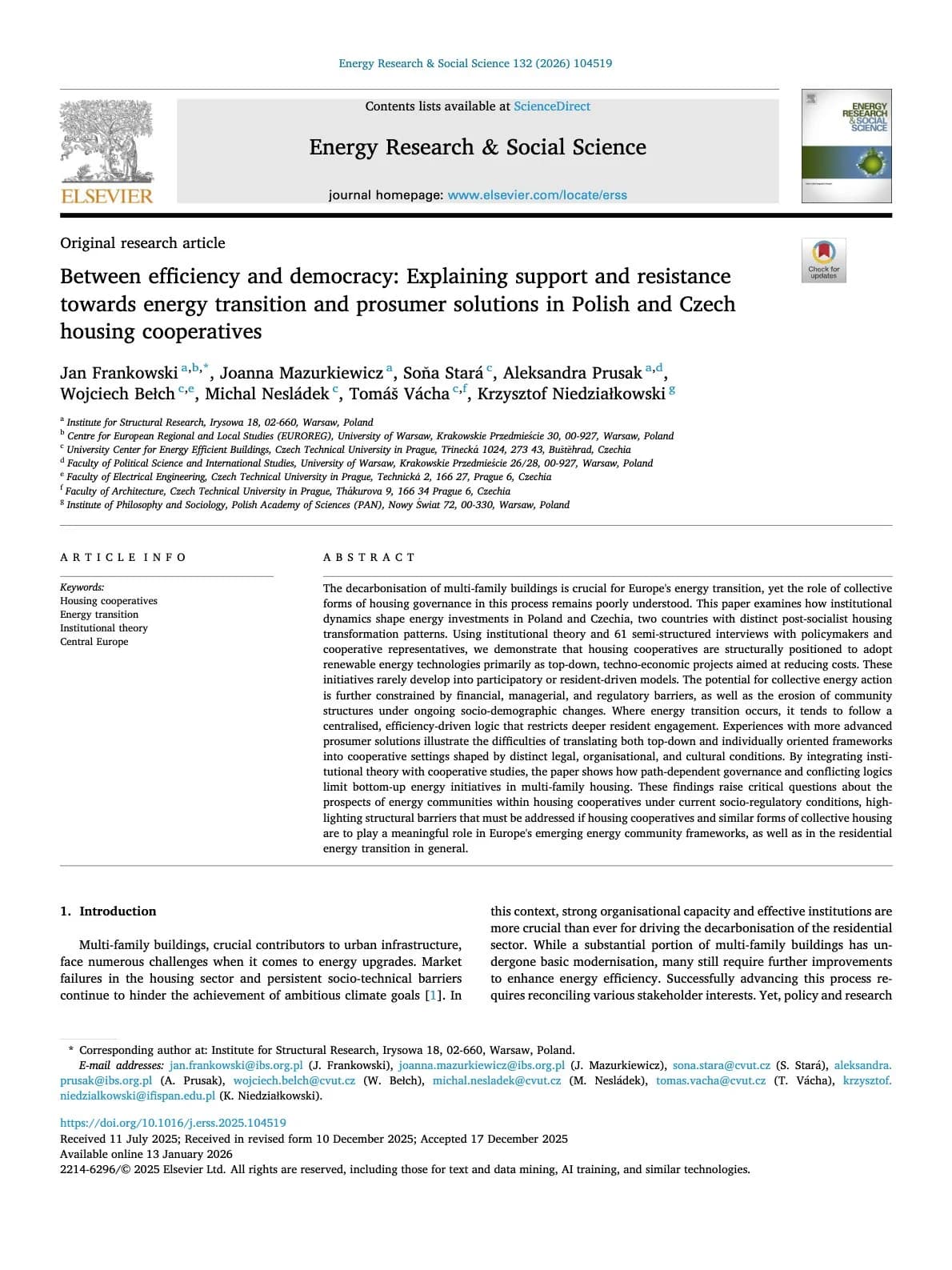
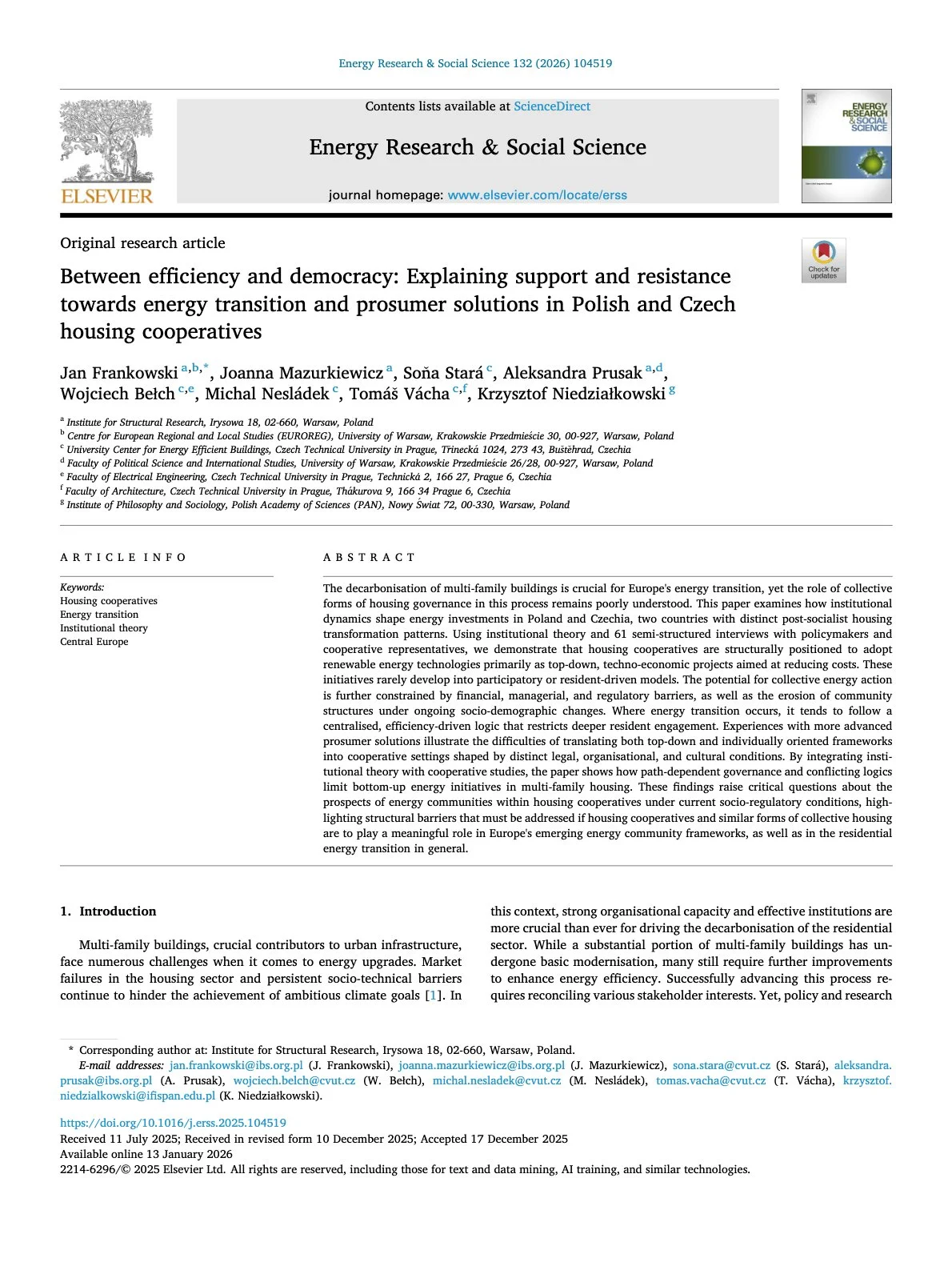
The article “Between efficiency and democracy: Explaining support and resistance towards energy transition and prosumer solutions in Polish and Czech housing cooperatives” is published in Energy Research & Social Science (2026). Authors Jan Frankowski, Joanna Mazurkiewicz, Soňa Stará, Aleksandra Prusak, Wojciech Bełch, Michal Nesládek, Tomáš Vácha and Krzysztof Niedziałkowski are researchers from institutions such as the Institute for Structural Research (Warsaw), the Centre for European Regional and Local Studies (University of Warsaw), the University Center for Energy Efficient Buildings (Czech Technical University), and the Institute of Philosophy and Sociology (Polish Academy of Sciences). Their expertise spans energy policy, institutional theory and cooperative governance.
Research Aim and Scope
The paper investigates how institutional dynamics shape energy investments in multi‑family housing cooperatives in Poland and the Czech Republic. Using institutional theory and 61 semi‑structured interviews with policymakers and cooperative representatives, it analyses support for and resistance to retrofits, renewable energy installations and collective prosumer solutions. The study highlights the dominance of top‑down, techno‑economic logic over participatory, resident‑driven models.
Housing Cooperatives in Poland and Czechia
Polish cooperatives own about 15 % of dwellings; Czech cooperatives about 3 %. In Poland, 51 % are micro‑cooperatives, while the Czech sector is 96 % micro‑cooperatives. The sector is largely urban (81 % in Poland, 96 % in Czechia) and comprises ageing post‑socialist blocks built in the 1950s‑1980s. Governance is democratic in law but decision‑making is often concentrated in board members.
Energy Retrofits Findings
Retrofit activities focus on window replacement, façade insulation and pipe upgrades. In Poland, retrofits are linked to the white‑certificate scheme and receive some state support, yet managerial barriers and low resident engagement delay projects. In Czechia, retrofits have been driven by programmes such as “Program PANEL” and “Nová zelená úsporám”, with financing mainly from cooperative funds and long‑term loans. Financial incentives are more significant than environmental motives in both countries.
Renewable Energy Installations Findings
Polish cooperatives mainly consider photovoltaic (PV) panels and heat pumps, but face technical constraints (roof condition, shared ownership) and view projects primarily as cost‑saving measures. Grants covering up to 50 % of costs are crucial; loans are less popular. Czech cooperatives experience similar barriers, with recent legal changes (LEX RES I‑III) easing permitting, yet limited technical expertise and uncertain ROI hinder uptake. In both contexts, external funding is a key enabler, while lack of resident awareness limits demand.
Collective Prosumer Solutions Findings
Both Polish and Czech cooperatives show scepticism toward community energy models. Legal uncertainty, complex metering, and unclear benefit distribution discourage collective projects. Interviews reveal that residents often do not perceive direct personal gains from shared energy, and cooperative boards lack time and expertise to manage such schemes. Policymakers acknowledge the potential of energy communities but note weak institutional support and lobbying from large utilities.
Institutional Logics and Barriers
The analysis identifies three pillars—regulative, normative and cognitive—shaping cooperative behaviour. In Poland, regulatory rules (energy law, funding procedures) and normative practices (risk‑averse boards, ROI focus) dominate, while cognitive narratives stress efficiency over democracy. In Czechia, similar pillars operate, but managerial capacity is perceived as weaker, reinforcing resistance to collective solutions. Socio‑regulatory barriers (information gaps, low engagement) are the most persistent across both countries.
Policy Recommendations
The authors propose: (1) stronger, targeted financial incentives for renewable projects without prior experience; (2) removal of legal obstacles to energy sharing and prosumer models; (3) development of digital participation tools to enhance resident involvement; (4) coordinated institutional work combining coercive, mimetic and normative pressures to shift cooperative logics toward more democratic, community‑oriented energy transition.
Contribution to Sustainable Housing Discourse
By linking institutional theory with cooperative studies, the paper provides a nuanced understanding of why energy transition in multi‑family housing often follows a top‑down efficiency logic rather than a bottom‑up democratic one. The findings are relevant for pan‑European stakeholders seeking to design policies that align financial incentives, regulatory frameworks and participatory mechanisms to accelerate sustainable retrofits and renewable energy adoption in collective housing settings.