
Affordability held up by the state, not a share certificate
Finland built its housing settlement around ownership and a strong state, not around a federation of cooperatives. Post-war reconstruction, a late and rapid urbanisation, and the 1949 ARAVA loan system pushed most households toward owning. When an intermediate tenure finally arrived in 1990, it came as a state-financed right-of-occupancy form copied from Sweden, not a member-owned movement. That history is why the Finnish affordability question is argued as how much housing the state should finance, not who holds the deeds.
The tenure mix carries the rest. About 68% of Finns are owner-occupiers and 32% are tenants. Within the rental base, roughly 15% of the national stock is public and non-profit ARA housing — around 320,000 dwellings let at cost rent. A further 16% is private rental. The genuinely cooperative slice — equity-share housing companies and the right-of-occupancy intermediate tenure counted as cooperative here — is just 1% of stock, about 30,000 homes across some 20 organisations. Add the public and cooperative tiers together and the non-market segment comes to 16% of all dwellings: modest beside Austria or the Netherlands, but anchored by an unusually deep state-financing apparatus.
- Owners
- Owner-occupier68.0%
- Renters
- Public & non-profit rental15.0%
- Cooperative1.0%
- Private rental16.0%
Social housing in Finland is a financing-and-regulation status rather than a tenure of its own. An ARA-financed dwelling carries omakustannusvuokra — a cost rent set to cover loans and upkeep with no profit — plus income-tested allocation and resale limits, for as long as the state loan runs. That covenant covers about 15% of national stock, spread across the public, cooperative and part of the private slices rather than forming a separate block. Roughly 35% of households would qualify for it on income grounds — several times the binding stock available.
The rent ladder is unusually flat, and that flatness is revealing. ARA rental runs at about €10.50 per square metre, right-of-occupancy at €12.50, the all-stock median at €12.30, newly-signed free-market contracts at €14.80, and furnished lets at €24. The non-market tiers sit close to the median rather than far below it. Finland holds affordability less through a deep rent discount than through secure tenure and a state-financed supply pipeline — closer to how the comparison of cost-based social rental systems across Europe frames the Nordic model than to Vienna's steep cost-rent gap.
- Public / ARA rental
- All-stock median
- Right-of-occupancy
- New free-market contracts
- Furnished / serviced (gross)
Net monthly rent per m² by tier (national; furnished is gross, all-in). The ARA cost-rent floor and the right-of-occupancy tier sit close to the all-stock median — the compression is the point: Finland holds its affordability less through a deep rent discount than through security of tenure and a state-financed supply pipeline. New free-market contracts run more than 40% above the ARA baseline.
Underused stock sits oddly alongside the pressure. Residential vacancy runs near 9.8% nationally — much of it structural, in emptying eastern and northern municipalities rather than in the growth regions. In the ARA sector itself vacancy is far tighter, about 3.8%. Short-term-let platforms add a localised squeeze in the few tourist-heavy cities: Inside Airbnb counts at least 1,205 full-time-equivalent entire-home listings in the covered cities, a floor rather than a national rate, but concentrated exactly where rental demand is sharpest.
It is impossible to solve problems without housing, regardless of whether people’s issues are related to health or social care.On the demand side, Finland now takes in about 60,700 people a year through immigration against roughly 23,000 residential building permits, across a stock of about 3,100,000 dwellings. The arithmetic tightened sharply after 2022, when permits fell and net migration turned strongly positive.
The cost of all this is landing unevenly, and the 2024 welfare cuts sharpened the edge. After the general housing allowance was reduced by about €363m and the allowance for owner-occupier costs scrapped, an Amnesty International investigation documented tenants in Helsinki choosing between rent and food, with low-income renters and students hit first. Official figures revised the rise in poverty from the cuts upward, and recorded homelessness ticked up in 2024 for the first time in over a decade — about 3,700 people, still low by European standards but no longer falling. Court-ordered evictions run near 7,000 a year. The squeeze reaches beyond the poorest: the work on how housing hardship spreads into ordinary working households maps the same pattern Finland is now seeing as new free-market rents pull away from incomes in Helsinki and the growth cities. The cooperative and right-of-occupancy tier is small, but it is the part of the system the rest of this profile follows, because it is where security of tenure is built in by design.

Asumisoikeus and the yleishyödyllinen landlords: a thin equity tier inside a deep state one
What counts as the cooperative tier in Finland is narrow, and worth describing precisely. The country never grew a large member-owned housing federation on the German or Swedish pattern. Instead the non-market floor is carried by two things: the yleishyödyllinen — non-profit or “generally beneficial” — landlords that own ARA-financed rental stock, and the asumisoikeus (right-of-occupancy) intermediate tenure. About 1% of Finns live in the slice counted as cooperative here. The work mapping the legal architecture of European cooperative housing places Finland firmly in the thinner-tradition group rather than alongside the dense federations.
The right-of-occupancy form is the closest thing to a genuine cooperative product. A resident pays an entry deposit of around 15% of the dwelling's price and then a monthly cost rent; the deposit is index-linked and returned on leaving, so there is no market capital gain to chase and the home cannot be sold out from under the resident. Introduced in 1990 on a Swedish template, it was meant to sit between renting and owning. The 2022 reform of the Right-of-Occupancy Housing Act strengthened resident influence and moved applicant selection onto fixed-term national queue numbers held by ARA.
Today the sector resolves into a handful of large, mostly municipal or foundation-owned operators rather than a long tail of small societies. In Helsinki, HASO (Helsingin Asumisoikeus Oy) runs the city's right-of-occupancy stock and HEKA the municipal ARA rental; nationally, foundation landlords such as TA-Asumisoikeus and the Y-Säätiö (Y-Foundation) operate across many cities. They are federated not by a cooperative apex body but by KOVA, the federation of affordable-housing companies, whose members own over 330,000 rental and right-of-occupancy homes housing more than half a million people. ARA — the Asumisen rahoitus- ja kehittämiskeskus, the state housing finance and development centre — sits above them as financier and regulator.


The legal architecture is therefore unusual: most of the affordability is locked by state loan covenants and the omakustannusvuokra cost-rent rule, not by member equity. Helsinki adds its own price-controlled owner-occupation model, Hitas, on top. The strength of the arrangement is that it can be steered nationally and financed counter-cyclically; its weakness, increasingly visible, is that it depends almost entirely on continued state appetite for financing the stock — a dependency the current decade is testing directly.
Retrenchment from the top: the Orpo cuts, the ARA wind-down, and Housing First under strain
Finnish housing policy is steered nationally, and the direction reversed in 2023. The National Coalition–led government of Petteri Orpo came to office committed to consolidating public finances, and housing has borne a visible share. The claim is that the state should subsidise less and target what remains more tightly; the evidence the affordable-housing sector points to is a string of concrete cuts. State interest-subsidy authorisation for ARA production was reduced, the general housing allowance was cut by about €363m, and the allowance for owner-occupier housing costs ended on 1 January 2025. The government also signalled it would steer ARA rental production toward the lowest-income and special groups, scaling back broader supply.
The sharpest move is structural. In 2024 the government proposed winding up ARA and folding the Valtion asuntorahasto (the State Housing Fund) into the state budget — removing, the sector argues, the off-budget instrument that let earlier governments run counter-cyclical construction stimulus. The analysis of how social housing is categorised in EU national-accounting rules is directly relevant: where the financing vehicle sits, on or off the state balance sheet, shapes how much affordable supply a government can commit to. The dissolution plan turns that accounting question into a live Finnish one.
If not all the cuts are implemented, I firmly believe that it will be possible to end homelessness by the end of 2027.The national level frames the regions through agreement, not command. The Maankäytön, asumisen ja liikenteen sopimukset (the land-use, housing and transport, or MAL, agreements) bind the state and the seven largest urban regions — Helsinki, Tampere, Turku, Oulu, Jyväskylä, Kuopio and Lahti — to shared targets for land release and ARA production, with concrete measures running to 2027. A redrafted national Land Use Act is in consultation alongside them. Municipalities still hold the operative levers: they release land, own the big ARA and right-of-occupancy companies, and run the queues.
Support for the cooperative and non-profit tier is now a set of named, and shrinking, instruments. ARA still offers interest-subsidy loans and investment grants for cost-rent and right-of-occupancy production, and the MAL pacts still set delivery targets in the growth cities. But the headline subsidy envelope is falling, and the proposed ARA dissolution puts the financier itself in question. The federation’s own review of affordable housing argues the cuts will deepen segregation and price affordable supply out of exactly the cities that need it.
Set against the retrenchment is the one Finnish housing achievement the rest of Europe still cites: Housing First. From the 2007 Nimi ovessa (“Name on the Door”) blueprint onward, Finland reframed homelessness around giving people a permanent home first and support afterwards, run largely through the Y-Säätiö and municipal partners. It cut long-term homelessness for over a decade — until 2024, when the welfare cuts coincided with the first rise in years. The open question now is whether a model built on a steady supply of affordable, secure homes can hold while the financing of that supply is being pared back.
Two camps frame the argument, and both speak in the open. On one side stand the affordable-housing providers and the homelessness sector. Jouni Parkkonen, Director General of KOVA, called the plan to abolish ARA and the State Housing Fund an administrative reversal without precedent, warning it strips the state of a counter-cyclical tool. Juha Kaakinen, who led the Y-Säätiö through the Housing First years, has long argued that nothing else works until the home comes first. On the other side, the government and fiscal-consolidation advocates hold that broad housing subsidies are poorly targeted and crowd out private supply, and that scarce funds should go to those who cannot reach the market at all. The argument is being settled, for now, on the side of less state financing — precisely the lever Finland's affordability model has always pulled.
- 1990[source]
Right-of-occupancy housing introduced
Modelled on the Swedish system, asumisoikeus gives a resident an indefinite, low-deposit right to occupy an ARA-financed flat — Finland’s intermediate tenure between renting and owning.
- 2007[source]
“Name on the Door” and Housing First
A national working group reframes homelessness policy around a permanent home first, support second. The Nimi ovessa report becomes the blueprint that later cuts long-term homelessness sharply.
- 2022[source]
Reformed Right-of-Occupancy Housing Act
A new act phases in from January 2022, strengthening resident influence and moving applicant selection onto fixed-term national queue numbers.
- 2023[source]
Orpo government + ARA retrenchment
The National Coalition–led coalition takes office and begins steering ARA production toward the lowest-income and special groups, cutting state interest-subsidy authorisation.
- 2024[source]
Housing-allowance cut + queue centralisation
Around €363m is cut from the general housing allowance and the allowance for owner-occupier costs ends; right-of-occupancy queue numbers move to ARA’s national list. Homelessness rises for the first time in over a decade.
- 2024[source]
Plan to wind up ARA + State Housing Fund
The government proposes dissolving ARA and merging the Valtion asuntorahasto into the state budget — a move the affordable-housing sector warns would remove a counter-cyclical financing tool.
- 2027[source]
MAL agreements + new Land Use Act
The land-use, housing and transport pacts with the seven largest urban regions run their concrete-measures period to 2027, alongside a redrafted national Land Use Act.
- 2030[source]
Homelessness + climate horizon
Finland’s long-standing target of ending homelessness, and its carbon-neutral-by-2035 commitment, frame the decade ahead for the cost-rent and right-of-occupancy stock expected to help deliver both.
From the 1990 introduction of right-of-occupancy housing and the Housing First turn to the Orpo government’s 2023– retrenchment, the planned ARA dissolution, and the 2030 land-use and homelessness horizons.
Where the model is built: Helsinki’s intermediate tenures, the wood blocks, and the Housing First estates
The clearest case for the Finnish approach is not in a cooperative statute but in how a few cities have built security of tenure into ordinary neighbourhoods. Helsinki carries most of the weight, with Tampere, Turku and Oulu close behind as the MAL growth regions where ARA and right-of-occupancy production is concentrated.
Helsinki runs the densest mix of intermediate tenures in the country. HASO holds the city's right-of-occupancy stock, letting residents buy in for a modest deposit and stay indefinitely at cost rent; HEKA, the municipal landlord, runs the large ARA rental estates; and the city's own Hitas model caps the resale price of owner-occupied flats on city land, keeping a slice of ownership permanently below market. Together they are why a teacher or nurse can still find a regulated home inside the capital — the practical answer to the rent ladder in §1.
The sustainability strand shows in the city's wood construction. Wood City, at the gateway to Helsinki's Jätkäsaari district, pairs two timber residential blocks — the first of them affordable apartments for the city's own housing production department — with offices and a hotel, built from Finnish laminated-veneer-lumber panels for a fraction of the embodied carbon of concrete. It is the demonstrator the Finnish carbon-neutral-by-2035 target keeps pointing to, in a country where tall timber is a returning tradition rather than a novelty.
The Housing First estates are the other landmark, and arguably the more influential abroad. Run largely through the Y-Säätiö, they converted hostels and shelters into permanent, self-contained flats with on-site support — the Rukkila and Väinölä-type supported-housing units in Helsinki being the model the international comparisons of homelessness policy single out. The review of which countries do housing policy best repeatedly returns to this Finnish record as the clearest evidence that ending, rather than managing, homelessness is both possible and cheaper.
The scaffolding that makes these neighbourhoods repeatable is state machinery, not a member movement. ARA financed and regulated the cost-rent and right-of-occupancy stock; KOVA federates the non-profit and affordable-housing companies that own it; and the MAL agreements tie the state to the growth cities that build it. Where Germany leans on a cooperative federation and Austria on a limited-profit sector, Finland leans on a ministry, a state fund and a handful of large municipal landlords. That has kept a regulated home reachable in Finnish cities for thirty years — but it also means the whole arrangement turns on a single political appetite for financing it, with no member-owned layer to carry the stock if that appetite fades.
What the 1990 right-of-occupancy law set in motion, the Housing First turn extended and these neighbourhoods demonstrate is a single proposition: that a homeowner-majority country can still keep a meaningful share of its city homes permanently regulated and secure, financed through the state rather than locked by member equity. Whether that proposition survives the decade depends less on the buildings than on whether Finland still wants to pay for the pipeline that produces them.
References
Statistics16Click on any number to see the source
Housing market
Tenure & affordability
Cooperative, social & public
Population & migration
From our library7
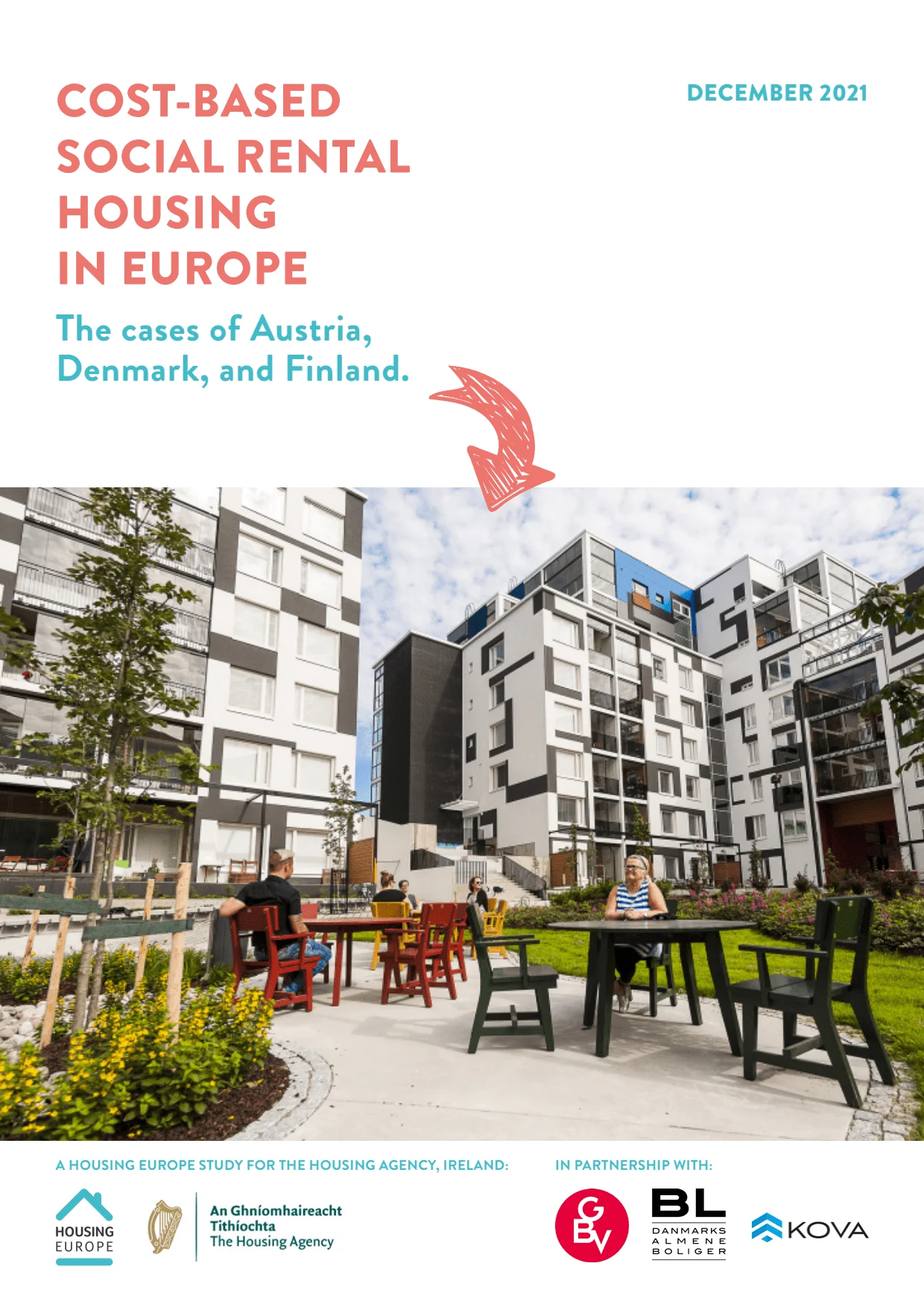
- Cost-based Social Rental Housing In Europe — Knowledge
- Housing hardships hit home — Knowledge
- ICA-EU Partnership - Legal Framework Analysis - Regional report: Europe — Knowledge
- KOVA (Finnish Affordable Housing Companies' Federation) — Organisation
- ARA (Housing Finance and Development Centre of Finland) — Organisation
- Categorisation of Social Housing in EU National Accounting Rules: Implications for Social Housing Finance, Provision and Implementation of the EU Affordable Housing Action Plan — Knowledge
- Housing policy: Who Does It Best? - Part 1 — Knowledge
Further sources15
- Right-of-occupancy housing — Ministry of the Environment (Finland)
- New Right-of-Occupancy Housing Act — TA-Asumisoikeus
- HASO — Helsingin Asumisoikeus Oy — HASO
- Land use, housing and transport (MAL) agreements — Ministry of the Environment (Finland)
- New Land Use Act (consultation) — Finnish Government
- KOVA — ARA and State Housing Fund dissolution statement (Parkkonen) — KOVA
- KOVA — Review of Affordable Housing in Finland 2025 — KOVA
- Housing Europe — State of Housing in the EU 2025 (Finland) — Housing Europe
- Amnesty International — housing-cost report on Finland (2025) — Amnesty International
- Housing-allowance cuts explainer — SYL (National Union of University Students in Finland)
- Helsinki Times — poverty rise from welfare cuts — Helsinki Times
- Juha Kaakinen on Housing First (INSP interview) — International Network of Street Papers
- Juha Kahila (Y-Foundation) on ending homelessness despite the cuts — thebetter.news
- Wood City, Jätkäsaari, Helsinki — SRV
- ARA — Housing Finance and Development Centre of Finland — ARA