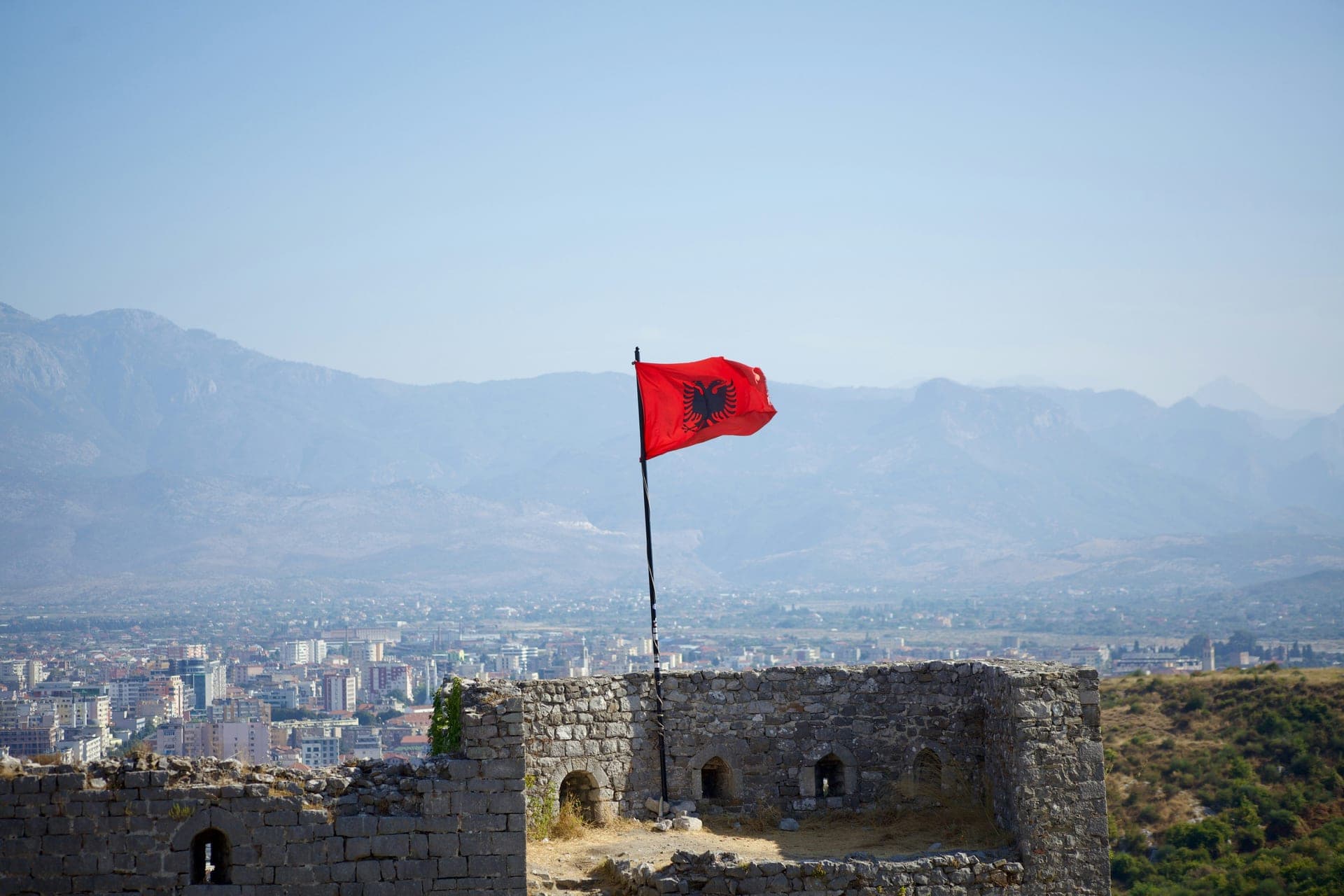
Albania's housing landscape
Post-1991 housing privatisation produced Europe's second-highest owner-occupation share (after Romania). Tirana anchors the contemporary scene. EU-accession negotiations introduce new affordable-housing obligations.
Albania carries the post-transition housing-system legacy + the EU-accession or EU-integration framework that shapes contemporary housing-policy reform.Data at a glance for Albania: 7% of households rent across 1,050,000 dwellings. Rents sit at €5.80/m² across the existing stock against €8/m² for new contracts. Non-market housing covers 0% in the cooperative sector and 2% as public housing. Residential vacancy is 22%; office vacancy 9%. Annual in-migration runs at 12,000 new residents. Source: NextAgora geo-replica, EHC tenant geo-field values.
Cooperative + non-profit housing tradition
Cooperative-housing tradition in Albania carries post-transition legacy in modified form. EU-accession context introduces new requirements for affordable-housing delivery.
Tirana + federal housing-policy framework
Albania's housing politics runs through Tirana + federal channels + EU-accession requirements. Panorama, Shqip, Top Channel, RTSH cover from different angles.
- 1991-2000[source]
Post-transition privatisation
Mass privatisation reshapes housing landscape.
- 2014-2024[source]
EU-accession housing requirements
EU-accession introduces new affordable-housing obligations.
- Sep 2026[source]
National housing programme drafted into law
On 10 September 2026 the government presents a national housing programme running to 2030, now written as a draft law awaiting public consultation. It bundles six schemes, from social rental to subsidised loans and adapted homes for disabled people.
Lighthouse city in Albania: Tirana
Albania's post-transition housing-policy reforms + cooperative-housing-revival run primarily through Tirana. Library still building out.
Long-form catalog anchors for Albania: the EHC library carries deeper context across Housing policies in the European Union (Institute for Housing and Environment, 2021-09), #Housing2030 Effective policies for affordable housing in the UNECE region (United Nations Economic Commission for Europe, 2021), Fairville - Data collection for inequalities’ impact analysis on political participation and democratic quality (FAIRVILLE, 2023-07), The 2026 European Funding Toolkit For Social Enterprises And Their Support Organisations (Euclid Network, 2025), and Housing for the Common Good: Sustainable Governance from European Best Practice for Recovery in Ukraine (Federal Ministry for Climate Action, Environment, Energy, Mobility, Innovation and Technology, 2024-04).
References
Statistics7Click on any number to see the source
Housing market
Cooperative, social & public
Adaptive reuse & vacancy
Population & migration
From our library5
- Housing policies in the European Union — Knowledge
- #Housing2030 Effective policies for affordable housing in the UNECE region — Knowledge
- Fairville - Data collection for inequalities’ impact analysis on political participation and democratic quality — Knowledge
- The 2026 European Funding Toolkit For Social Enterprises And Their Support Organisations — Knowledge
- Housing for the Common Good: Sustainable Governance from European Best Practice for Recovery in Ukraine — Knowledge
Funding & land tenure
What a housing cooperative could actually build on hereLand tenure has not been assessed for Albania yet — that is a gap in the research, not a finding.