
Bern's housing landscape today
Bern is the federal capital sitting at a mid-sized Swiss scale — a city of 79,648 dwellings where 86% of households rent, and where 12.4% of the housing stock operates outside the speculative market through a mix of cooperatives and municipal ownership. It carries the same Swiss Gemeinnützigkeit tradition that produced Zurich's flagship cooperatives, but in a federal-political idiom: the Bundesamt für Wohnungswesen, the Eidgenössische Steuerverwaltung and the policy infrastructure that shapes national cooperative-housing finance all run through Bern.
The contemporary Bern cooperative landscape runs through wbg-beso (Wohnbaugenossenschaften Schweiz Regionalverband Bern-Solothurn), which coordinates more than 200 affiliated non-profit cooperatives across the canton. They collectively operate roughly 7,850 cooperative units in the city — a 9.90% share of total stock. Add 2,000 städtische Wohnungen and Bern's combined Gemeinnützigkeit footprint sits at 12.4%, putting it firmly in the upper tier of the Swiss map alongside Zurich and Basel, though at a smaller absolute scale than Zurich's 25%.
- Owners
- Owner-occupier14.0%
- Renters
- Public & non-profit rental2.5%
- Cooperative9.9%
- Private rental73.6%
Share of dwellings by tenure, resolved live from the geographic catalogue. Bern rents: roughly seven in eight households do, and the non-speculative share — city-owned flats plus Wohnbaugenossenschaften — is about an eighth of the whole stock.
Migration runs at 17,000 inbound moves per year (including OECD / WHO / WTO staff drawn to Bern's federal-international milieu), and residential vacancy sits at 0.44% — tight enough that the cooperative + municipal floor matters more than the headline pricing dynamic suggests.
- Cooperative (gemeinnützig)
- Bestandsmieten (existing tenancies)
- Angebotsmieten (advertised rents)
- Furnished (gross)
Cooperative rents under wbg-beso run at €13.10/m², roughly half the price of newly advertised contracts (€25.50). Net rents in existing tenancies sit at €16.40. Source: BFS Strukturerhebung 2023; Homegate/ZKB Bern asking 2024-25.
Cooperative + non-profit + social housing in Bern
Bern's cooperative-housing tradition has the same federal legal foundation as the rest of Switzerland — Articles 828-926 of the Swiss Code of Obligations (1911), with cooperative capital share-based and Gemeinnützigkeit defined under cantonal tax law. What's specific to Bern is the institutional density around the federal-policy machinery. The Bundesamt für Wohnungswesen, which administers federal cooperative-housing finance (Wohnbauförderung) and partners with cooperatives nationally, sits in Grenchen within Bern's catchment. The Eidgenössische Steuerverwaltung — the federal tax authority that publishes the Besteuerung der juristischen Personen rules under which cooperatives are taxed — is in Bern itself. These are the policy-side counterparts to the operational cooperatives.
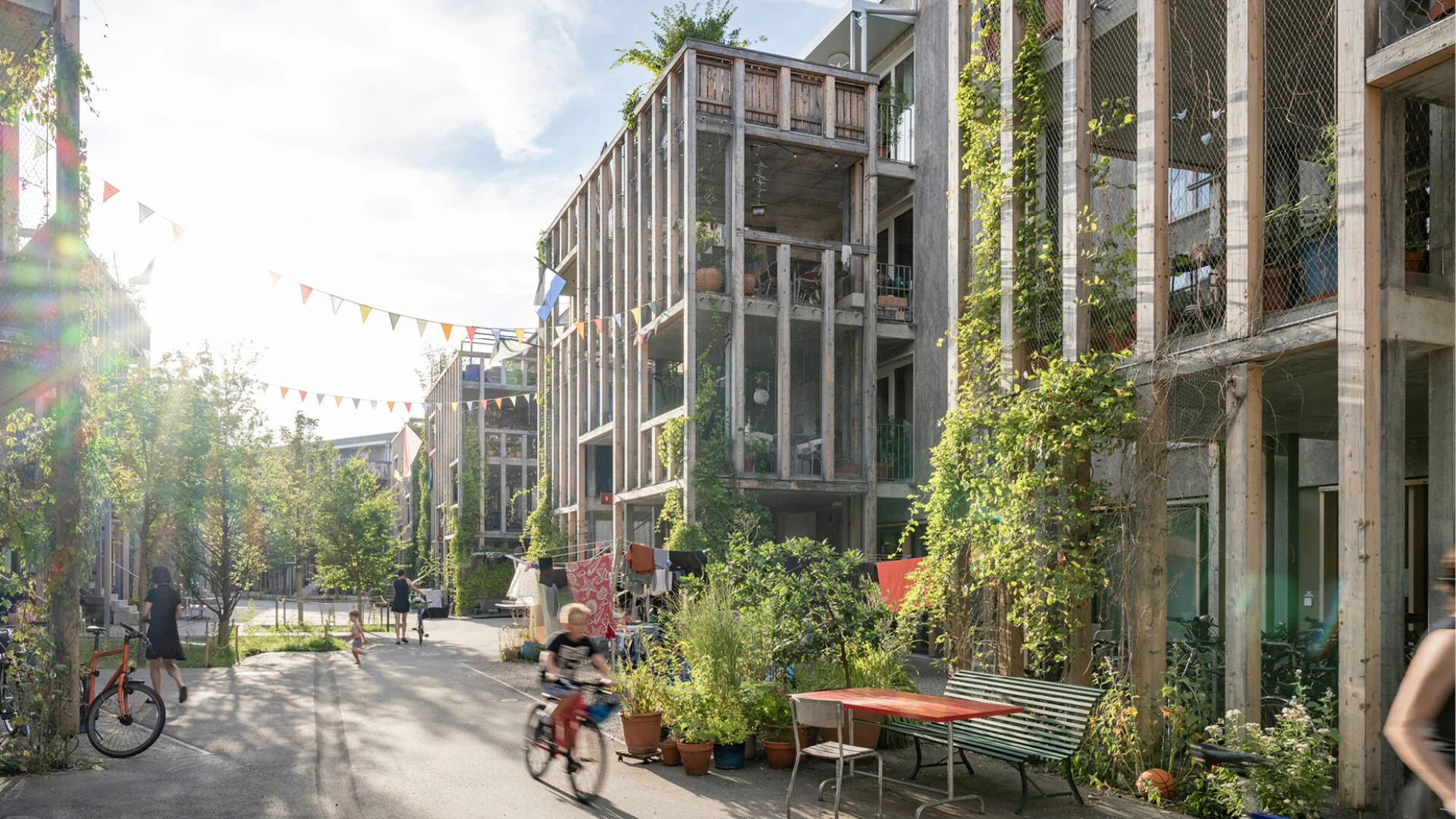
The operational cooperative-housing layer runs through wbg-beso, the Regionalverband Bern-Solothurn of Wohnbaugenossenschaften Schweiz. wbg-beso coordinates roughly 200 affiliated Baugenossenschaften across the canton, operating about several thousand cooperative units cooperative units in the city of Bern. The local flagship project is Huebergass — over 100 affordable cooperative apartments in timber-clad buildings around a central laneway and a district park, the result of a competition-won design and a model that the wbg-beso network references when scaling future builds. Wir sind Stadtgarten — a Bern-based affordable-community-housing developer — completes the contemporary local cooperative-housing ecosystem.

Bern's cooperatives sit inside a national network that is dense enough to give regional cooperatives access to peer-learning, federated financing instruments, and shared regulatory voice. The Mehr als Wohnen flagship (Hunziker Areal) in Zürich, the Kraftwerk1 cooperatives, Genossenschaft Kalkbreite, the Allgemeine Baugenossenschaft Zürich (ABZ), and Basel-based actors including the Genossenschaft Mietshäuser Syndikat and the patient-capital foundations Stiftung Edith Maryon and Stiftung Abendrot all form the national backdrop. The Romandie counterpart runs through Coopérative Equilibre and LA CODHA in Geneva, with urbaMonde providing the international peer-network bridge. The ETH Wohnforum / ETH CASE academic anchor provides the cross-cantonal research circuit. The gta Verlag primer Cooperative Conditions (Kockelkorn / Schindler / Hirschberg, 2025) maps the Bern-Solothurn region as one of the principal regional anchors of the Swiss Gemeinnützigkeit ecosystem.
Bern housing policy + debate
Bern's housing politics has a different texture from Zurich's. Where Zurich is a centre of global finance with an institutional-investor problem, Bern is the federal capital with a comparatively under-pressured rental market — net rents in existing tenancies sit at €16.40/m², asking rents on new contracts at €25.50, and cooperative rents under wbg-beso at €13.10. Office vacancy of 2.4% is tight; residential vacancy at 0.44% is among the lowest in Switzerland. The federal policy frame — Wohnbauförderung, the Wohneigentumspolitik report from the BWO, the Eidgenössische Steuerverwaltung's cooperative-taxation rules — sits in Bern and exports to the rest of the country.
What the WILCO comparative project — published in Social Innovations in the Urban Context (Brandsen / Cattacin / Evers / Zimmer, Springer 2016) — identifies as Bern's governance signature is the governance-of-co-operation type: continuous public-private partnership-building, welfare-mix solutions, the city as innovator-by-pragmatism. The WILCO chapter on Bern's integration guidelines (the late-1990s document on migrant integration) is the canonical case. The same governance pattern shows up in the contemporary Bern cooperative-housing-public-policy interaction: the city builds coalitions with cooperatives + Bund-level housing-finance bodies rather than imposing top-down rules. The editorial conversation runs through Der Bund, Berner Zeitung, Journal B, SRF, WOZ, Republik.
- 1911[source]
Swiss Code of Obligations: cooperative law
Articles 828-926 of the Swiss Obligationenrecht (OR) codify the cooperative form, including the rule that cooperative capital must be share-based — the federal legal foundation that all Bern Baugenossenschaften still build on.
- 1922[source]
Dora Staudinger: "Wohnung für Alle!"
Dora Staudinger publishes the founding text of the modern Swiss cooperative-housing movement from Zürich. Read across the country, it sets the moral frame that cooperatives in Bern build under as the post-1920 movement matures.
- 1948[source]
Bundesamt für Wohnungswesen (BWO) precursors
Federal housing-policy instruments crystallise around what becomes the Bundesamt für Wohnungswesen — the federal housing office that today still anchors cooperative-housing finance support (Wohnbauförderung) from Grenchen, in Bern's catchment.
- 1990s[source]
WILCO Bern case: governance-of-co-operation
In the second half of the 1990s, faced with growing migrant integration challenges, the Stadt Bern develops an integration-guideline document combining municipal welfare policy with public-private partnerships — the model that the WILCO comparative project would later identify as Bern's governance-of-co-operation signature, grouped with Amsterdam, Münster, Barcelona and Varaždin.
- 2010[source]
Federal land + housing-policy report
The Eidgenössische Steuerverwaltung, Bundesamt für Sozialversicherungen and Bundesamt für Wohnungswesen co-publish the Wohneigentumspolitik in der Schweiz report — Bern becomes the editorial centre of the federal housing-policy conversation.
- 2018-2024[source]
Huebergass + cooperative pipeline
The Huebergass project delivers over 100 affordable cooperative apartments through timber-clad buildings around a central laneway and district park — the contemporary local flagship for the Bern cooperative-housing movement, and a competition-won design.
- 2024[source]
Cooperative + municipal coverage hits 12.4%
Statistik Stadt Bern records 79,648 dwellings total, of which 7,850 are cooperative (wbg-beso member coverage) and 2,000 städtisch — combined 12.4% non-market stock, with rental vacancy at 0.44%.
- 2024[source]
"Organisiert Euch!" — Urban Equipe
Urban Equipe and Kollektiv Raumstation publish "Organisiert Euch!" — a German-language manual for self-organising collective housing initiatives, widely circulated across Bern, Zürich and Basel cooperative networks.
- 2025[source]
Cooperative Conditions primer
gta Verlag (ETH Zurich) publishes "Cooperative Conditions" — Bern-Solothurn region (wbg-beso) is documented as one of the principal regional anchors of the Swiss Gemeinnützigkeit map alongside Zurich.
The 2024 "Organisiert Euch!" manual from Urban Equipe and Kollektiv Raumstation — a German-language guide to self-organising collective housing initiatives — circulates widely in the Bern, Zürich and Basel cooperative networks as the practitioner's handbook. The Holm/Laimer collection Gemeinschaftliches Wohnen und selbstorganisiertes Bauen (TU Wien 2021) names Bern-based partner Bürgi Schärer Architekten (Susanne Schmid) as part of the cross-DACH cooperative-housing-research circuit.
Bern: cooperative-housing pipeline + institutional layer
Huebergass is Bern's contemporary cooperative-housing flagship: a competition-won design delivering over 100 affordable apartments in timber-clad buildings around a central laneway and district park. The project sits at the intersection of architectural ambition (timber + cohesive ground-floor programming) and cooperative-financial discipline (gemeinnützig rents at the wbg-beso scale), and it is the visible reference that Bern points to when comparing local delivery against Mehr als Wohnen's Hunziker Areal or the Kalkbreite block in Zurich.
Wir sind Stadtgarten — a Bern-based affordable-community-housing developer — is the contemporary civic-society anchor for next-generation cooperative housing in the city, operating at the small + community-led end of the spectrum where Huebergass and the wbg-beso scaled cooperatives complement each other. Together with the federal-policy infrastructure (Bundesamt für Wohnungswesen + Eidgenössische Steuerverwaltung) and the national peer-network (Mehr als Wohnen, Kraftwerk1, ABZ, Stiftung Edith Maryon, Stiftung Abendrot, LA CODHA, Coopérative Equilibre), Bern operates a complete cooperative-housing institutional layer at a federal-capital scale.
The combination — Huebergass at the local-project end, wbg-beso at the regional-coordination end, and the Bund-level Bundesamt für Wohnungswesen + Eidgenössische Steuerverwaltung at the federal-policy end — is what makes Bern distinctive within the Swiss cooperative-housing map. The contemporary research conversation, anchored by ETH Wohnforum and the Cooperative Conditions primer (gta Verlag 2025), names Bern-Solothurn (wbg-beso) as one of two principal regional anchors of the Swiss Gemeinnützigkeit map alongside Zurich.