
The city that capped its rents
Barcelona is a city built to a plan. Ildefons Cerdà drew its octagonal Eixample grid in 1859 to let in light and air, and that plan left Barcelona one of the densest, most walkable capitals in Europe. That density is now the housing problem in miniature. A growing city of 1.7 million people, hemmed in by sea and hills, has very little room to build — and over the last decade it has answered with two of the boldest housing experiments on the continent: a rent cap, and a municipal revival of the cooperative.
Ownership runs deep here, as it does across Spain. Barcelona households own at a rate of 61%, against 31% who rent, with roughly 8% in institutional, employer-provided or non-market arrangements that fall outside the standard categories. Cooperatives are tiny as a legal tenure: only 0.07% of dwellings, around 465 homes across about 20 projects, housing a similar 0.07% of residents. Municipal landlords hold just 1% of the stock, some 6,300 flats. Private landlords let the remaining 29.9%. The non-market tier — cooperative plus municipal — comes to barely 1.1% of all dwellings, a fraction of what Vienna or Amsterdam carry.
- Owners
- Owner-occupier61.0%
- Renters
- Public & non-profit rental1.0%
- Cooperative0.07%
- Private rental29.9%
- Other8.0%
- Free use (cesión gratuita)8.0%
On top of those tenures sits a regulatory layer almost too thin to register. Only about 1.7% of Barcelona's dwellings carry a social-housing rule, a covenant that overlays the tenures rather than forming a slice of the pie. That share is far below the European average and one of the lowest of any large Western city. By contrast, nearly a third of residents would qualify for social housing on income grounds — a gulf between need and stock that frames every policy argument the city has.
Price each tier per square metre and the affordability gap becomes literal. Tenants in the city's municipal flats pay around €7 per square metre, and members of the new cooperatives a near-identical €7.10. A median home across all stock rents at €13.50; a newly-let apartment asks a median €22; and furnished, serviced lets reach €25.30 per square metre gross. A new market contract therefore runs more than three times the regulated floor. That single comparison is the whole affordability problem.
- Public/municipal housing
- Cooperative
- All-stock median
- New contracts
- Furnished / serviced (gross)
Net-cold monthly rent per square metre by tier (furnished is gross, all-in). The regulated municipal and cooperative floor sits far below the market median; a newly-let private contract runs more than three times the municipal rate.
Two kinds of empty stock pull in opposite directions. Counted at the 2021 census, residential vacancy reached about 10%, some 75,500 unoccupied dwellings, though much of that is second homes and inherited flats; the regional housing agency counts closer to 14,800 genuinely empty buildings. Offices are looser still: around 918,900 square metres stand vacant, roughly 8.8% of the office stock. Tourism applies the sharper squeeze. Full-time entire-home holiday lets number an estimated 4,961 dwellings, heavily concentrated in the centre — the Eixample alone holds close to half of them — which is why the city has moved to phase out tourist-flat licences by 2028.
Today we've taken the first step to close the loophole in seasonal rentals and room lets and prevent these schemes from driving up prices. But this law is not enough on its own.Newcomers arrive far faster than the city can build for them, and the strain now reaches the middle. Set the 129,030 moves a year of net inbound migration against only about 4,100 housing permits annually and the arithmetic is stark. The pressure no longer falls on the poorest alone. Across Catalonia, around 32.6% of market-rate renting households spent more than 40% of their income on housing in 2023, well above the safe threshold, and Barcelona sits at the sharp end of that figure. Energy poverty touches roughly 12% of households, and evictions still run at about 2,800 a year. Surveys consistently rank housing as the top public worry in the city, ahead of jobs or security.
Cessió d'ús: the model Barcelona borrowed and made its own
The Barcelona cooperative is built on cessió d'ús — a grant-of-use model in which the cooperative owns the building and each member holds a long, transferable right to live in a specific flat, but can never sell it for profit. A member pays an entry contribution and a monthly fee well below market rent. This is a limited-equity, use-right form, closer to the Danish andelsbolig or the Uruguayan housing cooperative than to ownership. It deliberately separates the use of a home from its exchange value, so the flat cannot be flipped.
The tradition is older than the recent revival suggests. Catalonia had a strong cooperative and mutualist culture before the civil war, rooted in the same anarchist and workers' movements that shaped the city. That thread was cut by dictatorship and then by Spain's long post-war drive into private ownership. The form returned only after 2008, when the crash, mass evictions and a new municipal politics of the right to housing gave a generation both the anger and the public land to try again.
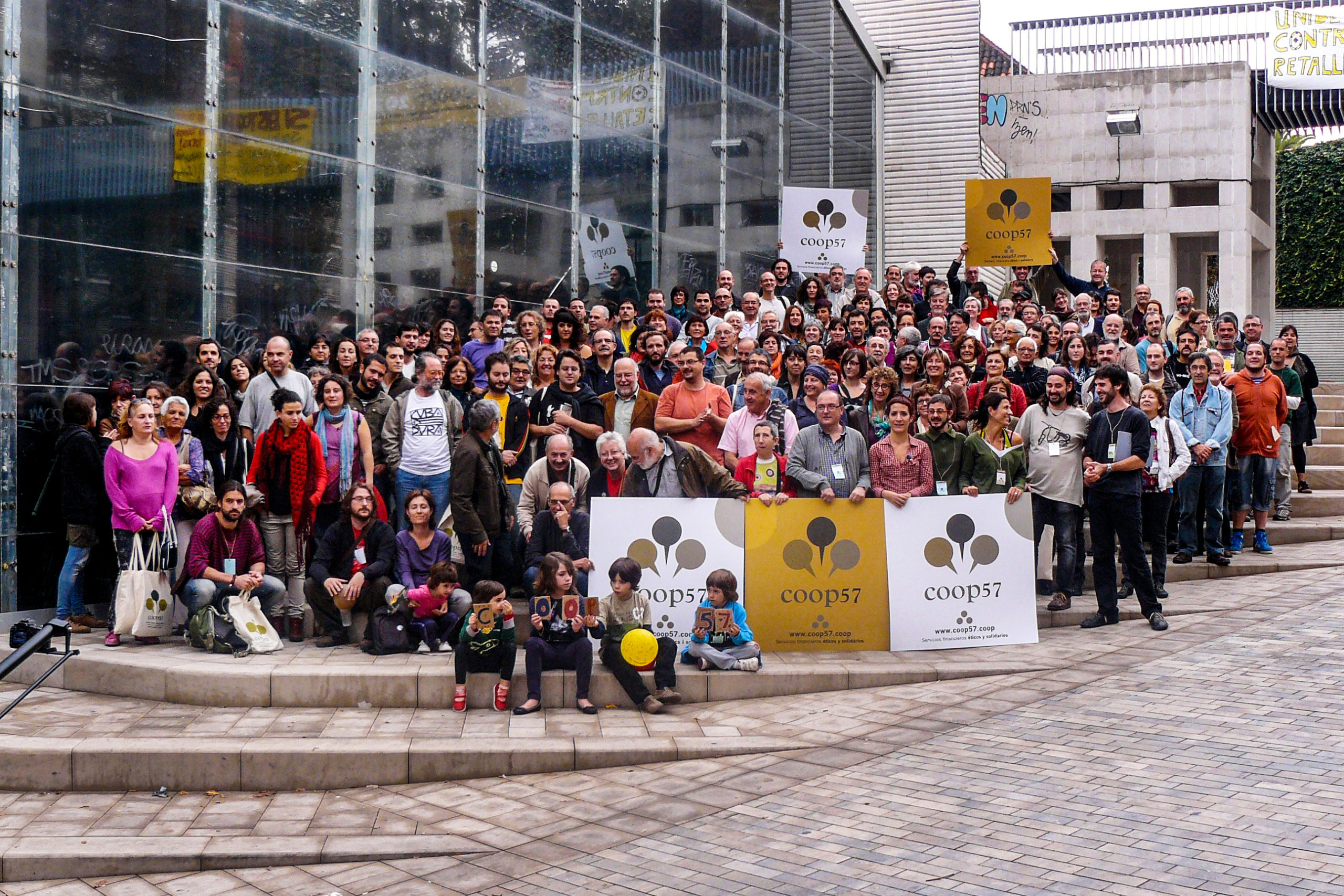
Today the sector is small but unusually well-organised, and it clusters into a few groups with shared problems. Sostre Cívic, the largest cessió-d'ús cooperative, develops and tenants most of the new projects; La Dinamo Fundació supports and finances them; and a tight design world — LACOL, Celobert, Peris+Toral Arquitectes and Perviure SCCL — turns the briefs into buildings, often in timber. The ethical financier Coop57 lends where mainstream banks will not, and Fundació Hàbitat3 manages social lettings alongside. Their common bottleneck is the same: land and finance. Banks are reluctant to lend to not-for-profit developers, so projects lean on member capital and social finance, and the supply of public plots sets the ceiling on how fast the form can grow.
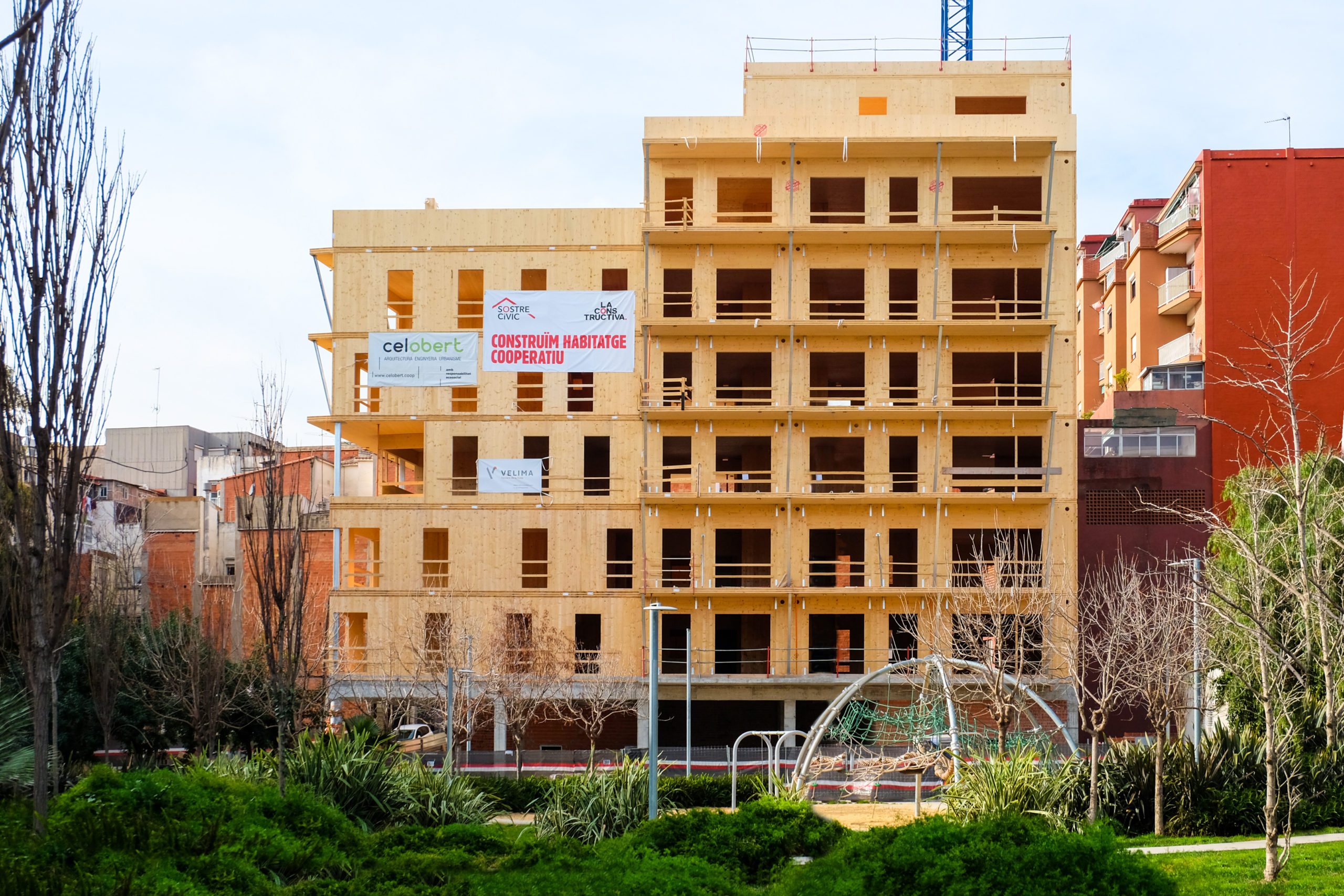

Where most governments treat cooperatives as a private quirk, Barcelona wrote them into policy. The city treats the cessió-d'ús cooperative as a deliberate affordable-housing channel, not a private curiosity: it leases municipal plots on long surface rights, runs competitive calls for cooperative-led schemes, and folds the form into its wider right-to-housing strategy. The city's support for collaborative housing for lower-income and migrant households, partly through access to low-cost land, is singled out as a European outlier by a RE-DWELL study of community-led housing.
A cap, a quota, and the search for public land
Barcelona's housing politics is a search for two scarce things: regulation that holds, and land to build on. Jaume Collboni of the Catalan socialists has led the city since 2023, with Jordi Valls as the deputy mayor carrying the housing brief. The headline programme is direct public building: in October 2025 the European Investment Bank signed a €113 million loan to fund 640 social and sustainable rental homes across nine developments, which the mayor called another step to accelerate public housing in the city. The aim is to lift the municipal stock toward the European average from a very low base.
Madrid writes the law, Catalonia switches it on, and the city hall hands over the land — three hands that rarely move in unison. Spain's national housing law of 2023 created the power to cap rents in stressed-market zones; Catalonia was the first region to switch it on, in Barcelona and 139 other municipalities; the city allocates the land and runs the calls. The cap brought new-contract rents down — average registered rents fell about 2.4% in the first nine months of 2025 — but the number of new rental contracts also fell sharply, the supply-side worry critics had warned of. A December 2025 law then extended the cap to seasonal and room lets, the loophole landlords had used to escape it.
- 2015[source]
Right-to-housing turn
A new city government makes housing its headline issue after the eviction wave of the post-2008 crisis, and begins handing publicly-owned plots to cooperatives on long leases rather than selling them.
- 2018[source]
La Borda completed
The 28-home La Borda cooperative opens on municipal land at Can Batlló, a six-storey timber building under a cessió d'ús lease — the model the city now replicates.
- 2020[source]
Catalan rent regulation
Catalonia passes one of the first rent-price caps in Spain, championed by the tenants’ union, before the Constitutional Court strikes it down in 2022 pending a national framework.
- 2023[source]
Spanish Housing Law
Spain’s first national housing law lets regions declare stressed-market zones and cap rents; Catalonia is the first to apply it, in Barcelona and 139 other municipalities.
- 2024[source]
Housing as a metropolitan priority
Mayor Jaume Collboni reframes housing at metropolitan scale, arguing that affordable supply has to be planned across the whole Barcelona conurbation, not city by city.
- Jul 2025[source]
30% affordable quota shelved
The city's plan to extend the rule requiring 30% affordable housing in major renovations is set aside for the term after talks with Junts collapse.
- Oct 2025[source]
EIB-backed public rental
The European Investment Bank signs a €113 million loan to fund 640 social and sustainable rental homes across nine developments in the city.
- Dec 2025[source]
Seasonal-let loophole closed
The Catalan parliament extends rent regulation to seasonal and room lets, the route landlords had used to escape the cap on long-term tenancies.
- 2030[source]
Public-housing build-up
The city aims to keep expanding its municipal and cooperative stock toward the European social-housing average through the decade, anchored by the metropolitan housing operator.
From the post-crisis right-to-housing turn and the first cooperative pilots to the Catalan rent cap, the metropolitan operator and the EIB-backed public-rental push.
The cooperative sits deliberately inside this programme. The city leases plots to cessió-d'ús cooperatives on long surface rights rather than selling them, treating the model as a way to add affordable homes the budget could not build directly. A bolder instrument has stalled, though. Collboni's plan to extend the rule requiring 30% affordable housing in major building renovations was shelved for the term in July 2025 after talks with Junts collapsed. The city governs in a minority, and its most ambitious tools depend on shifting coalitions.
With almost no open land left, Barcelona's answer to its vacant stock is to build inward rather than outward. The city is converting former industrial buildings into homes — old textile mills, warehouses and factories across the inner districts — rather than expanding outward onto scarce land. Europe's wave of office obsolescence offers a further conversion frontier the city is only beginning to use, set out in a study of adaptive reuse for housing. The sharpest move is on tourism: Barcelona has decided to cancel all tourist-flat licences by 2028, returning those dwellings to residents.
Decarbonising the housing stock and making it affordable have become one problem in Barcelona. Its homes average around 55 years old, only about 9% of dwellings are rated energy-efficient, and the renovation rate crawls near 0.8% a year — far short of the EU's deep-retrofit targets. The cooperative and public projects are where the climate ambition shows: timber structures, shared services and passive design cut both carbon and bills. That ties the retrofit goal directly to the non-market tier the city is trying to grow, a link traced in the #Housing2030 review of effective affordable-housing policy.
Few in Barcelona argue against intervention now; the fight is over how far the cap should stretch. The Sindicat de Llogateres, the city's tenants' union, treats the cap as necessary but unfinished, pressing for it to cover every form of letting. Catalonia's housing minister frames the regulation as proof that intervention works. Property owners and many agents argue the opposite — that caps without new supply push flats toward sale or seasonal use and dry up the rental market. All sides agree the non-market tier is too small; they disagree on whether to grow it by regulating the private market or by building outside it.
If housing works, the country works, and this law moves us in that direction.After La Borda: timber cooperatives on borrowed land
Barcelona's working examples are small in number but outsized in influence, and the thread that connects them is a single idea: build on public land, own the building collectively, and put the home permanently beyond speculation. The buildings below are where that idea became concrete; the organisations after them are the ones trying to make it repeatable.
La Borda is the project that started the wave. Completed in 2018 on municipal land at the resident-run Can Batlló site, it is a 28-home timber cooperative on a long cessió-d'ús lease, with a quarter of its floor area given to shared space and a rent far below the market. Its friction is the one every project since has inherited: mainstream banks would not lend to a not-for-profit developer, so it leaned on member capital and the ethical financier Coop57, and the roughly €17,000 entry contribution is a real barrier for the lowest-income households the model most wants to reach.
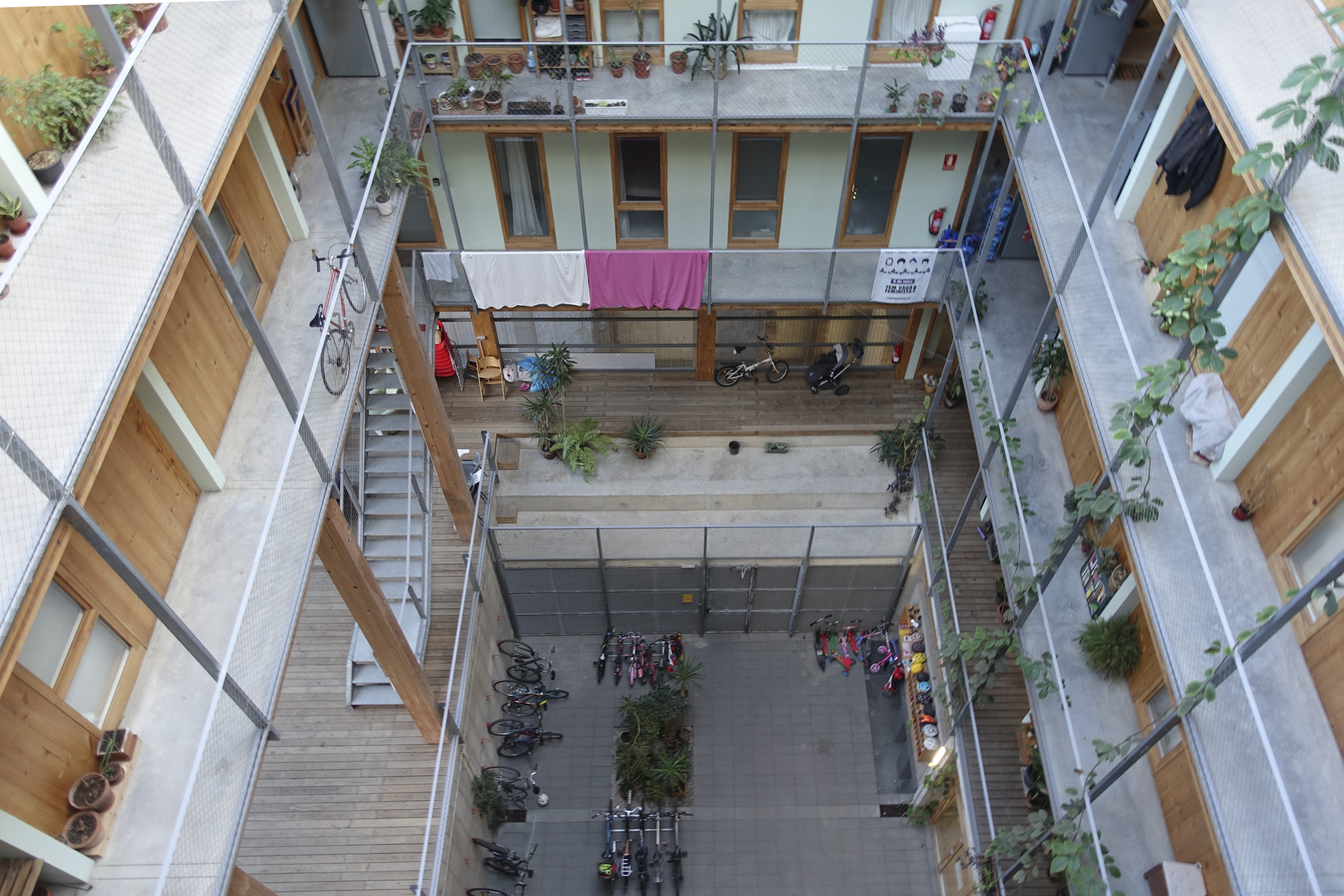
Princesa49 took the model into the historic core. It was the first cessió-d'ús housing inside Barcelona's old city, a rehabilitated historic building on a 75-year surface right rather than a new build. Restoring a protected structure to cooperative standards is slow and costly, and the scheme shows both the promise and the limit of the form: heritage conversion answers the city's no-land problem, but it rarely produces homes at scale or at the lowest price point.
Can 70, La Balma and Cirerers spread the form across the city and across needs. Can 70 is Barcelona's first senior cooperative on public land, 39 homes on a 99-year lease for older residents who want to age together rather than alone. La Balma added a social-inclusion flat for young people leaving foster care to its 20 units, and Cirerers built an eight-storey timber block of 32 small apartments around 771 square metres of shared space. Each is celebrated, and each runs up against the same ceiling: the supply of public plots, and the years of negotiation each lease takes.
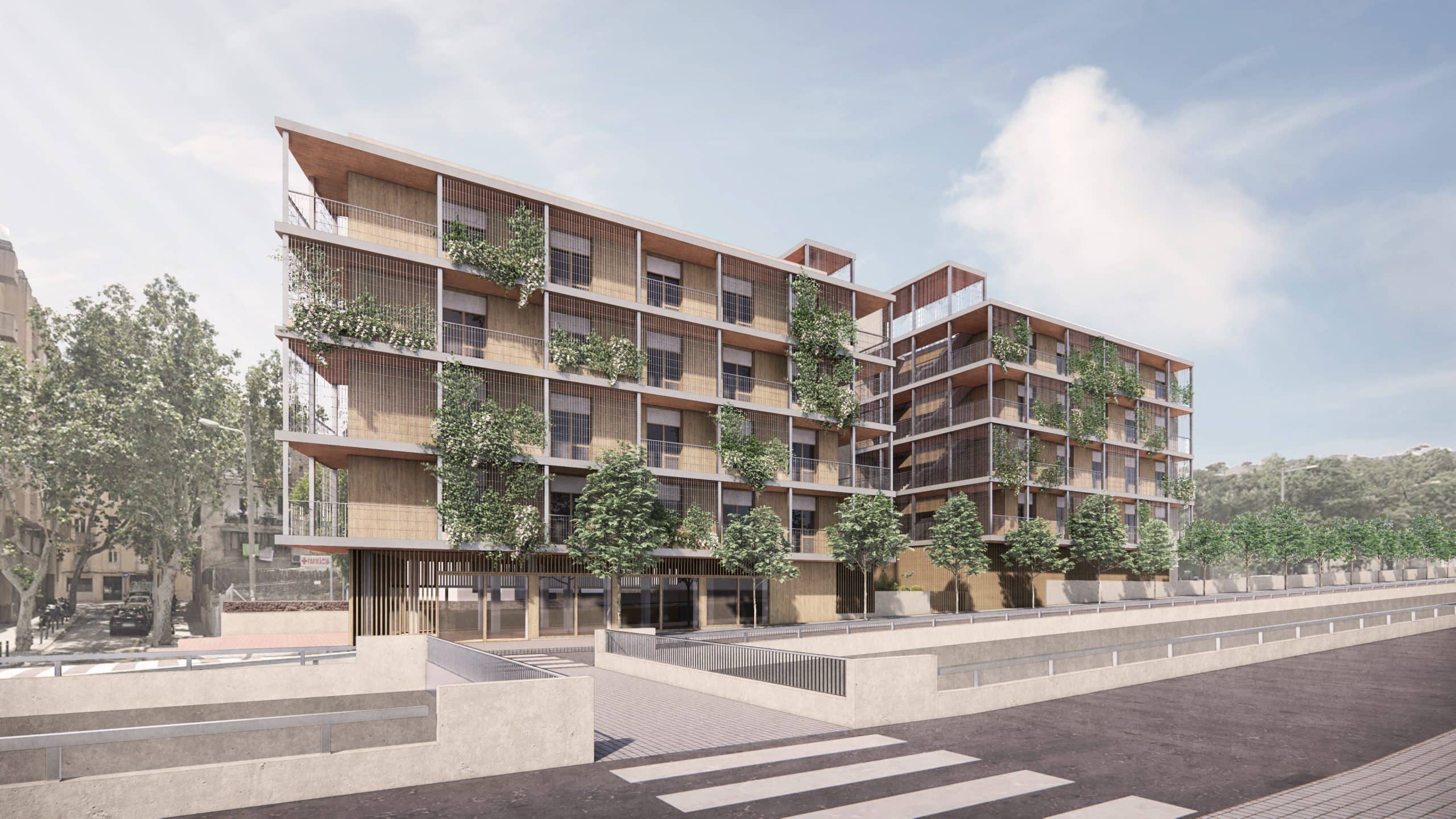
The adaptive-reuse projects answer the city's vacancy story directly. Fabra & Coats turned a 1905 textile warehouse into 46 family homes with a timber structure and artist residencies, and the Greenh@use tower stacks senior, affordable and refugee housing around a sunlit atrium as social housing designed by Peris+Toral. La Chalmeta added 32 affordable apartments, and Terrazas para la vida used cross-laminated timber and suspended terraces to cut construction in half. All show how readily Barcelona's industrial shells become homes — and how dependent that pipeline is on the city owning the plot first.
A small ecosystem of organisations keeps these buildings standing up, and it is steadily thickening. Sostre Cívic develops and tenants the cooperatives; La Dinamo Fundació finances and advises them; Coop57 supplies the patient credit; and LACOL, the architecture cooperative that designed La Borda, doubles as a movement actor. Knowledge bodies thicken it further: urbanNext publishes the case studies, metropolis convenes the cities, and NETCO connects Barcelona's local governments to peers experimenting with collaborative housing. The financing and decommodification questions these actors wrestle with are mapped in work on community finance and on shared, sufficiency-minded living. It is a thinner institutional layer than Vienna's or Zurich's, and almost all of it is recent — but it is real, and it has already exported a model.
References
Statistics20Click on any number to see the source
Housing market
Tenure & affordability
Cooperative, social & public
Adaptive reuse & vacancy
Population & migration
From our library27
- Sostre Civic — Organisation
- La Dinamo Fundació — Organisation
- LACOL — Organisation
- Celobert arquitectura, enginyeria i urbanisme — Organisation
- Peris+Toral Arquitectes — Organisation
- Perviure SCCL — Organisation
- Coop57 — Organisation
- Fundació Hàbitat3 — Organisation
- Transdisciplinarity for Affordable and Sustainable Housing — Knowledge
- Adaptive Reuse for Housing — Knowledge
- Part 1: Mapping the housing needs in the EU, assessing the impacts of scarcity and providing an overview of relevant EU legislation — Knowledge
- #Housing2030 Effective policies for affordable housing in the UNECE region — Knowledge
- La Borda — Project
- Can Batlló — Project
- Princesa49 — Project
- Can 70 — Project
- La Balma — Project
- Cirerers — Project
- Fabra & Coats — Project
- Greenh@use — Project
- La Chalmeta — Project
- Terrazas para la vida — Project
- urbanNext — Organisation
- metropolis — Organisation
- NETCO — Organisation
- Funding the Cooperative City: Community Finance and the Economy of Civic Spaces — Knowledge
- Small is Necessary: Shared Living on a Shared Planet — Knowledge
Further sources11
- EIB finances Barcelona with €113m for 640 social rental homes — European Investment Bank
- Parliament passes landmark law to close rent-cap loophole — Catalan News
- Catalonia rents amid rent caps (INCASOL 9M-2025) — Catalan News
- Collboni shelves Barcelona's 30% affordable-housing reform — Spanish Property Insight
- Collboni frames housing as a metropolitan priority — Ajuntament de Barcelona
- Mayors for Housing — housing demands to the European Council — Ajuntament de Barcelona
- Rent cap in 140 Catalan towns and cities comes into force — Catalan News
- La Borda housing cooperative — urbanNext
- La Borda — RE-DWELL case study — RE-DWELL
- Barcelona governing team — housing brief — betevé
- Barcelona to eliminate tourist apartments by November 2028 — Catalan News