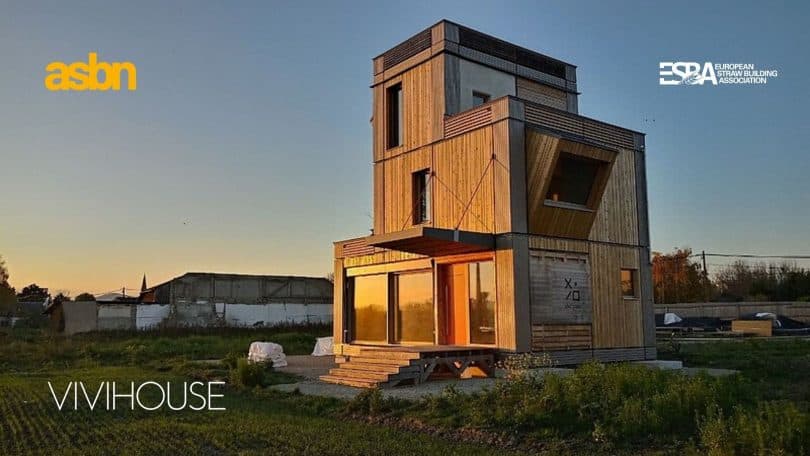
vivihouse is a Vienna-based initiative developing a modular building system for multi-storey ecological buildings. The concept, created by architects Adrian Schulz, Nikolas Kichler, and Michael Fürst, emerged from a desire to make sustainable construction accessible, flexible, and participatory. The system relies on renewable materials such as timber and straw, allowing for the modular prefabrication of up to six-storey buildings for residential and office use.
The project began development in 2017 with involvement from students and experts associated with TU Wien and TU Graz. vivihouse’s first construction was a single-storey prototype built in Pernitz in late 2018. By summer 2020, a three-storey demo house was completed in Vienna’s Donaufeld district. This structure was publicly presented as an example of urban-scale ecological building and is currently used as a communication space by the local urban renewal office. The prototype integrates prefabricated wall and ceiling elements, ready-made wet room modules, and a ventilation system with heat recovery.
A notable feature of vivihouse is its openness: building elements can be assembled by professionals, students, or supervised laypersons in workshops, and the designs are open source. The organisation has facilitated hands-on training with the Austrian Strawbale Network and encourages broad participation in its ongoing development.
Looking ahead, vivihouse aims to realise five- to six-storey projects and expand its cooperative model. The initiative is supported by public research funds and continues to experiment with material cycles, ecological optimization, and community-led construction approaches.