Overview of the Report
The Urban Land Institute (ULI), a global network of more than 48,000 real‑estate and urban‑development professionals, published “What’s Old Is New – The Business Case for Adaptive Reuse.” The report, released in 2025, examines how reusing existing buildings can create economic, environmental, and social value, especially in the context of sustainable urban development across Europe and beyond.
Why Adaptive Reuse Matters
Adaptive reuse modifies existing structures to meet new economic, social, and environmental conditions, reducing embodied carbon, preserving cultural heritage, and revitalizing neighborhoods. The report highlights that 80 % of the global urban population will live in cities by 2050, and 80 % of the buildings they occupy already exist, making reuse a critical climate‑action strategy.
Key Findings and Data
- Embodied‑carbon reductions range from 58 % to 60 % compared with new construction across three case studies.
- Whole‑life carbon savings over ten years range from 35 % to 70 %.
- Economic benefits include job creation, increased property values (e.g., a 105 % rise for the Congress Square project), and higher rents.
- Social outcomes feature new residential units, community amenities, and improved public spaces.
Case Study 1: West Bottoms Flats (Kansas City, USA)
Converted historic warehouses into market‑rate apartments, micro‑retail, and amenity spaces. The project achieved a 60 % reduction in embodied carbon, a 37 % reduction in whole‑life carbon, and a 94 % lease rate. Property values rose from $7.50–$8.00 / sq ft to over $40 / sq ft, demonstrating strong economic returns.
Case Study 2: Congress Square (Boston, USA)
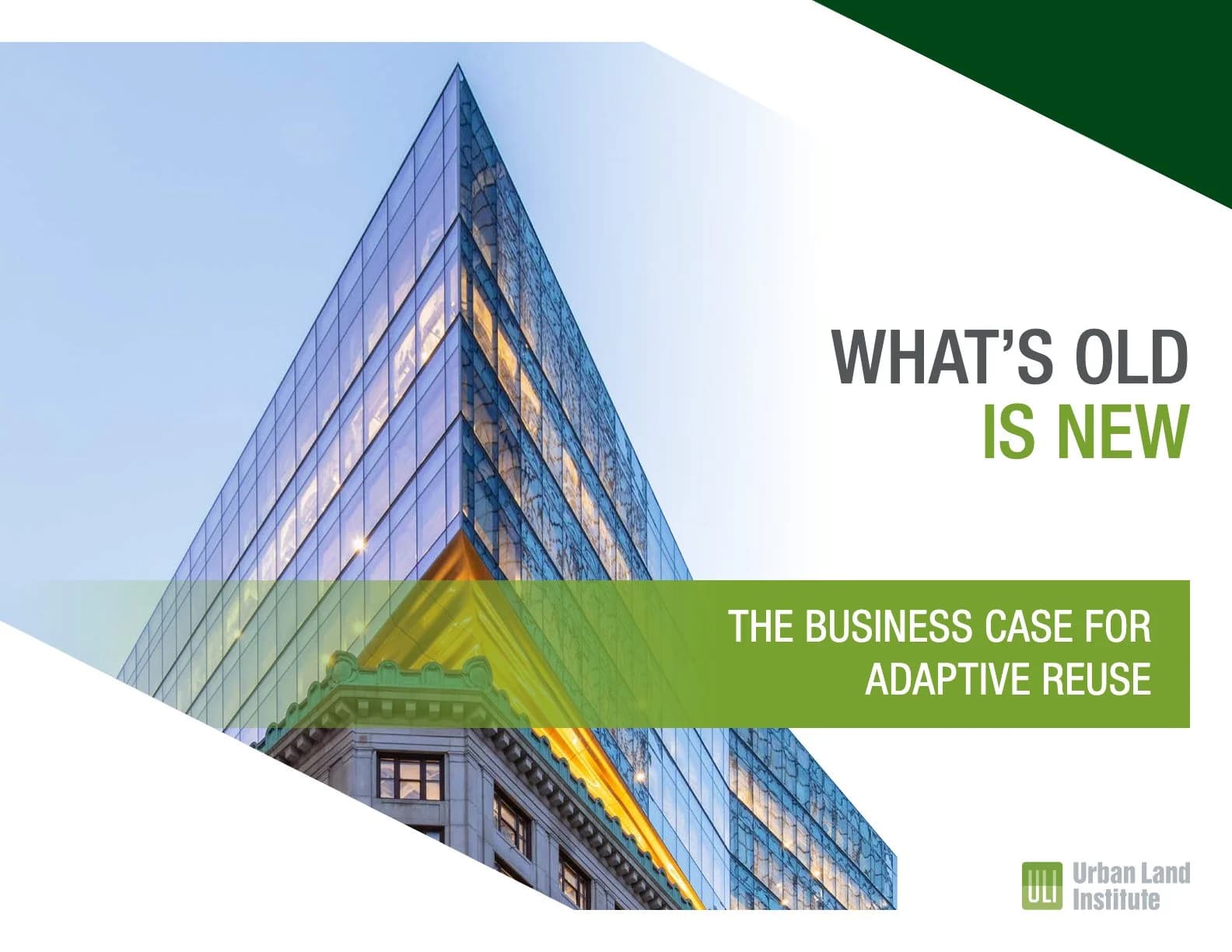
Adapted a historic commercial block into mixed office and retail space with a seven‑story glass addition. The project retained 77 % of the original structure, cut embodied carbon by 60 %, and achieved a 35 % whole‑life carbon reduction. Market value increased by 105 % from 2019 to 2024, and the development supports up to 1,100 permanent jobs.
Case Study 3: Oriente Green Campus (Lisbon, Portugal)
Transformed an abandoned shopping mall into a tech‑focused campus with university and corporate tenants. The reuse achieved a 58 % reduction in embodied carbon and a 70 % whole‑life carbon cut, powered by 100 % renewable energy. The project anticipates 2,500 + occupants, extensive green roofs, and significant local economic stimulation.
Enablers and Barriers Across Europe
Key enablers include historic tax credits, local government incentives, public‑private partnerships, and flexible zoning. Barriers identified are prevailing preference for new construction, regulatory complexities, financing uncertainties, and the need for specialized expertise to manage unknown building conditions.
Implications for Sustainable Housing in Europe
The report demonstrates that adaptive reuse can deliver measurable carbon reductions while generating economic growth and social benefits. For pan‑European audiences, the data suggest that policy frameworks supporting historic preservation, tax incentives, and streamlined permitting can accelerate the transition to low‑carbon, resilient housing stock. The case studies provide replicable models for converting underused commercial or industrial buildings into mixed‑use, energy‑efficient residential developments.
Authors and Contributors
The research was led by Lori Ferriss (AIA, PE, LEED AP BD+C) and Billie Faircloth (FAIA, LEED AP BD+C) of Built Buildings Lab, with contributions from ULI’s Randall Lewis Center for Sustainability in Real Estate, KPF, Arrowstreet, and a broad interdisciplinary team of architects, engineers, and sustainability specialists.