Resource context
This resource is a white paper published by Systemiq and commissioned by Ginkgo Advisor and Edmond de Rothschild Group. It presents Systemiq’s analysis of “urban regeneration” in Europe—transforming under-used land and obsolete buildings into compact, mixed-use neighbourhoods—positioning it as a response to Europe’s housing shortage alongside climate, nature and economic goals. The paper lists a Systemiq core team (Julia Okatz, Julie Hirigoyen, Amy Paterson, Lara Rabinowitz, Isha Patel, Elena Georgarakis) and a Ginkgo core team (Bruno Farber, Laura Nolier, Victor Granet), with additional contributors acknowledged.
Why regeneration is framed as a housing and land strategy
The paper links rising demand for urban housing and new types of flexible workspaces to continuing migration patterns and growth in city populations. It states that urban populations have increased by more than 9 million since 2010. At the same time, it highlights tightening constraints on greenfield development through the EU objective of “no net land take” by 2050, aimed at reducing Europe’s average consumption of virgin land (cited as 450 km² per year). This combination is used to justify a shift toward reusing existing space rather than expanding cities outward.
Scale of available “obsolete” space and market sizing
Systemiq estimates that a fraction of Europe’s under-used space could cover most projected demand for new buildings over the next 10–15 years while saving cities around 20% of projected infrastructure costs. The executive summary cites about 300 km² of empty office and retail space and 1,000–1,500 km² of brownfield land as a redevelopment opportunity set over the next 10–15 years. Based on this, the paper estimates a private-investment demand of roughly €4–6 trillion over 10–15 years, with mid-sized, neighbourhood-scale projects typically requiring €100–400 million each.
What “investable” urban regeneration looks like
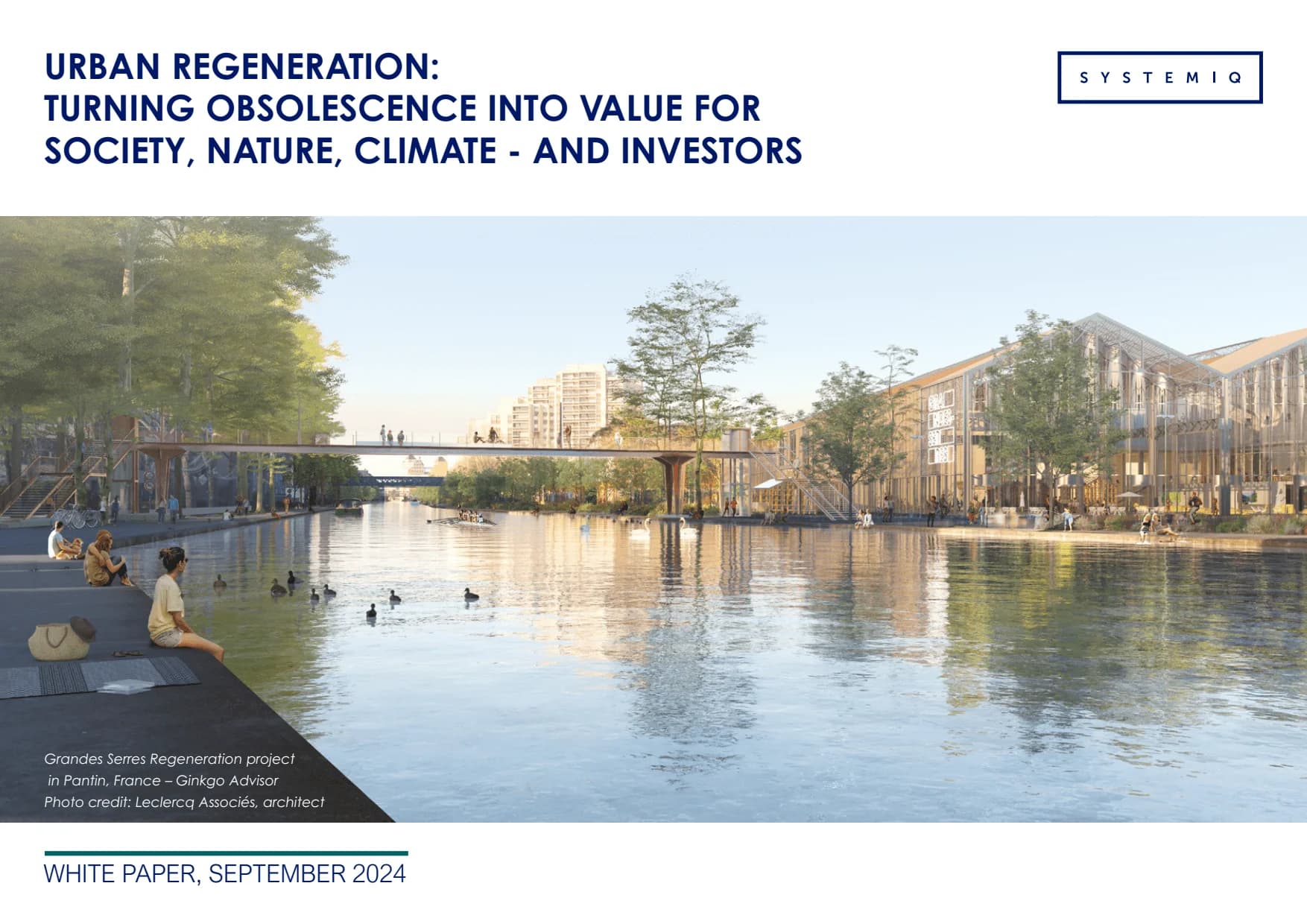
The paper describes four common characteristics of successful regeneration projects: (1) creating new value from obsolete spaces by turning abandoned or under-used areas into mixed-use, green neighbourhoods; (2) fostering city-level integration through urban diagnostics, stakeholder engagement and design that fits local economic needs; (3) shaping destinations through masterplanning and placemaking (public realm, community interaction, local business and culture, connectivity and green space); and (4) designing for resilience to reduce the risk of future vacancy and obsolescence (including adaptability to tighter regulations and climate extremes).
Returns and risk profile presented for investors
For investors with a 10–15-year horizon, the paper claims well-designed projects can generate mid-teens returns and around 2x cash multiples, supported by acquisition discounts on under-used (and sometimes contaminated) land, regulatory incentives, sales/rent premiums tied to placemaking, and lower vacancy risk from mixed-use “destinations.” It also argues that regeneration’s decarbonisation benefits reduce “transition risk” compared with conventional developments.
Environmental and citywide benefits quantified
Scaling regeneration is presented as a major lever for climate and nature outcomes, especially through compact living and avoided sprawl. The paper states that scaling urban regeneration could save about 45% of Europe’s yearly construction emissions, avoid 13,000 tonnes of particulate emissions per year (equated to pollution from 12 million cars), and enable an area of nature almost twice the size of Luxembourg to regrow or be saved over the next decade. It also highlights material savings (up to 50% construction-material savings in some contexts) and potential heating-emissions reductions (up to 70%) through efficient, low-carbon heating solutions.
Social outcomes and concerns the paper addresses
Urban regeneration is described as a contributor to high-quality homes in well-connected locations and as a way to improve quality of life through services, green space, safety and well-being. The paper acknowledges critiques around gentrification and cites research suggesting that regeneration designed for social diversity can increase housing prices by 1.3%–7% over five years while also benefiting existing residents via factors such as reduced commuting time (noted as 13% lower in more integrated communities), improved access to credit and higher employment opportunities. It also notes potential downsides such as pressure on local infrastructure (schools, hospitals) and increased traffic and noise, arguing for early coordination with city authorities.
Roles for cities, funds and “taskforces”
A recurring theme is that cooperation between cities, developers and investors is essential because cities control zoning, planning procedures, infrastructure and often land disposition. The paper proposes time-bound collaborative taskforces of limited partners, fund managers and developers to (a) define sub-classes of regeneration projects, (b) develop due-diligence frameworks and financial vehicles, and (c) improve methods to quantify placemaking returns over time to support better capital allocation and faster scaling.