Overview of the Special Issue
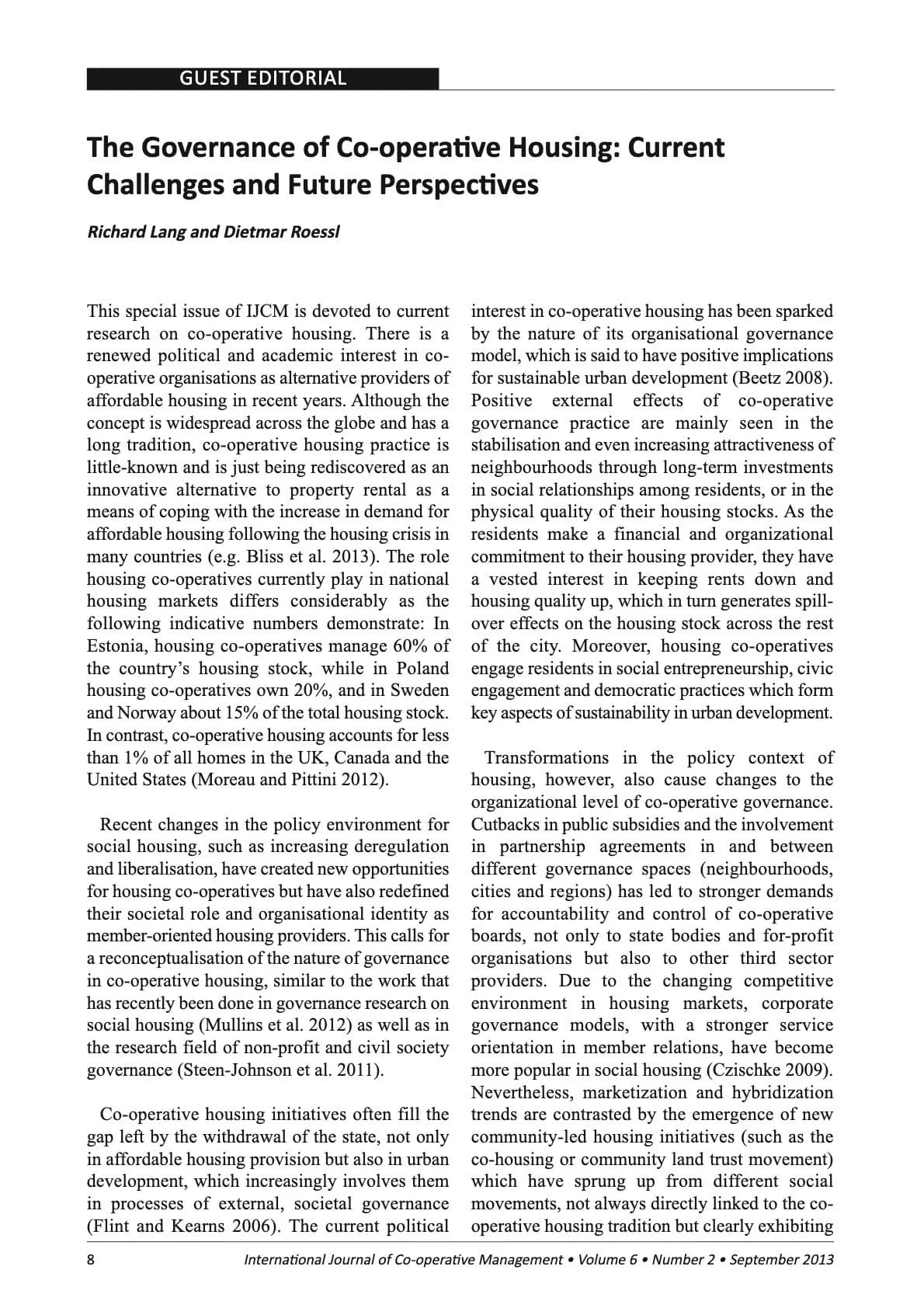
The International Journal of Co‑operative Management released a special issue dedicated to co‑operative housing, edited by scholars Richard Lang and Dietmar Roessl. The issue compiles peer‑reviewed research that examines governance challenges and future prospects for co‑operative housing across diverse regions, highlighting both internal organisational structures and external institutional influences.
Geographic Reach and Data Highlights
Contributions span five continents, with empirical evidence from Europe (Estonia, Poland, Sweden, the Netherlands, Germany, Italy, United Kingdom), North America (United States, Canada), and Africa (Nigeria). Notable statistics include co‑operative ownership of 60 % of housing stock in Estonia, 20 % in Poland, and about 15 % in Sweden and Norway, contrasted with less than 1 % in the UK, Canada and the US. These figures illustrate the uneven penetration of co‑operative models across national housing markets.
Sustainable Development and Community Benefits
The editorial underscores the link between co‑operative governance and sustainable urban development. Residents’ financial and organisational commitments foster long‑term rent stability, quality maintenance, and social capital, contributing to neighbourhood attractiveness and climate‑protective actions. Studies from Germany demonstrate that low‑threshold participatory methods can motivate residents to adopt climate‑friendly habits, reinforcing sustainability goals.
Policy Context and Governance Shifts
Recent deregulation and liberalisation of social housing policies have opened new opportunities for co‑operatives while simultaneously imposing greater accountability demands. In the Netherlands, market‑driven reforms challenge traditional social housing governance, prompting calls for democratic member control. Similar pressures are observed in the United States, where limited‑equity co‑operatives and mutual housing associations are examined as viable models for preserving affordable multifamily housing.
Academic Contributions and Theoretical Insights
Key papers introduce novel theoretical frameworks: Mändle applies game theory to externalities, suggesting enhanced public information to improve co‑operative reputations; Minora, Mullins and Jones develop a “habitability” model rooted in Ostrom’s commons theory to analyse self‑organising community initiatives in England and Italy. These works expand the academic discourse beyond organisational analysis to encompass institutional and societal dimensions.
Emerging Models and Innovation
The issue highlights new community‑led housing forms, such as co‑housing and community land trusts, which integrate co‑operative principles despite differing origins. Research from Nigeria reveals that capital base and membership size only partially explain loan beneficiary numbers, indicating the importance of income levels and repayment capacity. In the United States, feasibility studies of converting subsidised rental units to resident‑controlled models show promising financial sustainability.
Challenges and Resource Constraints
Across case studies, co‑operatives face persistent challenges: limited access to capital, dependency on public subsidies, and regulatory hurdles that can compromise autonomy. The Austrian example of Vienna illustrates successful public‑promotion programmes aligned with sustainability, yet such supportive environments remain rare.
Recommendations for Future Practice
Authors advocate for the establishment of national and regional networks to bolster resident‑controlled housing, increased transparency of co‑operative performance, and policy frameworks that balance market efficiency with co‑operative autonomy. Emphasising interdisciplinary collaboration, the issue calls for continued research that integrates organisational, institutional, and community perspectives to advance sustainable co‑operative housing across Europe.