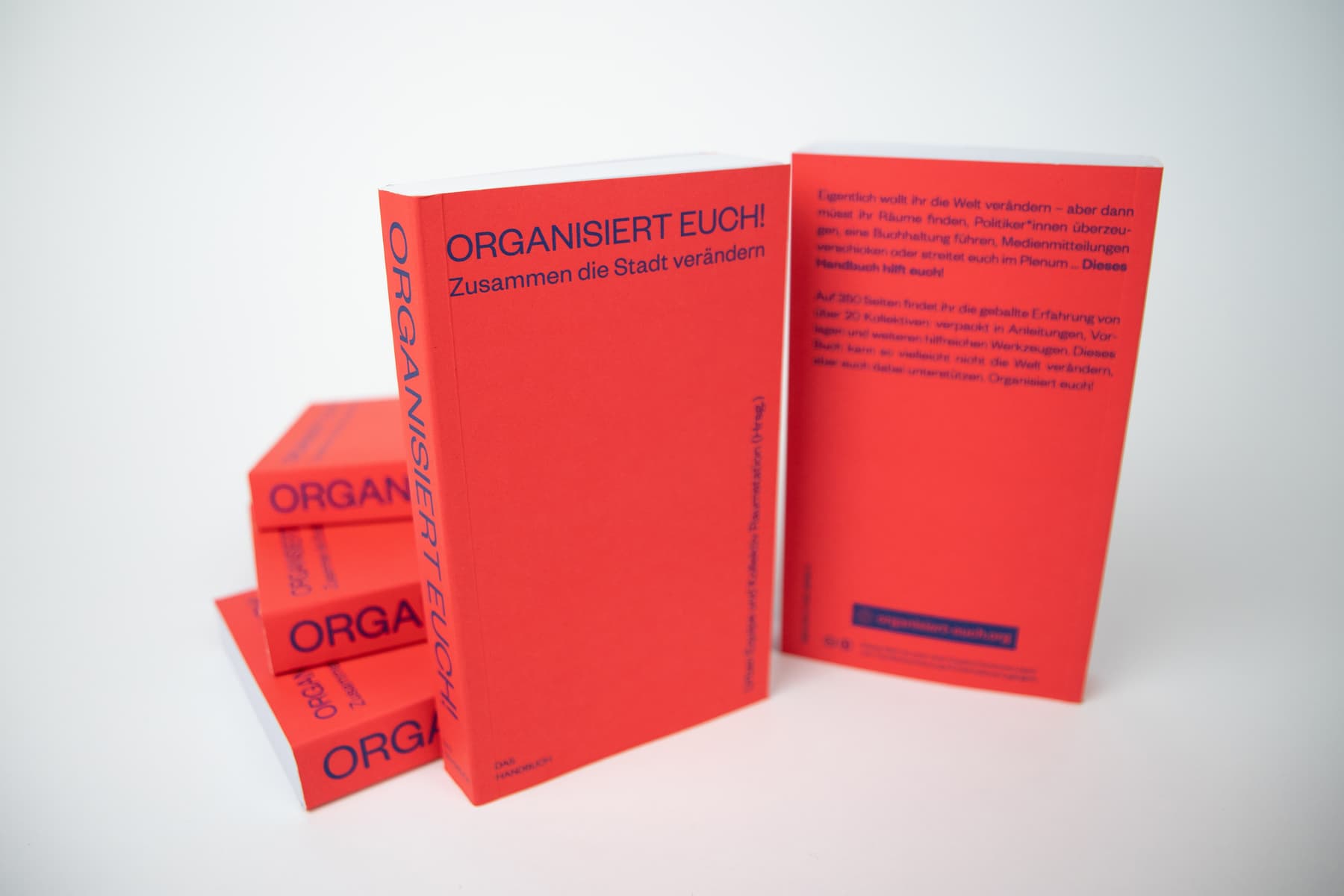
Context, publisher and contributors
“Organisiert Euch! Zusammen die Stadt verändern” is a practical organising handbook created for people who want to shape their neighbourhoods and cities through collective action. It is published by Urban Equipe together with Kollektiv Raumstation, and it draws on contributions from more than 30 people from over 20 collectives, groups and networks across cities in Switzerland, Germany and Austria.
What the handbook is for
The book positions itself as “not another handbook on how to design or activate the city”, but as a guide to how collectives organise themselves so they can keep acting over time. It starts from common challenges described by contributors: enthusiasm that later turns into overload, burnout, recurring conflicts, uneven speaking time, unfair task distribution, the need to manage budgets, find spaces, deal with media, and communicate with institutions.
Why collective organising matters
A core message is that lasting urban change is rarely achieved alone. The handbook argues that collectives can be stronger, more diverse in perspectives and more resilient, but only if they deliberately build ways of working together. It emphasises that “no structure” is still a structure—often an informal one that can exclude newcomers and concentrate power without being discussed.
Tools for internal organisation
Across its chapters, the handbook offers practical methods for day-to-day collective work, including: clarifying shared purpose and a “shared self-understanding”; preparing and structuring meetings; assigning roles (such as facilitation, note-taking, timekeeping and awareness); collecting and prioritising agenda items; and documenting decisions so absent or new members can follow. It also highlights inclusion and accessibility, encouraging groups to reflect on who can realistically participate given time, language, care responsibilities and other constraints.
Democracy, institutions and power
The handbook acknowledges that contributors do not all agree on how to relate to existing democratic institutions—whether to respect, challenge or ignore them—because this depends on political context, scale and the issue at stake. At the same time, it stresses that democratic institutions and the rule of law are important achievements that should not be abandoned; instead, they should be continually “democratised” and defended against anti-democratic attacks.
Hierarchies and sustainability
A dedicated focus section discusses how informal hierarchies emerge through experience, contacts, time and reliability. The handbook recommends making power dynamics speakable, distributing responsibilities, rotating tasks where possible, and transferring knowledge so individuals do not become indispensable. These practices are presented as essential for sustaining collective efforts, preventing burnout and keeping initiatives open to new participants.
How it is structured and used
The content is organised into thematic sections covering “coming together” (shared vision, meetings, accessibility, structure, roles, decision-making, documentation and communication) as well as practical topics like finding and sharing space, budgeting, fundraising and administration. The handbook is also made available online via organisiert-euch.org, with additional examples and tools referenced through numbered links.
Overall message
“Organisiert Euch!” aims to be a usable, adaptable resource rather than a fixed recipe. It encourages groups to experiment, learn, iterate, and keep acting together—because, as the book argues, collective change begins with the first shared step.