Overview of the NETCO Report
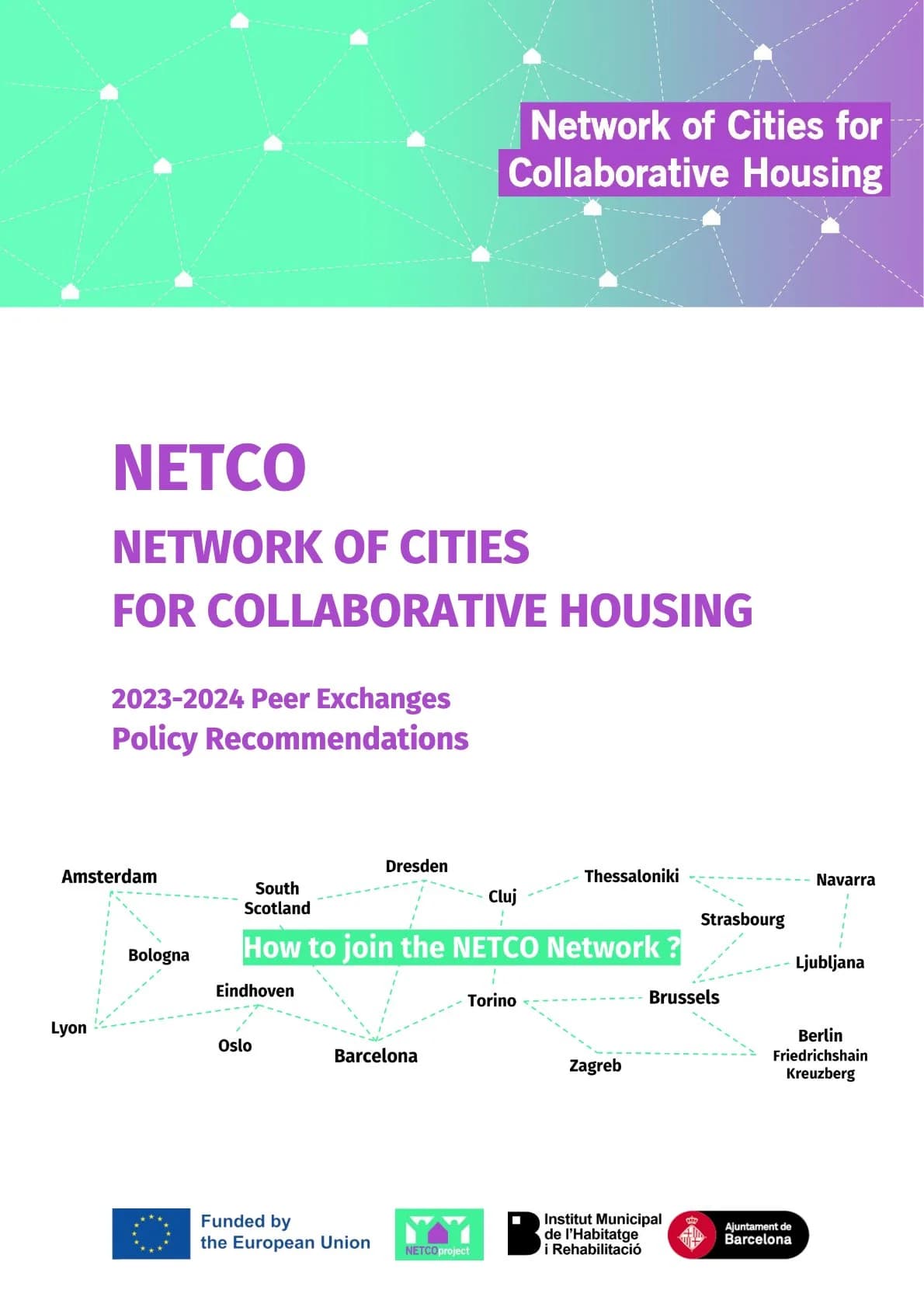
The document “NETCO Network of Cities for Collaborative Housing – 2023‑2024 Peer Exchanges Policy Recommendations” presents the findings and policy suggestions of the European Network of Cities for Collaborative Housing (NETCO). Authored by Pierre Arnold and Michael LaFond and published by the Network of Cities for Collaborative Housing in April 2024, it compiles insights from 17 partner cities across Europe. The report draws on field visits, surveys, and peer‑exchange meetings conducted between November 2022 and April 2024, and it is publicly available through the NETCO website and research‑gate profile of Pierre Arnold.
Network Structure and Membership
NETCO brings together municipal public servants, practitioners, and civil‑society organisations from cities such as Amsterdam, Barcelona, Bologna, Brussels, Cluj‑Napoca, Dresden, Eindhoven, Ljubljana, Lyon, Navarra, Oslo, Strasbourg, Thessaloniki, and Zagreb. The network is coordinated by policy consultants from Barcelona City Council and the Region of Navarra. Membership is free of charge, but leading members contribute financially or in‑kind, while associate members participate without a leading role.
Key Findings on Collaborative Housing
A survey of the 17 cities identified four factors that most significantly affect the development of collaborative housing: national or regional legal frameworks, funding schemes, political will of local decision‑makers, and mobilisation of civil society. Private bank financing was also highlighted as a critical element; lack of loan products for collective projects can stall initiatives. Respondents indicated that responsibility for enabling change spans municipal, regional, national, and EU levels, with legal frameworks primarily at the national level and funding often needed from national and EU sources.
Data on Current Projects
The report lists several flagship projects illustrating diverse models:
- Porto 15 (Bologna) – 18 units, public‑owned rental, rents €290‑€390, target income under €40,000.
- Salus Space (Bologna) – 20 units, municipal ownership, eco‑friendly wood construction, includes migrant and refugee housing.
- La Borda (Barcelona) – 28 units, grant‑to‑use cooperative on public land, 75‑year lease, 18 % resident equity, 52 % funded by equity loans, rest by public grants.
- CALICO (Brussels) – 34 units, CLT‑leased land, includes Housing First and feminist cohousing units. These examples demonstrate common features such as shared common spaces, resident organisations, long‑term land leases, and mixed funding sources (public subsidies, equity loans, crowdfunding).
Policy Recommendations for Cities
NETCO proposes twelve actionable recommendations, including:
- Adopt long‑term visions for community‑led living.
- Advocate for removal of legal and administrative barriers.
- Set quantitative targets (e.g., 100 collaborative homes per year).
- Provide training for municipal staff and practitioners.
- Finance “process facilitators” who mediate between residents and developers.
- Offer renewable long‑term public‑land leases instead of sales.
- Encourage collaboration among multiple developers on each land parcel.
- Facilitate access to municipal loan guarantees for cooperatives.
- Support shared‑space funding through mixed public‑private mechanisms.
- Pilot innovative financing and construction methods.
- Create a European revolving fund for low‑interest loans.
- Fund research, advocacy, and trans‑national knowledge exchange.
European‑Level Actions
At the EU scale, NETCO calls for:
- Harmonised guidelines for affordable‑housing legislation.
- Dedicated European calls to showcase collaborative‑housing pilots.
- Co‑funding schemes that combine EU loans with national or local financing.
- A revolving funding facility to recycle repayments into new projects.
- Support for research that links banking, impact‑investment, and insurance sectors to collaborative housing.
Access and Further Resources
The full set of recommendations, case‑study details, and contact information (netcoprojectcontact@gmail.com) are available through the NETCO website and the linked research‑gate profile. Additional bibliographic resources on collaborative housing concepts, European policy frameworks, and sustainability innovations are listed in the annex, providing a comprehensive knowledge base for policymakers, practitioners, and researchers interested in scaling sustainable, inclusive housing across Europe.