Resource context
CORRECTIV, an investigative journalism publisher, presents an article by Marius Münstermann examining the scale and consequences of building demolition and replacement construction across Europe, and the lack of harmonised EU-level data on demolitions.
Demolition as a hidden driver of crises
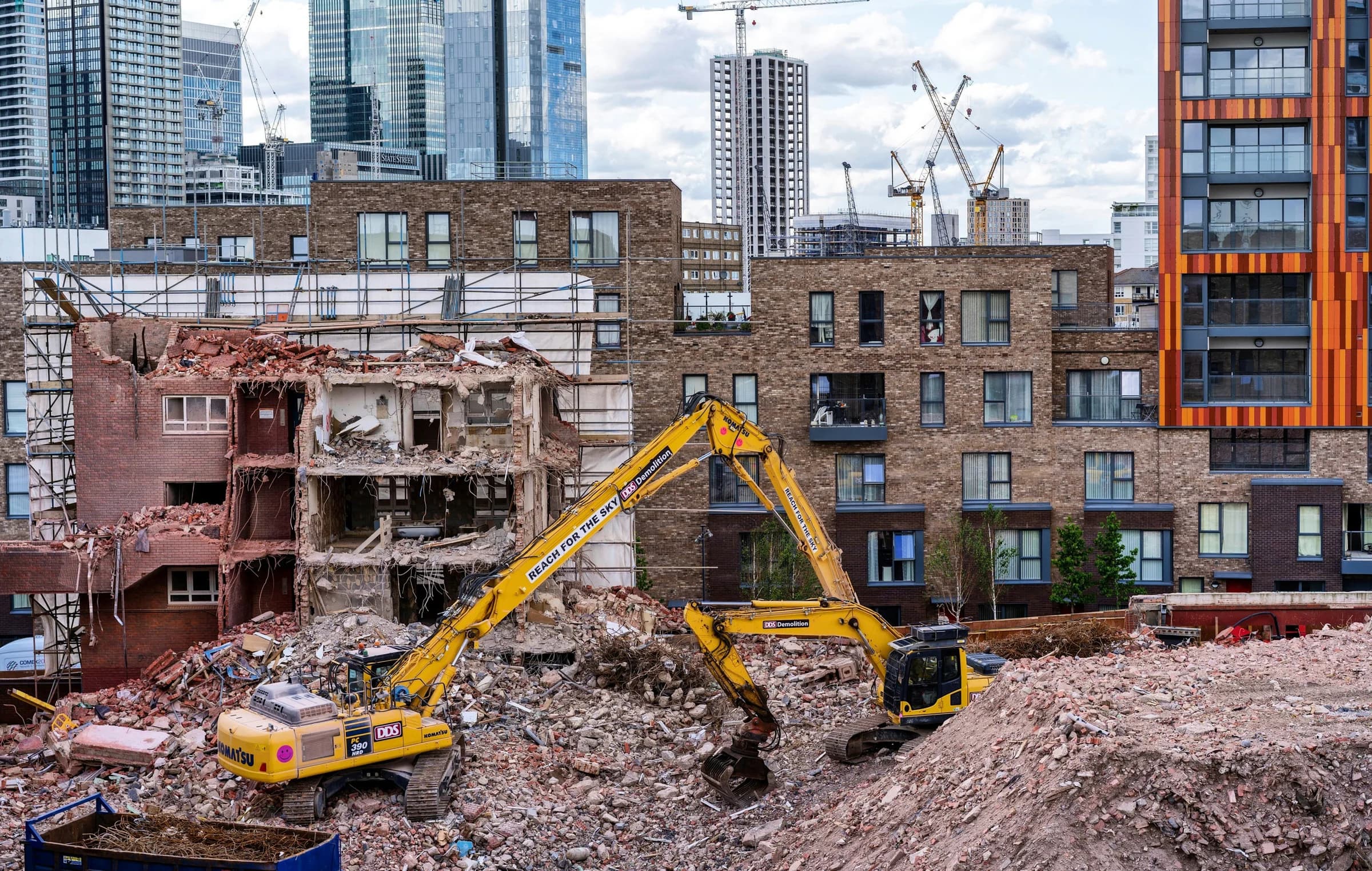
The article argues that demolition and rebuilding are widely overlooked in policy debates despite significant environmental and social impacts. According to CORRECTIV’s reporting, the European Commission stated that there are no official EU-level figures on how many buildings are demolished. Green MEP Ciarán Cuffe is quoted warning that demolition and new-build activity intensify both the climate crisis and Europe’s housing crisis, and that many buildings could provide homes if renovated instead of torn down. The piece links demolition to displacement risks for lower-income households and to rising rent and heating costs when existing affordable housing is removed and replaced.
Climate and resource impacts of construction
The article situates demolition within the broader footprint of the building sector. It cites the European Commission’s assessment that buildings are the EU’s largest energy consumer, responsible for about 40% of total energy use and 36% of greenhouse-gas emissions, driven by construction, operation, renovation, and demolition. It also highlights the emissions embodied in materials such as steel and concrete. For Germany specifically, the German Environmental Aid (Deutsche Umwelthilfe, DUH) is cited estimating around 3.3 million tonnes of CO2 per year from demolition and new construction; DUH’s rule of thumb is that keeping and energetically refurbishing existing buildings is almost always ecologically preferable to demolishing them for a more efficient new-build. DUH is also cited suggesting refurbishments could cut emissions by around one third compared with demolition-and-rebuild approaches.
Renovation rates vs. EU targets
The article describes the EU’s “Renovation Wave” ambition to renovate 35 million buildings by 2030 as part of the Green Deal, but emphasises that current renovation performance is far below what is needed. It cites the European Commission’s view that the annual energy renovation rate is still about 1%, with estimates across member states ranging roughly from 0.4% to 1.2%. To modernise the remaining non-efficient stock by mid-century, the article notes that the renovation rate would need to roughly triple to about 3%, echoing calls from the Efficient Buildings Europe industry group. A 2022 study referenced in the article estimates that every €1 million invested in improving energy efficiency could create about 19 mostly local construction jobs, framing renovation as both a climate and employment strategy.
Tracking demolitions: Demolition Atlas Europe
To address missing data, CORRECTIV launched the “Demolition Atlas Europe,” collecting reports of demolished and planned demolitions with public participation, first in Germany and Switzerland and then with partner media across Europe. For Germany, the article cites official statistics of 12,600 demolished buildings in 2022, associated with the loss of 16,500 dwellings, while also stressing that many demolitions do not require permits and therefore the true number is likely higher. The article presents better, localised demolition data as a prerequisite for understanding impacts on housing supply, climate goals, and biodiversity and for shifting policy away from demolition toward renovation and adaptive reuse.
Policy proposals to make renovation the default
The article highlights the HouseEurope! initiative and three demands aimed at reducing demolition and scaling refurbishment: tax reductions for renovation materials and labour; redirecting subsidies from new construction to renovation; and putting a price on “grey energy” (embodied energy and emissions) that is lost when buildings are demolished. It also points to calls for common standards to evaluate existing buildings as assets rather than “ruins,” and to financing barriers where renovation loans can be costlier than new-build financing. The piece notes that some European countries are already introducing life-cycle assessment requirements for buildings, and that updated EU buildings-energy rules foresee mandatory accounting of construction-material emissions for new buildings from 2028, with member states encouraged to also capture embodied impacts in the existing stock.