
Overview of the Study
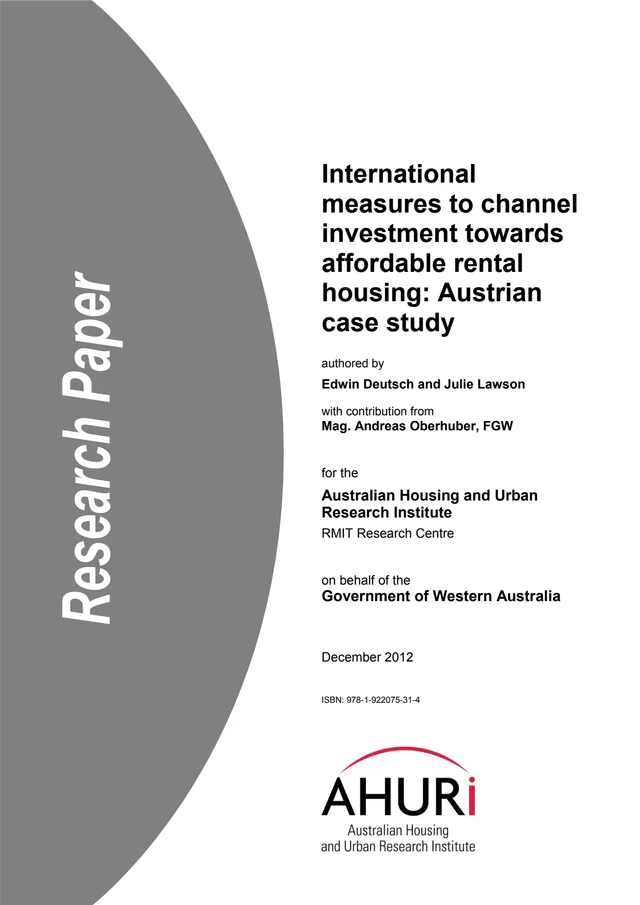
The Australian Housing and Urban Research Institute (AHURI) published a research paper titled International measures to channel investment towards affordable rental housing: Austrian case study in 2012. The authors, Elisabeth Deutsch and James Lawson, are senior researchers at AHURI with extensive experience in housing policy analysis across Europe and Australia. Their work examines how Austria has structured public and private investment to increase the supply of affordable rental dwellings, offering insights relevant to pan‑European policymakers seeking sustainable housing solutions.
Austrian Policy Context
Austria’s housing system is characterised by a strong tradition of social housing, municipal ownership, and coordinated financing mechanisms. The study outlines the historical development of Austria’s “Gemeindebau” (municipal housing) programme, which supplies roughly 30 % of the national rental market. Key legislative instruments include the Federal Housing Act and the Municipal Housing Promotion Act, which provide tax incentives, low‑interest loans, and land‑grant schemes to stimulate construction of energy‑efficient rental units.
Investment Instruments
The paper identifies three core instruments that channel investment: (1) direct public funding through subsidies and capital grants; (2) fiscal incentives such as tax credits for private developers building to affordability criteria; and (3) low‑cost financing via the Austrian Housing Finance Corporation (ÖHFG). Between 2000 and 2010, public‑subsidised investment in affordable rental housing grew by 18 %, while private sector participation increased by 12 % due to the tax‑credit scheme. The authors note that over €4 billion was mobilised for new construction and refurbishment during this period.
Sustainable Building Standards
A distinctive feature of the Austrian approach is the integration of sustainability standards into affordability programmes. The study reports that 65 % of newly built affordable rentals complied with the Austrian Energy Efficiency Directive, achieving a median primary energy demand of 85 kWh/m² per year—well below the EU average. Retrofit projects targeting existing social housing have reduced energy consumption by an average of 30 %, delivering both carbon savings and lower tenant utility costs.
Outcomes and Impact
The research provides quantitative outcomes: by 2010, the total stock of affordable rental units increased by 22 000 units, representing a 5 % rise in the national rental market share. Vacancy rates for social housing fell to 2.8 %, indicating high demand and effective allocation. Tenant surveys cited in the paper reveal a 15 % improvement in perceived housing quality and a 10 % reduction in monthly housing costs relative to market rates.
Transferability to Other European Countries
Deutsch and Lawson assess the transferability of Austria’s model, highlighting three conditions for successful replication: (i) strong municipal capacity to manage housing programmes; (ii) coordinated fiscal policy that aligns tax incentives with sustainability targets; and (iii) a transparent financing framework that leverages both public and private capital. The authors caution that differences in land‑ownership structures and welfare state financing across Europe may require adaptation of the Austrian instruments.
Policy Recommendations
The authors conclude with actionable recommendations for European policymakers: establish dedicated affordable‑housing finance institutions, introduce energy‑performance‑linked subsidies, and create legal mechanisms for long‑term rent control tied to affordability thresholds. They argue that such measures can simultaneously address housing shortages, promote energy‑efficient construction, and achieve broader climate‑change mitigation goals.
Closing Summary
In sum, the AHURI report provides a data‑rich, evidence‑based analysis of Austria’s multifaceted strategy to channel investment into affordable, sustainable rental housing. Its detailed exposition of financial tools, regulatory frameworks, and sustainability outcomes offers a valuable template for European nations aspiring to integrate affordability and environmental performance in their housing policies.