Overview of Study and Contributors
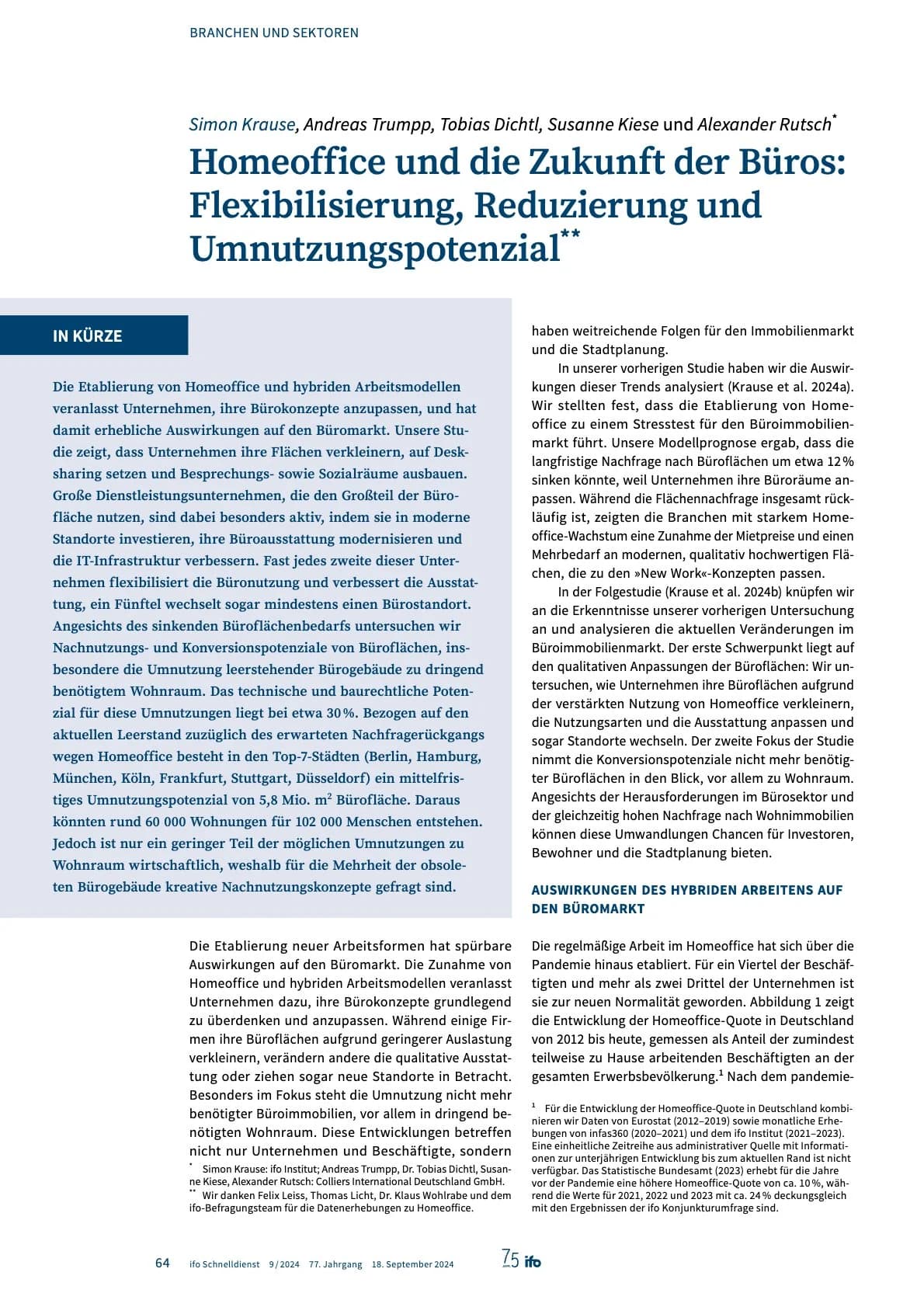
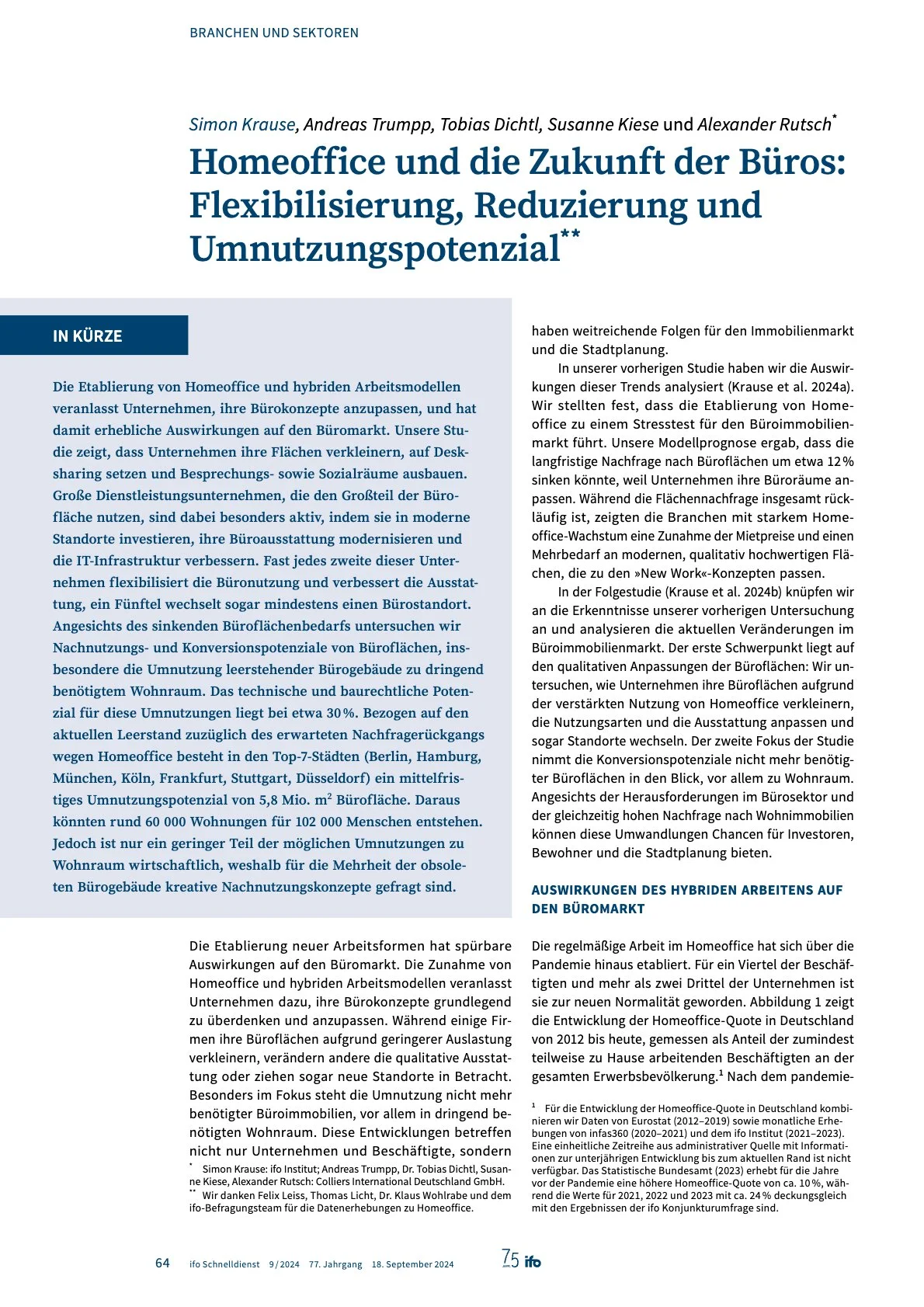
The study “Homeoffice and the Future of Offices: Flexibilisation, Reduction and Conversion Potential” is produced by the ifo Institute’s Schnelldienst series. Authors Simon Krause, Andreas Trumpp, Tobias Dichtl, Susanne Kiese and Alexander Rutsch combine expertise from the ifo Institute and Colliers International Germany, bringing together academic research and market‑analysis experience to assess how remote‑working trends reshape office real estate across Europe.
Impact of Home‑Office on Office Demand
Home‑office and hybrid work models have become entrenched beyond the pandemic. Approximately one‑quarter of the German workforce now works remotely, with the ifo‑survey indicating a stable home‑office share of around 23–25 % in 2024. Companies are responding by shrinking office footprints; the study forecasts a long‑term decline of about 12 % in overall office space demand. In the seven largest German cities, this translates to a reduction of roughly 11.5 million m² of office area, though the effect materialises gradually due to existing lease structures.
Conversion Potential of Vacant Offices
The analysis highlights a significant conversion opportunity. In the top‑seven German metropolitan areas, an estimated 5.8 million m² of office space could be repurposed in the medium term. Assuming a 30 % technical feasibility rate, about 1.7 million m² are suitable for residential conversion, potentially creating up to 60 200 new apartments and housing roughly 102 000 people. However, only a small fraction is economically viable, given high renovation costs and the need for adequate market rents.
Economic Assumptions and Investment Outlook
A detailed scenario evaluates a typical office building with 50 % occupancy at €11/m² and 50 % structural vacancy. After accounting for a 20 % area loss during conversion, the target residential rent is €17/m² (effective €13.60/m²). The study calculates a conversion cost of about €2 400 per m², placing many projects at the lower end of profitability. Investors therefore must weigh rent uplift against capital expenditure and financing conditions.
Broader Urban Implications
Beyond residential use, the report identifies alternative conversion pathways such as life‑science facilities (3–4 % of office stock), educational institutions, mixed‑use developments, and social services. Partial repurposing—e.g., ground‑floor retail, cafés, or co‑working spaces—can enhance building vitality while preserving structural integrity. The authors stress that creative, multi‑functional concepts are essential for the majority of obsolete office assets.
Market Trends and Future Outlook
Office vacancy rates in the seven cities have risen from about 3 % in 2019 to 6.7 % presently, with projections of up to 8 % in the coming years. Simultaneously, demand for sustainable housing continues to grow across Europe, making the conversion of underused office buildings a strategic lever for meeting climate‑friendly urban development goals. The study concludes that while the office market will not disappear, its evolution will hinge on flexible space design, intensified desk‑sharing, and targeted conversion strategies that align with broader sustainability objectives.