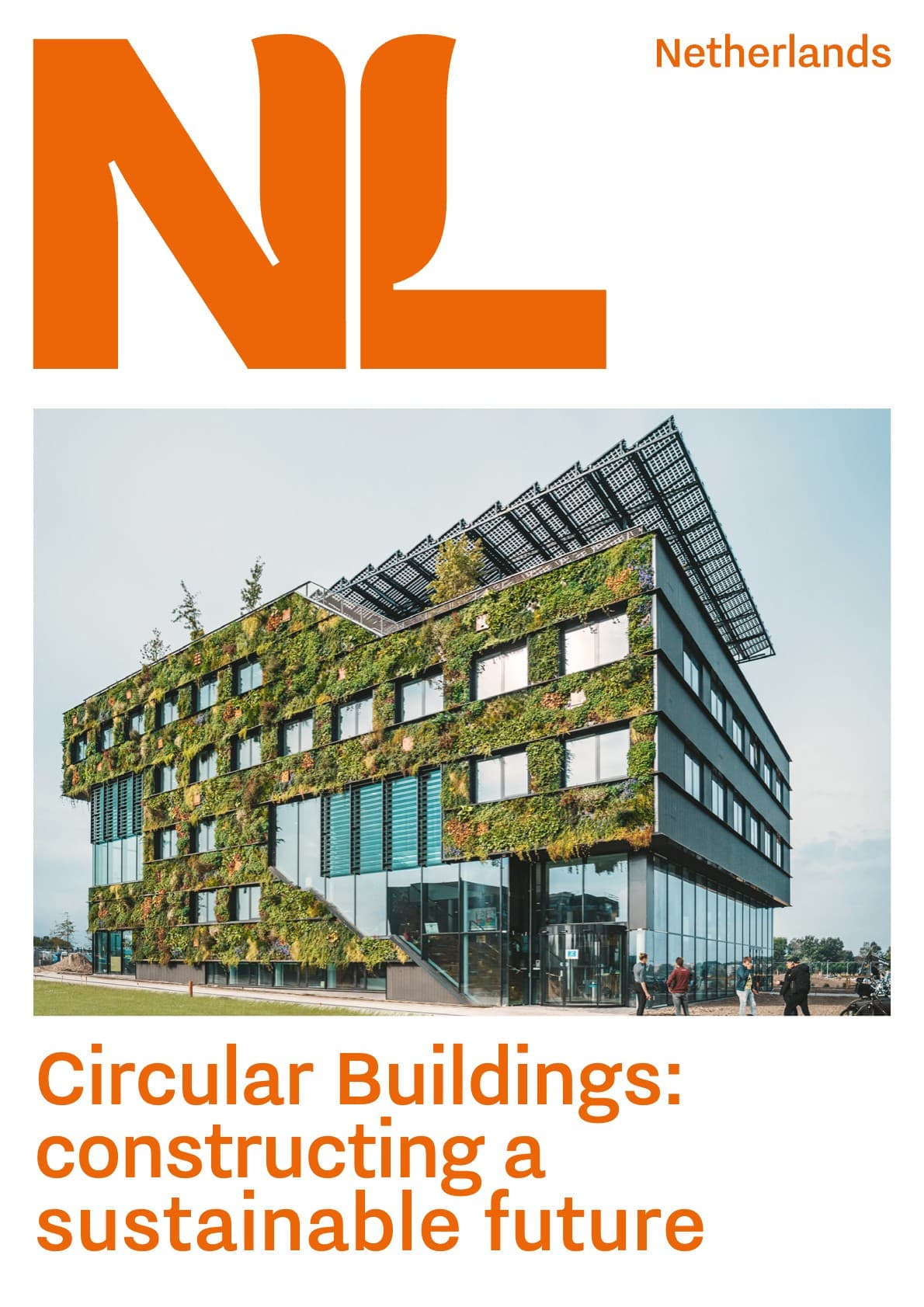
Resource context (publisher and authors)
Circular Buildings: constructing a sustainable future is a publication from Holland Circular Hotspot, produced with the Transition Team Circular Construction Economy and Arcadis, with contributions involving various ministries in the Netherlands. The resource positions itself within a broader series by Holland Circular Hotspot that explores circular economy challenges and opportunities across multiple sectors, including infrastructure, plastics, manufacturing, and textiles/apparel, and it brings that lens specifically to the building sector.
Purpose and relevance to the building sector
The document focuses on how circular economy concepts can help address challenges in construction and the wider building ecosystem, with the aim of supporting a transition toward a more sustainable and future‑proof industry. It frames construction as a key sector for circularity because decisions about materials, design, procurement, and end‑of‑life practices influence both resource use and the long-term environmental footprint of buildings.
What the publication contains
At the core of the resource are 25 “good practices” drawn from the construction value chain. These examples are presented as practical illustrations of circular approaches that can be applied across different stages of building development and delivery. Alongside these practices, the publication provides a framework intended to support an international shift toward circular construction.
Framework for an international shift to circular construction
The proposed framework highlights several building blocks needed for broader adoption and coordination: policies that enable and incentivise circular outcomes; measurement standards that allow actors to define, track, and compare circular performance; collaboration initiatives that connect stakeholders across the value chain; and knowledge exchange mechanisms to share learning and accelerate replication of effective approaches. The emphasis is on combining practical implementation examples with enabling conditions so that circular methods can scale.
Collaboration and knowledge exchange
A recurring message is that progress depends on cooperation between public institutions and private-sector actors, supported by shared standards and accessible knowledge. By linking good-practice cases with themes such as policy, measurement, collaboration, and knowledge sharing, the publication underlines the need for coordinated action to move from isolated pilots toward sector-wide change.
Key takeaway for a pan-European audience
For audiences interested in sustainable housing across Europe, the resource serves as a structured overview of how circular economy principles can be operationalised in construction: it pairs concrete examples (25 practices) with a roadmap of enabling elements (policy, standards, collaboration initiatives, and knowledge exchange). In doing so, it presents circular construction as both a practical agenda and an organisational challenge requiring shared metrics and cross-border learning.