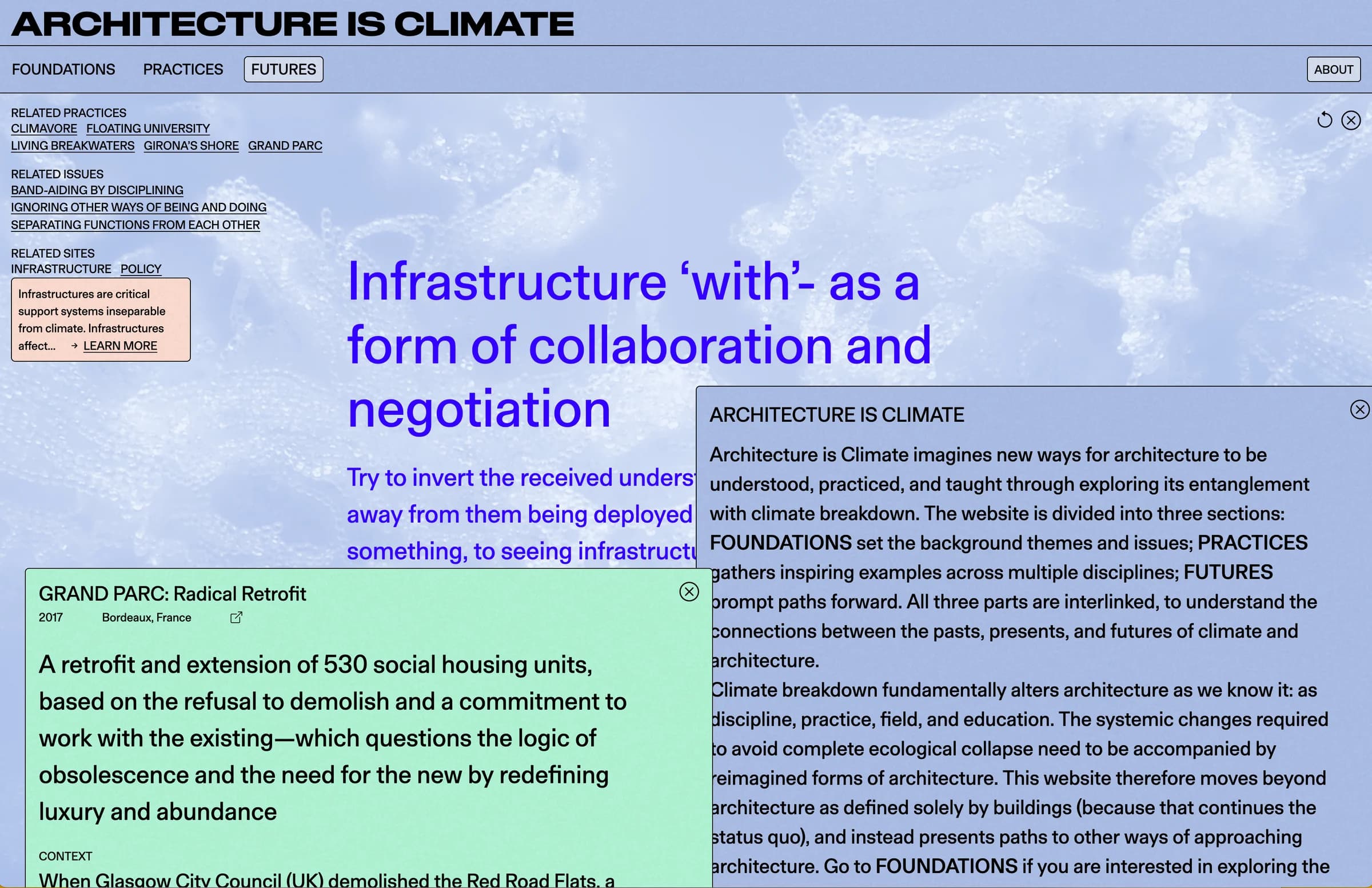
Introducing Architecture is Climate
Architecture is Climate is a research‑driven website that explores how spatial practice can respond to the climate emergency. It emerged from the grant “Architecture after Architecture: Spatial Practice in the Face of the Climate Emergency,” funded by the German Research Foundation (DFG) and the UK Arts and Humanities Research Council (AHRC). The site is curated by the interdisciplinary research collective MOULD, whose core members include Sarah Bovelett, Anthony Powis, Tatjana Schneider, Christina Serifi, Jeremy Till and Becca Voelcker. Their work is supported by institutions such as Technische Universität Braunschweig and Central Saint Martins (UAL).
Scope of the “Practices” Section
The “Practices” section gathers over a hundred examples of projects, policies, organisations, typologies, philosophies and economies that directly address climate breakdown. Each entry is described with its local context, the challenges it faces, and the concrete actions taken. The entries are tagged by site and issue, allowing users to filter examples that match their interests. This structure aims to broaden architectural thinking beyond technocratic and solutionist approaches, highlighting collaborative governance, ethical processes and innovative forms of organisation.
Key Data and Facts
- The database includes contributions from a wide network of scholars, designers and activists across Europe and beyond.
- Contributors such as Friederike Wolf (design) and Alfonso Sánchez Uzábal (coding) have shaped the digital platform.
- The site lists more than 30 core team members and over 40 advisory and critical‑friend participants, illustrating a pan‑European collaborative effort.
- The resource explicitly links practice entries to external resources and further reading, supporting deeper research for sustainable housing initiatives.
Relevance for Sustainable Housing
For a pan‑European audience interested in sustainable housing, the platform offers concrete case studies that demonstrate how housing projects can integrate climate‑responsive strategies. Examples cover passive design, material circularity, community‑driven retrofits and policy frameworks that incentivise low‑carbon construction. The site’s tagging system enables housing professionals to locate practices that address specific issues such as energy efficiency, resilient design, or social equity.
Collaboration and Community Input
MOULD acknowledges the contributions of numerous collaborators, including researchers, designers, coders and copyeditors. Advisory group members span institutions from Saveetha College of Architecture & Design (Chennai) to Barnard College (New York) and Atelier Bow‑Wow (Tokyo), underscoring a global perspective. The platform invites public comments, suggestions for new practices and corrections via email, fostering an open‑source ethos that aligns with sustainable, participatory housing development.
Access and Further Resources
All practice entries provide links to original projects, publications and multimedia resources, allowing users to explore detailed methodologies and outcomes. The website also hosts “Foundations” and “Futures” sections that contextualise current practices within broader theoretical and speculative frameworks, offering a comprehensive knowledge base for architects, planners and policymakers seeking climate‑responsive housing solutions.