The city that stayed the landlord
Vienna is a city of coffee houses, concert halls and a cemetery with more residents than most Austrian towns. It is also the rare European capital where, for over a century, the city rather than the market has been the main supplier of homes. That choice from the 1920s still defines daily life: most Viennese rent, most renters pay a regulated or cost-based price, and the housing question here is less about how to start a public sector than how to keep a vast one fit for the future.
The tenure mix is unlike almost anywhere else. About 77% of households rent and only 20% own — the reverse of most of Europe. Of the dwellings, 20.5% are municipal flats owned by the city itself, some 220,000 homes that make Vienna one of the largest public landlords on the continent. A further 17.8% are cooperative, around 221,000 homes run by the limited-profit associations, with 20.7% of Viennese living in one. Some 38.7% of dwellings are let on the private market, and a small residual of roughly 3% sits outside the standard categories.
- Owners
- Owner-occupier20.0%
- Renters
- Public & non-profit rental20.5%
- Cooperative17.8%
- Private rental38.7%
- Unclassified3.0%
- Unknown / Other3.0%
Social housing here is a regulatory layer, not a slice of the pie. About 36.5% of Vienna's dwellings carry a social-housing rule, a larger figure than the municipal-tenure share because the rule sits across several tenures at once. It covers the city's own Gemeindebauten, but also the cost-based flats let by the Gemeinnützige Bauvereinigungen, the limited-profit housing associations governed by the Wohnungsgemeinnützigkeitsgesetz. Eligibility is deliberately broad: a comparative study of central-European social housing records that around 78% of Vienna's households qualify, so the sector houses the middle as well as the poor.
Translate that structure into rent and the regulated majority holds the middle down. A tenant in the municipal Gemeindebau pays around €5.10 per square metre and a member of the limited-profit associations about €6.10. Across the whole stock the median is €7.50; a newly-signed private contract asks a median €13.70, and only furnished, serviced lets break away at €21 gross. A fresh private lease runs close to three times the regulated floor — but because the regulated tracks still house most of the city, the all-stock median sits at barely more than half the new-let rate, and holding that median down is the whole point of the Viennese model.
- Public/municipal housing
- Cooperative
- All-stock median
- New contracts
- Furnished / serviced (gross)
Net-cold monthly rent per square metre by tier (furnished is gross, all-in). The municipal and limited-profit floor keeps the all-stock median strikingly low for a capital: a newly-let private contract now runs close to three times the municipal rate, yet because the regulated tracks house most of the city the median still sits at barely more than half the new-let figure.
Vacancy in Vienna is something the city manages, not something that haunts it. Residential vacancy runs at about 2.5%, and the city reckons only nearer 25,000 flats are genuinely empty and usable out of a wider count of some 104,700 unoccupied dwellings — much of the rest second homes and unmodernised stock. The office picture is just as tight: around 420,304 square metres stand vacant, about 3.6% of the stock. Holiday letting barely registers for a tourist capital, with an estimated 4,896 dwellings run as full-time entire-home lets, and since 2024 a Building Code amendment bans regular commercial short-letting in residential zones and caps it elsewhere at 90 days a year.
Growth is what keeps the pressure on. Each year Vienna absorbs a net 68,168 moves a year and clears around 8,000 housing permits a year trying to match it, and the gap lands on newcomers rather than on long-tenured insiders. A European Parliament mapping of EU housing need traces a sharp split: established moderate-income households keep their below-market rents, while younger, lower-income and migrant arrivals are pushed into a smaller, unregulated private stock and absorb the full force of market pricing. So Vienna's affordability problem is felt most by those who have not yet got into the protected system, even as the city ranks year after year among the most liveable on Earth.
Housing is a human right — that is a special concern for us as social democrats.The limited-profit machine behind the Gemeindebau
Vienna's cooperative sector runs on the Gemeinnützige Bauvereinigungen — limited-profit building associations bound by a Gemeinnützigkeit (public-benefit) statute that caps their returns and locks their assets into housing forever. Most let their flats as cost-based rentals; some sell on a long Baurecht (ground-lease) or a part-ownership model where a member pays a contribution to move in. The defining trait is the asset lock: once a flat is built under this rule, its rent tracks cost, not the market, and it cannot be cashed out. That is why the form has stayed affordable across generations where elsewhere it privatised away.
The tradition grew out of the same Rotes Wien moment as the Gemeindebau. After 1919 the city built municipal blocks directly; in parallel, cooperative and limited-profit builders took on a share of the workers' housing programme, and the two have run side by side ever since. The limited-profit housing law of the late 1970s gave the associations their modern cost-rent rules, and the developer competitions of the 1990s gave them a steady pipeline of subsidised land. A primer on Zurich's cooperatives notes how unusual it is that Vienna sustained this public-benefit form at scale when Germany abolished its own equivalent at reunification.
Today the sector clusters into three groups with overlapping but distinct problems. The large established associations — Sozialbau AG, the trade-union-rooted WBV-GPA and Wien-Süd among them — manage tens of thousands of cost-rent flats and are now absorbed in energy-retrofitting an ageing stock. A second cluster is the federation and regulator layer: the GBV, the national association of limited-profit builders, audits members and defends the cost-rent rules. A third, smaller cluster is the resident-led Baugruppe wave — self-organised groups who commission their own building, often documented by Eutropian and its Cooperative City Magazine. The big associations struggle with retrofit cost and land prices; the small Baugruppen struggle with finance and the patience that resident-led building demands.
What ties these builders to City Hall is that Vienna treats the limited-profit sector as a core delivery vehicle, not a private leftover. It channels subsidised land and Wohnbauförderung loans to the associations through the Bauträgerwettbewerb, and asks them to compete on quality and cost rather than price. That cost-rent, broad-eligibility design is exactly what a European Parliament review holds up as a route out of the affordability crisis, and it is the lever the city reaches for first.
Keeping a century-old promise solvent
Vienna's housing politics is the politics of maintaining an inheritance. Mayor Michael Ludwig of the Social Democrats has led the city since 2018, and after the 2025 election he and the NEOS Vice-Mayor Bettina Emmerling renewed their coalition under the banner of an Aufschwungskoalition, or upswing coalition. Its 191-page programme promises 1,500 new municipal flats — the city building Gemeindewohnungen directly again after a long pause — plus thousands more subsidised units and a renovation offensive across the existing Gemeindebau. In February 2026 the long-serving housing councillor Kathrin Gaal stepped down, and Elke Hanel-Torsch, the party's housing spokesperson and a tenants'-association chair, took the brief.
Unusually, Vienna holds nearly every control itself. Being at once a municipality and a federal province, it sets its own housing subsidy, owns the land, runs the municipal landlord Wiener Wohnen and administers the developer competitions through wohnfonds wien. Only tenancy law and the limited-profit statute are framed nationally. The Wohnbauförderung that finances most affordable construction is a provincial competence the city wields directly — which is precisely why Vienna delivers at a scale most cities cannot.
The cooperative and limited-profit builders sit deliberately inside this machine. The city allocates subsidised plots through the Bauträgerwettbewerb, lends Wohnbauförderung money on long terms, and increasingly leases land on a Baurecht rather than selling it, so the public keeps the ground while the associations build. The point is to keep new flats inside the cost-rent system rather than letting them drift to the market — the mechanism a UNECE affordable-housing policy review singles out as a model worth copying.
The near-empty stock noted earlier shapes how the city chases supply. With residential vacancy low and a 2024 Building Code amendment now pulling short-let flats back toward long-term use, Vienna leans less on recovering empties than on building whole new districts and converting brownfields and obsolete offices. It levies no vacant-homes tax, because the vacancy rate does not demand one; the binding constraints are land and construction cost, which the developer competitions are designed to discipline.
- 1919[source]
Red Vienna begins
The Social Democrats take the city and start taxing land and luxury to fund municipal housing — the political settlement that still shapes the market a century later.
- 1925[source]
Karl-Marx-Hof era
Vienna launches a mass municipal building programme, completing tens of thousands of Gemeindewohnungen in a decade — the model the city still treats as its default.
- 1979[source]
Limited-profit housing law
The Wohnungsgemeinnützigkeitsgesetz codifies the cost-rent, asset-locked rules that govern the limited-profit associations to this day.
- 1995[source]
Developer competitions
wohnfonds wien institutionalises the Bauträgerwettbewerb, awarding subsidised land to the schemes that score highest on cost, design, ecology and social sustainability rather than on price.
- 2015[source]
Migration peak strains supply
A net-migration surge and the 2015 refugee arrivals push affordable supply onto the political agenda and accelerate the city expansion at aspern Seestadt.
- 2023[source]
Municipal rent freeze
The city caps and freezes rents in the Gemeindebau against the inflation surge, holding the municipal floor steady while private new-lets climb.
- Jul 2024[source]
Short-term-rental cap
A Building Code amendment bans regular commercial short-letting in designated residential zones and caps it elsewhere at 90 days a year without a permit.
- Jun 2025[source]
Aufschwungskoalition
Re-elected, the SPÖ and NEOS present a 191-page programme promising 1,500 new municipal flats and a renovation offensive across the existing Gemeindebau stock.
- Feb 2026[source]
New housing councillor
Kathrin Gaal steps down as deputy mayor and housing councillor; Elke Hanel-Torsch, the SPÖ housing spokesperson and a tenants’-association chair, takes the brief.
- 2030[source]
Seestadt completion target
The aspern Seestadt district is scheduled for completion, planned for around 25,000 residents and 20,000 jobs on the former airfield in the city’s east.
From Red Vienna and the first municipal building programme to the developer competitions, the renovation offensive and the next Gemeindebau target.
Decarbonising the stock is now inseparable from keeping it affordable. Vienna's housing averages around 50 years old, only about 24% of dwellings count as energy-efficient, and the renovation rate runs near 1.6% a year — ahead of many peers but still short of deep-retrofit targets. The renovation offensive in the new coalition programme aims squarely at the municipal stock, and a study of Vienna's green social housing argues its public and limited-profit sectors are the natural vehicle for decarbonising homes, because the same landlord owns the asset and carries the long horizon.
The debate here is not whether the model works but who it works for. Mayor Michael Ludwig frames housing as a human right and a public task, and points to a steady pipeline of subsidised flats as proof the city keeps its promise. Justin Kadi, a Cambridge housing scholar who has studied Vienna closely, agrees the system is remarkable yet warns it is hard to enter: it tends to reward those who already know how to navigate it and who have lived in the city longest, while inexpensive private flats are quietly lost to the newcomers who most rely on them. Neither doubts the system is worth defending; what divides them is how easily an outsider can still get through its door.
Overall, the system is complex, and tends to prioritise those who know how to navigate it and those who have been living in the city for longer.From the coffin factory to the lakeside city
Vienna's working examples run from a 1990s adaptive-reuse pioneer to a whole new district on a former airfield, and the thread that connects them is the developer competition that funds nearly all of them. The buildings below climb from the smallest resident-led house to the largest masterplan, before turning to the design studios and federations that make the model repeatable.
Sargfabrik is where the contemporary story starts. Built on the site of a former coffin factory in the 14th district and opened in 1996, it packs 112 flats around a bathhouse, a children's home, a café and a cultural hall — a self-organised mixed-use experiment that proved a resident association could deliver more than housing. It is celebrated almost to cliché now, and its very fame is the friction: a one-off built by an unusually determined group, hard to reproduce without the same patient organising, as a study of adaptive reuse for housing notes.
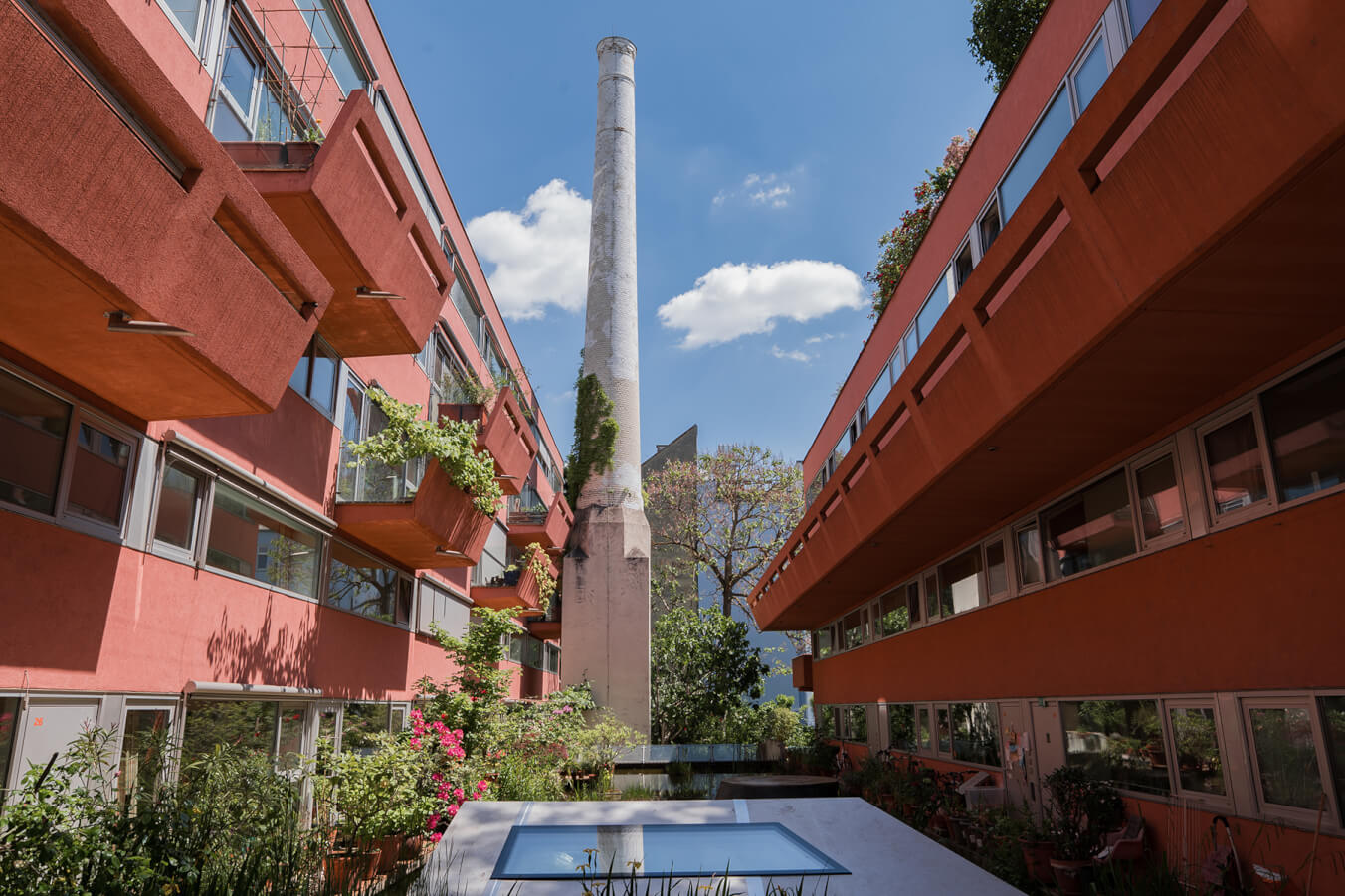
Wohnprojekt Wien and Gleis21 carried that idea into the new railway-yard districts. Wohnprojekt Wien, a timber-fronted co-housing block by einszueins architektur, runs on resident work groups and shared rooftop space; Gleis21 in the Sonnwendviertel adds a zero-energy frame, refugee-flexible rooms and a public cultural ground floor. Both are small, both depended on winning a subsidised plot, and both show the limit of the resident-led route: they scale one building at a time, not one district at a time.
MGG22 and Bikes and Rails push the technical edge. MGG22 heats its subsidised flats through thermal-component activation and wraps them around a large edible community garden; Bikes and Rails is a timber-frame passive house with a bike workshop and a strict no-car ethos in the same Sonnwendviertel. Die Hauswirtschaft adds a co-living block with shared kitchens, coworking and guest rooms. These are the city's proof that cost-rent and low-carbon can be built together — though each leans on a subsidy stack that not every group can assemble.
aspern Seestadt is the model at its largest and most contested. Planned for around 25,000 residents and 20,000 jobs on a former airfield in the east, it is one of Europe's biggest urban-development sites, built out in stages toward a 2030 completion. Its early phases drew media criticism for windswept asphalt squares and half-empty ground floors, which forced a 2022 redesign of the central pedestrian zone; turning a planned grid into a lived-in neighbourhood, with schools, shops and street life, has proven slower than building the flats themselves.

What lets Vienna repeat all this is an unusually deep bench of designers and conveners. Studios such as einszueins, gernegernerplus, AllesWirdGut and GABU Heindl Architecture have built much of the cooperative new-build, while the IBA Wien international building exhibition staged a wave of social-housing demonstrators across the city. Eutropian and its Cooperative City Magazine document the resident-led wing of the movement and connect it across Europe, and Erste Social Finance experiments with patient capital for the projects subsidy alone cannot reach. It is a deeper institutional layer than almost any other European city has — and the open question is whether even Vienna can keep building this way fast enough for the newcomers still locked outside the protected system.
References
Statistics20Click on any number to see the source
Housing market
Tenure & affordability
Cooperative, social & public
Adaptive reuse & vacancy
Population & migration
From our library24
- Housing Reforms in Czechia and Poland — Knowledge
- Part 1: Mapping the housing needs in the EU, assessing the impacts of scarcity and providing an overview of relevant EU legislation — Knowledge
- Cooperative Conditions - A Primer on Architecture, Finance and Regulation in Zurich — Knowledge
- Sozialbau AG — Organisation
- WBV-GPA (Wohnbauvereinigung für Privatangestellte) — Organisation
- Wien-Süd (Baugenossenschaft 'Wien-Süd') — Organisation
- Eutropian — Organisation
- Cooperative City Magazine — Organisation
- #Housing2030 Effective policies for affordable housing in the UNECE region — Knowledge
- Transdisciplinarity for Affordable and Sustainable Housing — Knowledge
- Sargfabrik — Project
- Adaptive Reuse for Housing — Knowledge
- Wohnprojekt Wien — Project
- Gleis21 — Project
- einszueins — Organisation
- MGG22 — Project
- Bikes and Rails — Project
- Die Hauswirtschaft — Project
- aspern Seestadt — Project
- gernegernerplus — Organisation
- AllesWirdGut — Organisation
- GABU Heindl Architecture — Organisation
- IBA Wien — Organisation
- Erste Social Finance — Organisation
Further sources14
- Aufschwungskoalition — Vienna government programme (presentation) — Stadt Wien
- Fortschrittskoalition / Aufschwungskoalition — full programme — NEOS Wien
- Kathrin Gaal leaves; Hanel-Torsch becomes new Vienna City Councillor — VOL.AT
- Interview mit Bürgermeister Michael Ludwig — "Wohnen ist Menschenrecht" — SPÖ Wien / Fokus
- Vienna has been declared a renters’ utopia — Justin Kadi — The Guardian
- Dr Justin Kadi publishes in the Guardian on Vienna’s housing policies — University of Cambridge — Department of Land Economy
- Wiener Wohnen — Gemeindebau / municipal landlord — Wiener Wohnen
- Bauträgerwettbewerb — wohnfonds wien — wohnfonds wien
- Wohnungsgemeinnützigkeitsgesetz (WGG) — Rechtsinformationssystem des Bundes
- New short-term-rental rules from July 2024 in Vienna — Fellner Wratzfeld & Partner
- aspern Seestadt — official site — aspern Seestadt
- Seestadt Aspern — overview — Wikipedia
- Gemeindebau — history of Red Vienna municipal housing — Wikipedia
- Green social housing: lessons from Vienna — Climate and Community Institute