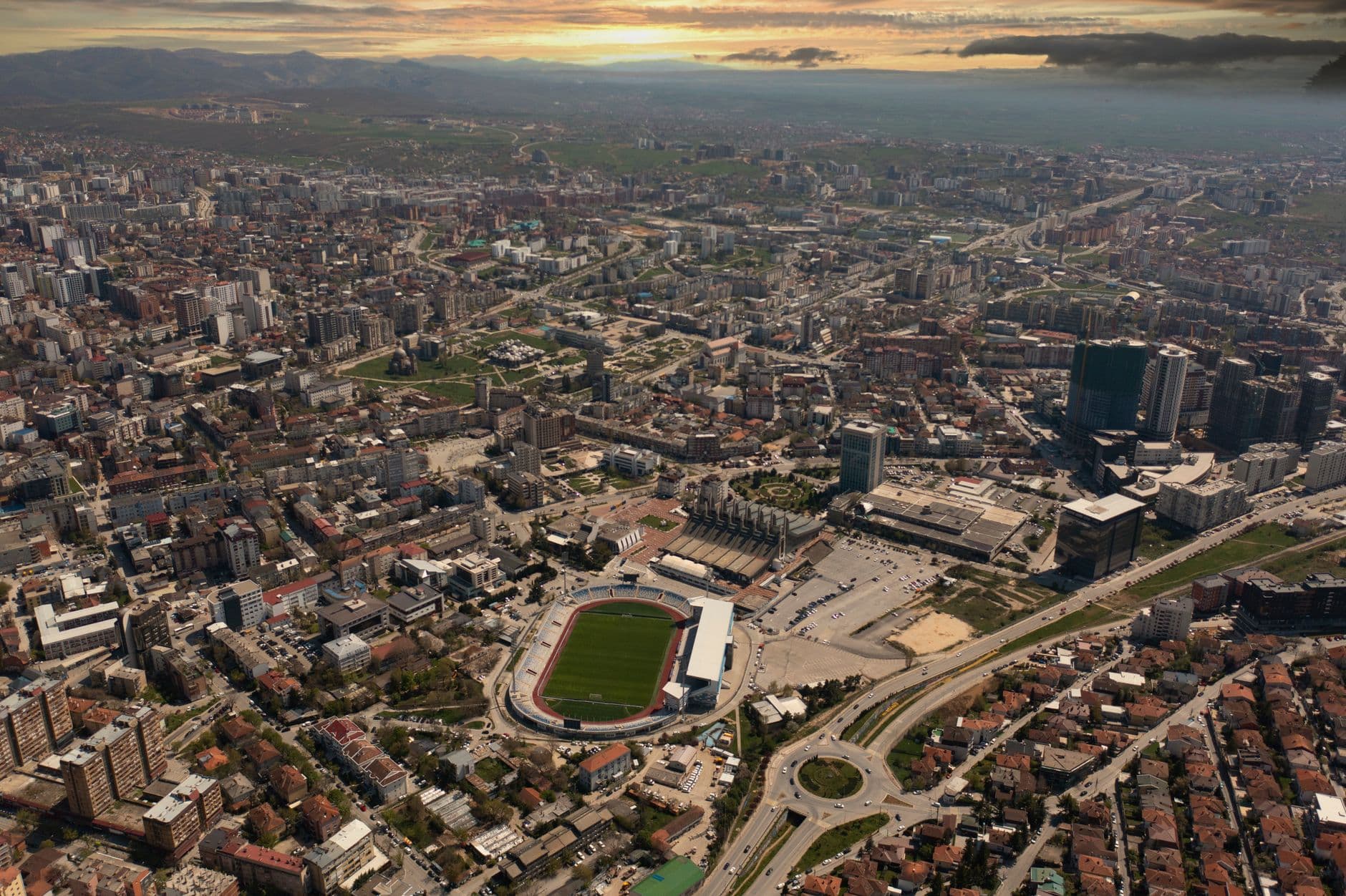
Pristina's housing landscape today
Pristina is built on the demographic singularity of Europe's youngest capital — median age in the late twenties — combined with the post-1999 + post-2008 institutional-construction context, post-conflict housing-reconstruction, and a heavily owner-occupied dwelling stock. The contemporary housing-policy debate runs through the Vetëvendosje government's flagship affordable-housing programme — 4,000 apartments at below-market price on public land across Prishtina, Gjilan, Prizren, Peja and Mitrovica, intended for young couples, female heads of households, and public-sector employees (teachers, nurses, police officers, firefighters, administrators). The research + policy-analysis conversation runs through GAP Institute (est. 2007), Riinvest Institute (the oldest Kosovo think tank, est. 1995), and UN-Habitat's 20-year Kosovo programme covering all 38 municipalities.
The tenure mix tells the rest of the story. (See chart above for the canonical breakdown; rent-spread details follow.)
- Owners
- Owner-occupier88.0%
- Renters
- Public & non-profit rental0.00%
- Cooperative0.00%
- Private rental8.0%
- Unclassified4.0%
- Unknown / Other4.0%
The cooperative-housing-revival opportunity + national institutional infrastructure are the subject of the next section.
- New contracts
- Furnished (gross)
- All-stock median
Net-cold monthly rent per m².
Data at a glance for Pristina: 8% of households rent across 75,000 dwellings. Rents sit at €7.8/m² across the existing stock against €6/m² for new contracts. Residential vacancy is 18%; office vacancy 10%. Annual in-migration runs at 6,000 new residents. Source: NextAgora geo-replica, EHC tenant geo-field values.
Cooperative + non-profit housing in Pristina
Cooperative-style housing in Pristina sits at an early stage. Kosovo never developed a Yugoslav-era stambena zadruga tradition at scale; the post-1999 + post-2008 context has been dominated by post-conflict housing reconstruction + state-institutional construction, conducted under UN-Habitat coordination across all 38 Kosovo municipalities. The contemporary affordable-housing policy debate runs through the Vetëvendosje government's flagship programme — 4,000 apartments at below-market price on public land, monthly payments of €120 over 120 months or €150 over 150 months, intended for young couples, female heads of households, and public-sector employees (teachers, nurses, police officers, firefighters, administrators). The annual programme cost: €22 million. The research + analysis layer is anchored by GAP Institute (est. 2007) and Riinvest Institute (est. 1995, the oldest Kosovo think tank).


The research + UN-agency layer that would anchor a future cooperative-housing revival is comparatively well-developed for a young state. UN-Habitat Kosovo has been present for over 20 years — supporting all 38 Kosovo municipalities in local governance, spatial planning, and urban-conditions improvement, including municipal cadastre + property-rights regularisation, informal-settlement integration, and post-conflict housing-reconstruction frameworks. The Riinvest Institute has produced the USAID-supported Gap Analysis of the Housing Sector and ongoing affordability + property-market monitoring for Pristina. The GAP Institute monitors public-institution performance and provides public-policy recommendations across Kosovo's economic, political and social challenges — including evaluation of the Vetëvendosje 4,000-apartment programme.
Pristina housing policy + debate
Pristina's housing politics runs through municipal + national channels + post-1990s EU-integration / international-cooperation housing-finance frameworks. Political debate runs through Koha Ditore, Zëri, Klan Kosova, Kallxo.com, Insajderi, Kosovo 2.0.
Pristina: institutional layer + cooperative-housing-revival pipeline
Pristina's contemporary housing-policy + research pipeline runs through three principal channels. The Vetëvendosje government's 4,000-apartment affordable-housing programme (2021-2025) provides the central housing-delivery channel — public-land-based, intended for young couples + public-sector employees + female heads of households. GAP Institute provides the principal independent policy-analysis layer, monitoring public institutions and the implementation of the programme. Riinvest Institute — the oldest Kosovo think tank — provides housing-sector and market-research analysis, including the USAID-supported Gap Analysis of the Housing Sector. UN-Habitat Kosovo provides the principal international + municipal capacity-building anchor across all 38 Kosovo municipalities.

What the post-2021 Vetëvendosje 4,000-apartment programme + post-1995 Riinvest research + post-2007 GAP Institute policy-monitoring + post-1999 UN-Habitat Kosovo capacity-building together demonstrate is that Pristina now hosts a comparatively well-developed contemporary policy-research infrastructure for a young state. The cooperative-housing-revival opportunity sits at an early stage; the demographic context (Europe's youngest capital, median age in the late twenties) makes Pristina a natural laboratory for cooperative-housing experimentation aimed at young-household formation.
References
Statistics6Click on any number to see the source
Housing market
Adaptive reuse & vacancy
Population & migration
Further sources10
- komuna — komuna
- kohaditore — kohaditore
- zeri — zeri
- klankosova — klankosova
- ktv — ktv
- kallxo — kallxo
- insajderi — insajderi
- rtk — rtk
- kosovotwopointzero — kosovotwopointzero
- ask — ask
·
Funding & land tenure
What a housing cooperative could actually build on hereLand tenure has not been assessed for Kosovo yet — that is a gap in the research, not a finding.