A city of tenants inside a rebuilt wall
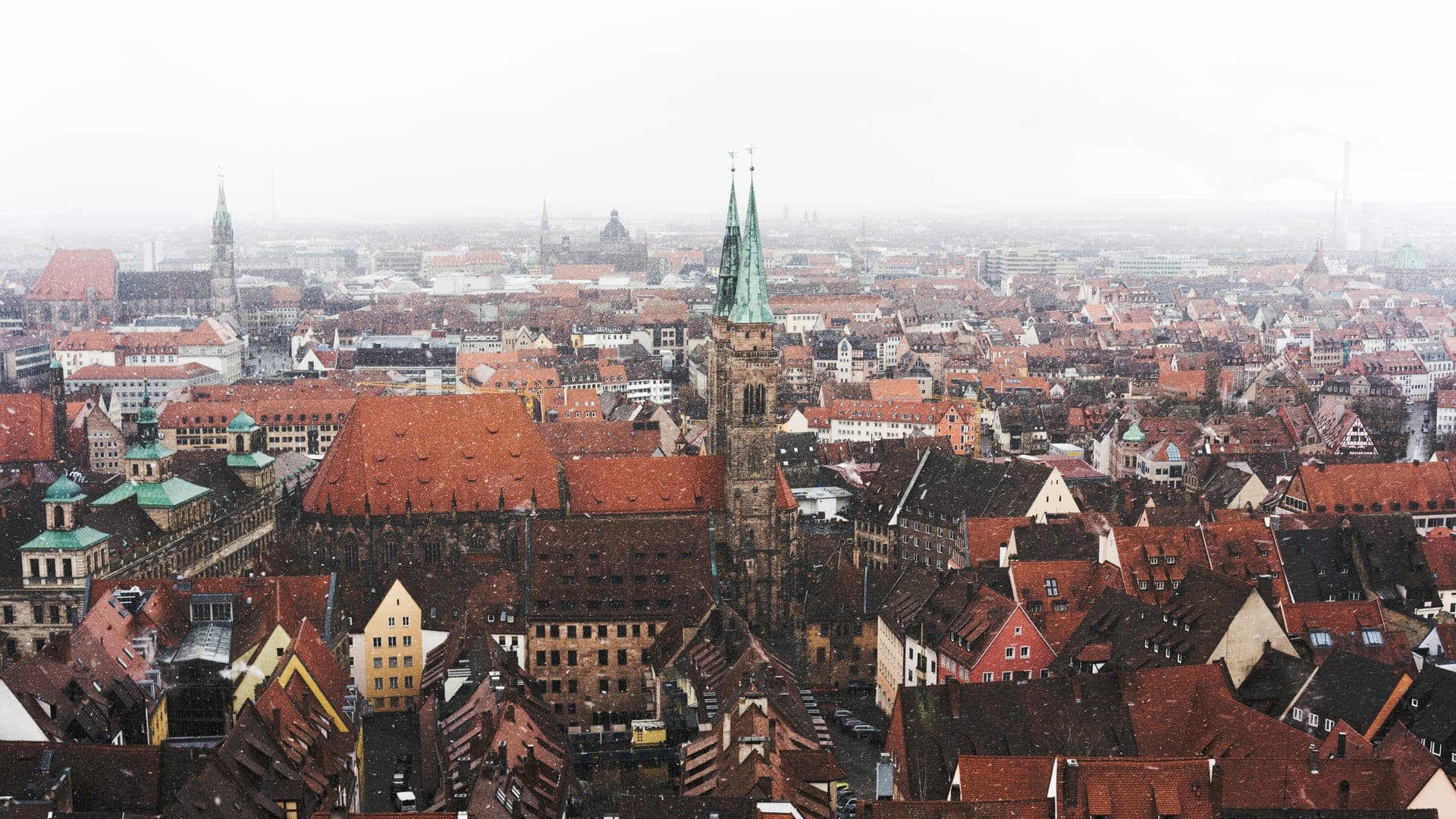
Nuremberg has rebuilt itself once already. The bombing of 1945 destroyed 90% of the buildings inside the medieval wall, and a single raid on 2 January left 100,000 people without a roof. Municipal and cooperative builders carried much of the reconstruction, and their estates still house a large part of the city. The pressure now is of a different kind: steady growth, stalled construction and rising rents.
Tenants dominate. Some 71.7% of homes are rented and only 28.3% are lived in by their owners, according to the 2022 census. Cooperatives hold 6.84% of the stock, or 19,573 homes spread across 15 cooperatives. The public slice of 2.2% counts only the 6,200 subsidised flats of wbg Nürnberg, the city's own housing company. Its whole portfolio is far larger, at almost 19,000 rental homes, so that slice is a floor. Private landlords let the remaining 62.7%.
- Owners
- Owner-occupier28.3%
- Renters
- Public & non-profit rental2.2%
- Cooperative6.8%
- Private rental62.7%
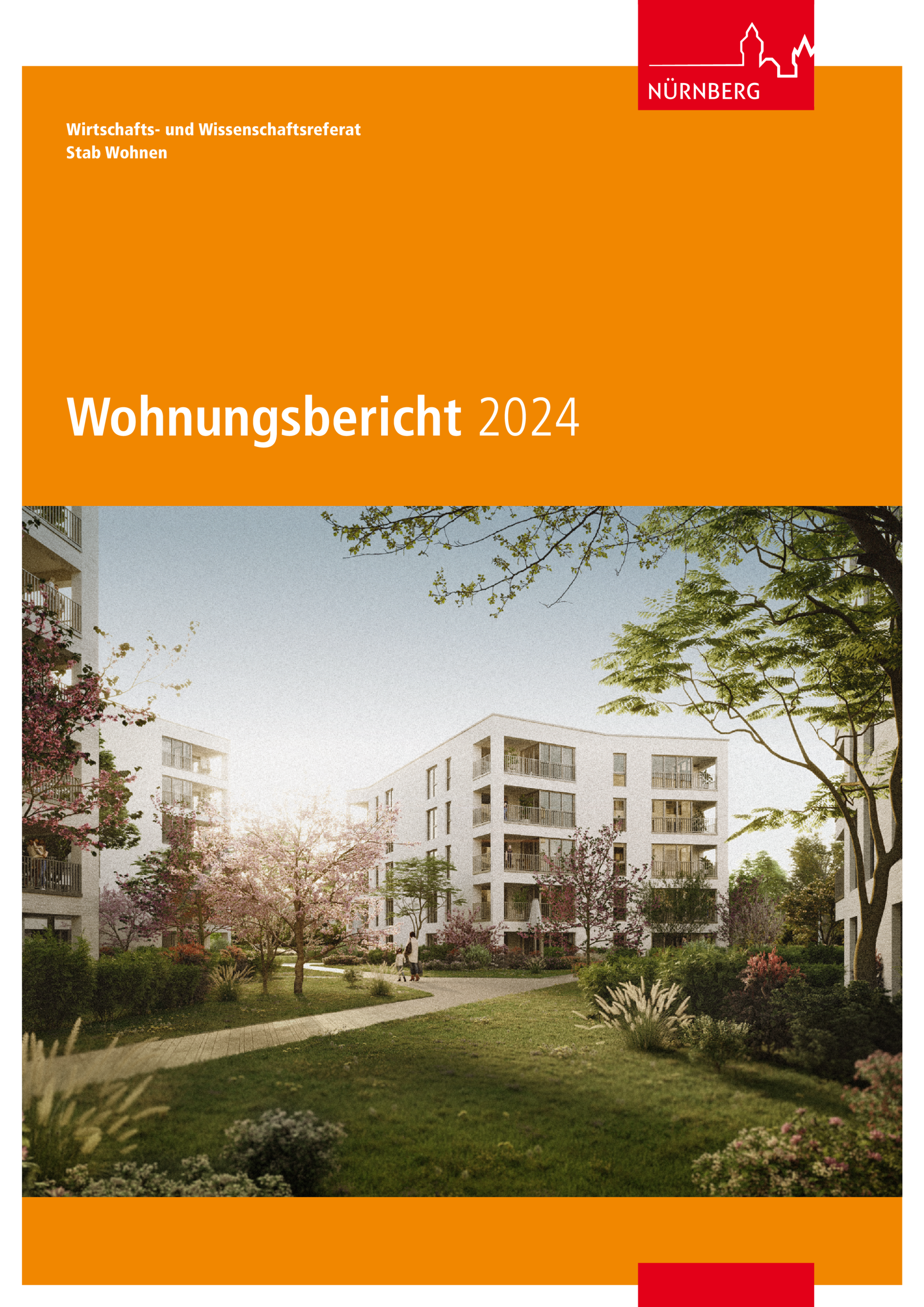
That covenant layer is separate from ownership. 6% of Nuremberg's dwellings carry a Sozialbindung (a time-limited rent cap and allocation right that comes with state subsidy), whoever owns them. The city's 2024 housing report counts 17,650 such homes, against 65,568 in 1980. In 2024 new subsidised completions outpaced expiring covenants for the first time in more than 20 years. Another 4,000 or so covenants are due to lapse by 2040.
What a tenant pays depends heavily on the landlord. Cooperative members pay about €6.69 per m² net cold, and subsidised wbg flats start near €6.50. Across all existing leases the median sits at €9.50, a figure from the 2025 index; the city's 2026 rent index has since moved the average to €10.33. New contracts are advertised at around €14.11. Furnished and serviced flats, priced gross with utilities and furniture included, reach €24.11.
- Public/municipal housing
- Cooperative
- All-stock median
- New contracts
- Furnished / serviced (gross)
Monthly rent per square metre, from the cooperative floor to furnished lets. Net cold rents except the furnished tier, which is gross.
Empty homes are scarce. The 2022 census found 3.2% of dwellings unoccupied, some 9,055 homes, but the city puts vacancy that the market can actually use at just 1.6%. That is below the reserve a market needs for people to move. Offices tell the opposite story: 9.0% of the 4 m² office stock stood empty at the end of 2025, about 0 m². Holiday letting is contained by a ban on misuse of housing. Since 2019 the city has logged 2,334 suspected cases and returned 382 homes to residential use.
Newcomers keep arriving, around 33,000 a year, and the city grew by 1,983 residents in 2024 alone. Building has gone the other way. Permits fell to 1,561 homes in 2024 and completions to 1,497, short of the council's goal of about 2,000 a year. The city's latest market forecast says 14,700 more homes are needed by 2033.
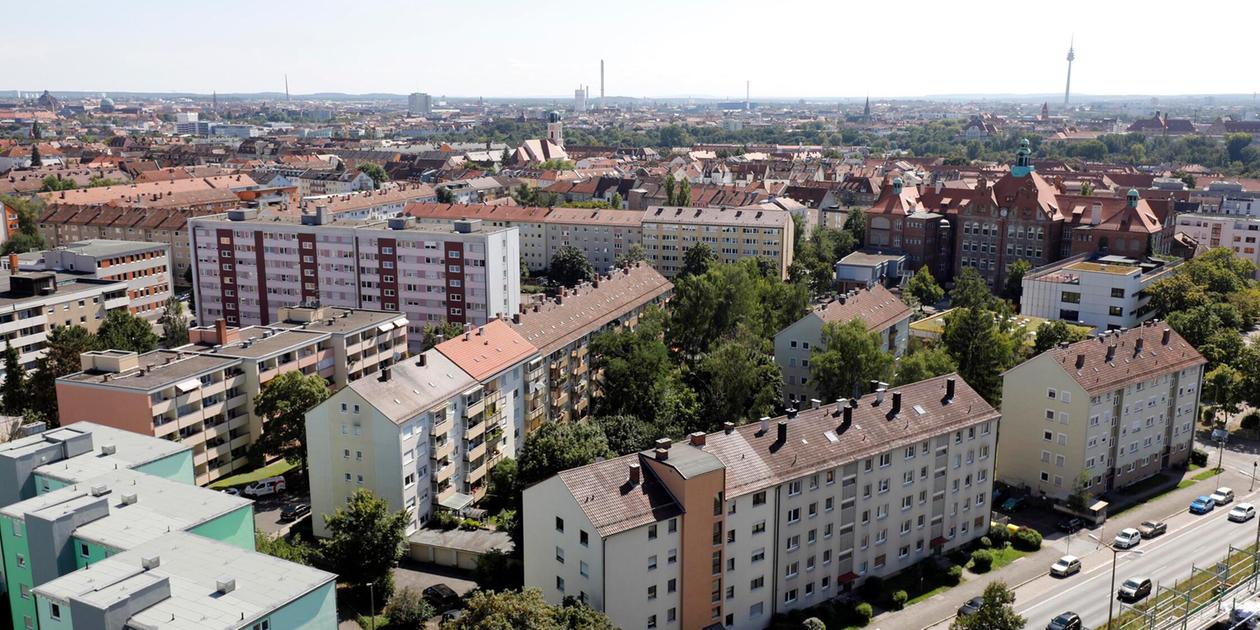
The squeeze falls unevenly. A Hans-Böckler-Stiftung study of 77 German cities found 49.81% of Nuremberg's renter households paying more than 30% of income on warm rent, and 11.60% paying more than half. Nationally, households at the poverty line spend around 46% of income on rent. The social-housing waiting list held 7,265 households at the end of 2024, and only 1,185 were housed that year. An estimated 45% of households meet Bavaria's income limits for subsidised rent, which reaches deep into the middle. In the city's 2021 resident survey, housing costs were the worst-rated feature of people's homes. About 2,435 people were registered homeless in late 2023. The German Tenants' Association's 2026 rent report describes the same pattern nationwide.
Against that pressure stands a cooperative sector that predates the First World War, founded by the city's railway staff and garden-city reformers.
Railwaymen, garden cities and a Syndikat on Julienstraße
Nuremberg's cooperatives are rental cooperatives. Members buy a Genossenschaftsanteil (a refundable share that entitles them to a home) and then pay a cost-based rent, with no right to sell the flat. The gap to the market is wide. The Wohnungsgenossenschaft Nürnberg Süd-Ost reported an average rent of €6.72 per m² in 2023, when the city's rent index stood at €11.51.
The tradition grew out of the railway and the garden-city movement. The Baugenossenschaft des Eisenbahnpersonals was founded by railway staff in 1907. A year later 57 railwaymen founded what is now Wohnungsunternehmen Nürnberg-Ost. Also in 1908, a newspaper editor, a merchant and a chemist registered Gartenstadt Nürnberg, which built a garden suburb to plans by Richard Riemerschmid. The Baugenossenschaft Selbsthilfe followed in 1912. The war damaged or destroyed over 70% of the Gartenstadt's houses, and members rebuilt much of it themselves after 1945. The Werderau estate nearby is not a cooperative: the engineering firm MAN built it for its own workers.
Today the sector falls into three camps. The century-old cooperatives are the largest: Gartenstadt manages about 2,500 homes, Selbsthilfe more than 3,000 across northern Bavaria, and Wohnungsgenossenschaft Nürnberg-Nord around 830. Their problem is money for old buildings. Süd-Ost told members it needs €28.6 million by 2035 for repairs and climate upgrades, which it cannot fund without loans at post-2022 interest rates. A second, newer camp is led by banks: the VR Wohnungsgenossenschaft der Metropolregion Nürnberg was founded in 2017 by four regional cooperative banks and a local builder. The third is self-organised. Under the Mietshäuser Syndikat model (a federation that takes houses permanently off the market by co-owning each one), residents of Hausprojekt jAcht bought Julienstraße 8 in 2022 and pay €9.15 per m². The Krähengarten house followed the same route in 2020. Syndicate houses struggle to buy at market prices; the older cooperatives struggle to renovate what they already own.
New building has stalled for all of them. When Bavaria paused its subsidy approvals in 2025, the state federation of housing companies said the freeze hit more than 90 member firms and 4,950 planned new homes. The city does give cooperatives a formal role. Under its quota rule, cooperative new-build with capped rents can count towards the subsidised share of a large development, up to a third of it. A federal study of cooperatives as municipal partners and a study of common-good housing policy describe bigger levers used elsewhere. Chief among them are land tenders scored on concept rather than price. No such tender line for cooperatives exists in Nuremberg today.
A 40% quota waiting for cranes
The city's answer is a quota and a target. Any scheme of more than 30 homes must set aside 40% of its floor space for subsidised rental housing, a rule the council last amended in January 2026. If subsidy money runs dry, developers may instead build 50% as rent-capped homes. wbg Nürnberg holds roughly half of the city's subsidised flats and has almost 900 income-linked homes in planning or under construction.
Each tier of government holds a different lever. Berlin sets tenancy law: the Bundestag extended the Mietpreisbremse (the cap on new-let rents in tight markets) to the end of 2029. The federal building ministry, the BMWSB, is putting a record €23.5 billion into social housing by 2029. Its Bau-Turbo, a fast-track clause in the Building Code, has applied since October 2025. The Bavarian government decides where the rent cap bites. Its renewed Mieterschutzverordnung (the state ordinance that switches on rent caps) covers 285 municipalities from January 2026. The state budgets €3.6 billion for housing subsidy in 2026 and 2027. Its own housing company, BayernHeim, promised 10,000 homes by 2025 but held 928 by mid-2025, as the Staatszeitung reported. Nuremberg itself controls land-use plans, its quota and wbg. Since the 2026 election the housing portfolio sits with Mayor Nasser Ahmed of the SPD, under CSU Lord Mayor Marcus König.
Help for cooperatives comes mostly through general subsidy rather than dedicated tools. Bavaria's income-linked rental subsidy (EOF) is open to them, and the quota rule counts their capped-rent new-build. The state's new 'Bayerischer Bauturbo' bill and its pilot of Gebäudetyp-e (a simplified building standard that drops non-essential norms) promise cheaper construction, as the Bavarian housing ministry set out in July 2026.
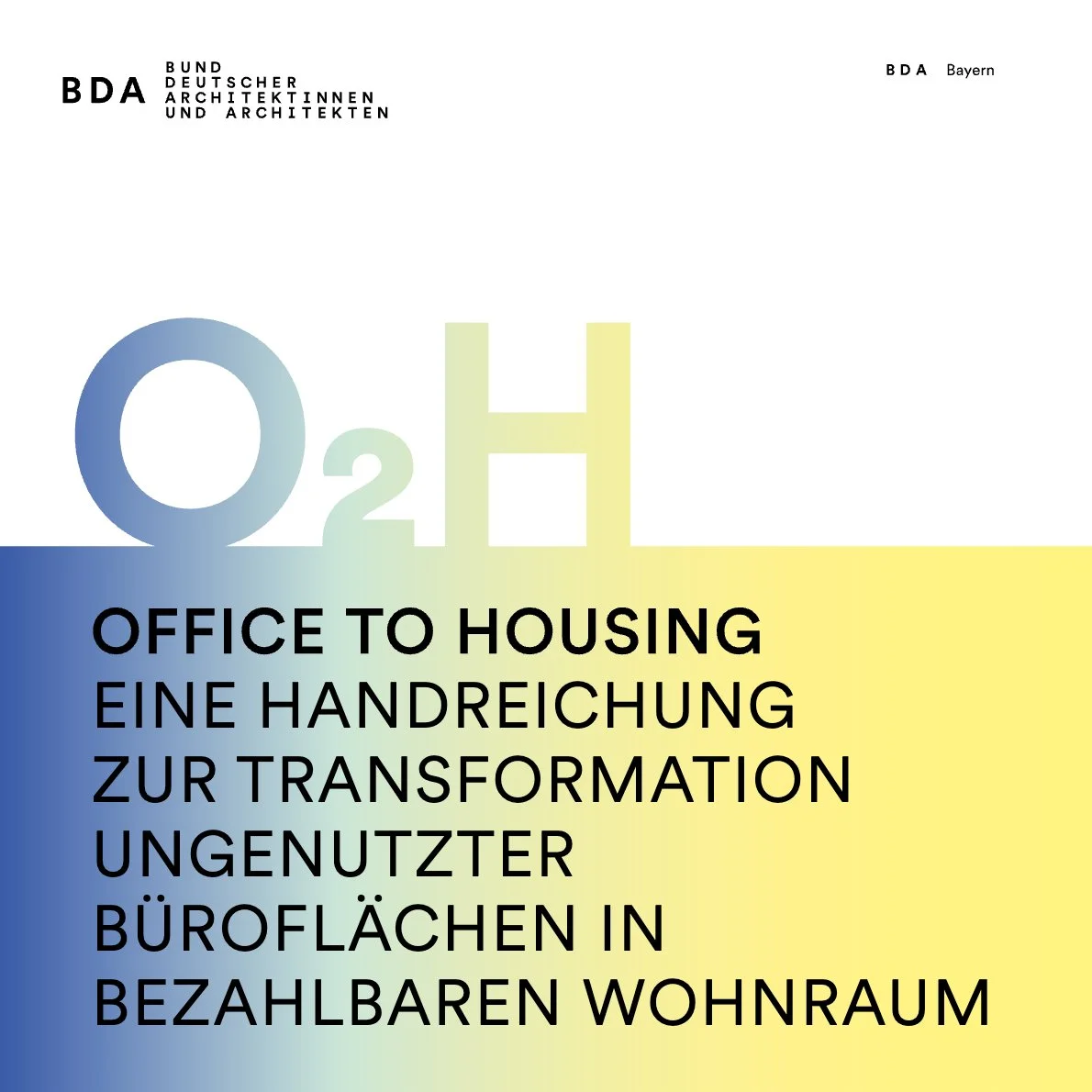
The empty offices are the obvious reserve, and policy is only starting to reach them. The federal ministry's report on office vacancy backs a 'Gewerbe zu Wohnen' (commercial-to-residential) programme, and the Bau-Turbo also covers change of use. In Bavaria, the Office to Housing handbook by the state's association of German architects sets out the planning, financing and building-code routes for conversion. An ifo Institute study of home-office trends expects long-run office demand to keep shrinking as hybrid work settles in. For homes, the misuse ban treats a flat left empty for more than three months as a breach.
The climate targets fall hardest on the old stock. Nuremberg aims to be climate-neutral by 2040, five years ahead of the federal goal, and adopted a municipal heat plan in June 2025. The Buildings Energy Act (GEG) and the EU's buildings directive push every landlord towards heat pumps and district heating. For the cooperatives and wbg, which own the densest post-war blocks, that means the retrofit bill and the climate bill are the same bill.
Basically, one has to say that only privately financed housing construction can create new housing on a sufficient scale and thus contribute to easing rents in the long term.This is no longer sustainable. Those who keep Nuremberg running must also be able to afford Nuremberg.The argument runs between those two lines. König also told wbg's magazine that permits had fallen so far that the city's completion target was unlikely to be met in the coming years. He asked the federal and state governments for subsidy programmes that are not cut every year. Ahmed wrote to Bavaria's premier Markus Söder demanding a new tenant-protection ordinance. From the landlords' side, Gerhard Frieser of the owners' association Haus & Grund Nürnberg argues the misuse ban mainly criminalises private landlords and should be scrapped. Local reporting on the 2025 market study sums up the paradox: land exists for 25,700 homes, but high costs keep approved projects on paper.
- 1908[source]
Gartenstadt cooperative founded
Registered on 22 September 1908; it builds a garden suburb in the south of the city.
- 1918[source]
Forerunner of wbg Nürnberg founded
The Nürnberger Wohnungsbauverein is set up; it becomes the municipal housing company.
- 1928–1931[source]
Nordostbahnhof estate built
The city housing company builds most of the 2,503-home estate after a 1928 competition.
- 2 January 1945[source]
The old town is bombed
About 100,000 people lose their homes in a single raid.
- May 2019[source]
Ban on misuse of housing
Holiday lets over 8 weeks a year and vacancy of more than 3 months now need a permit.
- Autumn 2023[source]
Quelle developer insolvent
Gerchgroup’s insolvency halts the conversion of the former Quelle building for months.
- 2024[source]
Subsidised stock grows again
The covenanted stock rises to 17,650 homes, the first increase in more than 20 years.
- 30 October 2025[source]
Federal Bau-Turbo in force
Section 246e of the Building Code lets councils approve housing that departs from local plans.
- January 2026[source]
Bavarian rent brake renewed
The new tenant-protection ordinance covers 285 municipalities until the end of 2029.
- 28 January 2026[source]
40% quota amended
The council last revises its rule requiring 40% subsidised floor space in large schemes.
- 22 March 2026[source]
Marcus König re-elected
The CSU mayor wins the run-off with 55.5%; SPD challenger Nasser Ahmed later takes the housing portfolio.
- 2029[source]
Rent brake due to expire
The federal extension of the Mietpreisbremse runs to the end of 2029.
- 2030[source]
First residents in Tiefes Feld
The new south-western quarter of 2,000 homes could welcome its first residents.
- 2033[source]
Housing gap horizon
The city estimates 14,700 more homes are needed by this year.
- 2040[source]
Climate-neutrality target
Nuremberg aims to be climate-neutral, five years ahead of the federal 2045 goal.
From freight yards to a mail-order palace
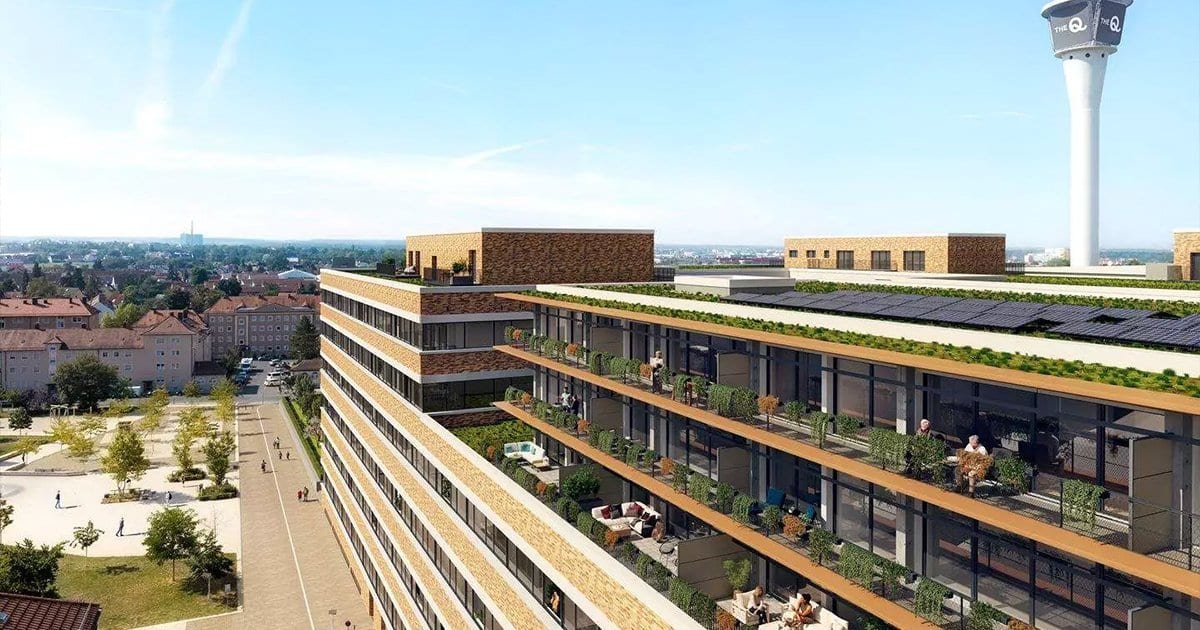
The Q, the conversion of the former Quelle mail-order building, is the city's biggest bet on reuse. The listed complex on Fürther Straße is to hold around 1,000 homes, alongside shops and offices. Its first developer, Gerchgroup, went insolvent in autumn 2023 and the site stood still for months. Work restarted only after the Bavarian pension fund Bayerische Versorgungskammer came in as investor and the Munich developer Accumulata took over. Supermarkets opened in December 2025, and the city is moving about 1,500 staff into the upper floors. No share of subsidised homes has been published.
Lichtenreuth, on the former southern freight yard, is the largest new district. The 90-hectare site beside the new technical university has approval for 1,300 homes in its first module and is planned for up to 6,000 residents. Within it, the church-based landlord Evangelisches Siedlungswerk finished LUMOS Lichtenreuth in 2025: 101 barrier-free rental flats under Bavaria's income-linked subsidy. The weak point is transport. The tram is not due until the end of 2028.
UmweltBank, a Nuremberg lender that finances only environmental projects, is building its future around housing. Its new head office on the Nordwestring is a 52-metre timber-hybrid tower using about 3,000 m³ of wood, due to open in November 2026. It is the first piece of a planned UmweltQuartier with about 300 homes, some publicly subsidised, and around 215 student flats. The homes still await planning approval, so the quarter remains a promise rather than a place.

wbg Nürnberg carries the municipal line from the 1920s to now. Its predecessor built the Nordostbahnhof estate, 2,503 homes completed mostly by 1931 and now a listed ensemble. In the Werderau, it bought MAN's old workers' houses and spent more than €10 million modernising them. At Reinerzer Straße it tested serial timber-hybrid blocks with standardised plans. Its limits showed in 2023, when rising costs forced it to cut investment in new building and modernisation by about a third, as its managing directors told BundesBauBlatt. Estates of this post-war kind are, in the words of a 2026 study of large housing estates, a last bastion of affordable housing.
Wetzendorf and Tiefes Feld show what the quota means on the ground. The Wetzendorf quarter in the north-west plans about 1,500 homes, mostly car-free. Its first section of about 370 homes is 40% subsidised, but building is not expected before 2029. Tiefes Feld in the south-west is planned for 2,000 homes, with first residents from 2030. On the former AEG works, the owner MIB won unanimous committee approval in July 2025 for a plan with about 100,000 m² of housing. All three rest on land the city helps to plan but mostly does not own.
The Gartenstadt's single-family streets and the Syndikat house on Julienstraße sit at the two ends of the same idea: homes held for use rather than resale. Between them, Nuremberg has land, a quota and builders who know how to do it. What it lacks is the capital to build at today's costs.
References
Statistics15Click on any number to see the source
Housing market
Tenure & affordability
Cooperative, social & public
Adaptive reuse & vacancy
Population & migration
From our library17
- Wohnungsbericht 2024 der Stadt Nürnberg — Knowledge
- Düstere Zukunftsprognose: Nürnberg fehlen fast 15.000 Wohnungen — Knowledge
- Wie viele (und welche) Wohnungen fehlen in deutschen Großstädten? — Working Paper 217 — Knowledge
- Mietenreport 2026 - Deutscher Mieterbund — Knowledge
- Gartenstadt Nürnberg eG — Organisation
- In Bayern werden immer weniger bezahlbare Wohnungen gebaut — Knowledge
- Bündnis für bezahlbares Wohnen und Bauen – Wohnungsgenossenschaften als Partner der Kommunen — Knowledge
- Gemeinwohlorientierte Wohnungspolitik - eine Studie — Knowledge
- Bundestag: Mietpreisbremse verlängert — Knowledge
- German housing crisis: government plans construction boost — Knowledge
- BayernHeim: Wohnungsbauziele werden deutlich verfehlt — Knowledge
- Schriftlicher Bericht des BMWSB zum deutschlandweiten Büroleerstand — Knowledge
- Office to Housing — Knowledge
- Homeoffice und die Zukunft der Büros: Flexibilisierung, Reduzierung und Umnutzungspotenzial — Knowledge
- The Q in Nürnberg lebt: Das kommt 2026 auf dem früheren Quelle-Areal — Knowledge
- UmweltBank — Organisation
- Large Housing Estates in Germany's Major Cities: A Last Bastion of Affordable Housing? — Knowledge
Further sources31
- Nürnberg ging unter: Wiederaufbau — Kunstbunker Nürnberg
- Luftangriff auf Nürnberg am 2. Januar 1945 — Stadt Nürnberg
- Interview mit OBM Marcus König — wbg Nürnberg magazine · 2025
- Wohnungsmarkt Nürnberg — Stadt Nürnberg
- Mietenspiegel Nürnberg 2026 — Stadt Nürnberg · 2026
- Mietbelastung in 77 Großstädten — Hans-Böckler-Stiftung
- Bürgerumfrage 2021: Wohnen — Stadt Nürnberg, Amt für Stadtforschung und Statistik · 2022
- Stellungnahme Marcus König zur Wohnungslosigkeit — Deutscher Bundestag · 2023-12
- Geschäftsbericht 2023 — Wohnungsgenossenschaft Nürnberg Süd-Ost eG · 2024
- Geschichte und Chronik — Gartenstadt Nürnberg eG
- Unsere Geschichte — Baugenossenschaft Selbsthilfe eG
- Hausprojekt jAcht — Mietshäuser Syndikat
- Krähengarten — Mietshäuser Syndikat
- Gründungsfeier der VR Wohnungsgenossenschaft — Schultheiß Projektentwicklung · 2017
- Quotenregelung für den geförderten Wohnungsbau — Stadt Nürnberg · 2026
- Sozialer Wohnungsbau 2026/2027 — BMWSB · 2026-03-20
- Neufassung der Mieterschutzverordnung — Bayerische Staatsregierung · 2025-12-16
- Wohnraumförderung und Bayerischer Bauturbo — Bayerisches Staatsministerium für Wohnen, Bau und Verkehr · 2026-07-22
- Nürnberg braucht jetzt Schutz vor steigenden Mieten — SPD Nürnberg · 2025-12-03
- Klimaneutrales Nürnberg — Stadt Nürnberg
- Kommunale Wärmeplanung — Stadt Nürnberg
- Bau-Turbo-Gesetz seit 30.10.2025 in Kraft — Deutsches Ingenieurblatt
- Lichtenreuth (Brunecker Straße) — Stadt Nürnberg
- LUMOS Lichtenreuth — Evangelisches Siedlungswerk
- UmweltHaus vor Fertigstellung — Holzbau Austria · 2026-07
- UmweltHaus auf der Zielgeraden — UmweltBank
- Siedlung Nordostbahnhof — Stadt Nürnberg
- wbg Nürnberg: Wohnungsbau schwierig wie nie — BundesBauBlatt · 2023-05-19
- Wetzendorf — Stadt Nürnberg
- Tiefes Feld — Stadt Nürnberg
- Auf AEG: Entwicklung — MIB