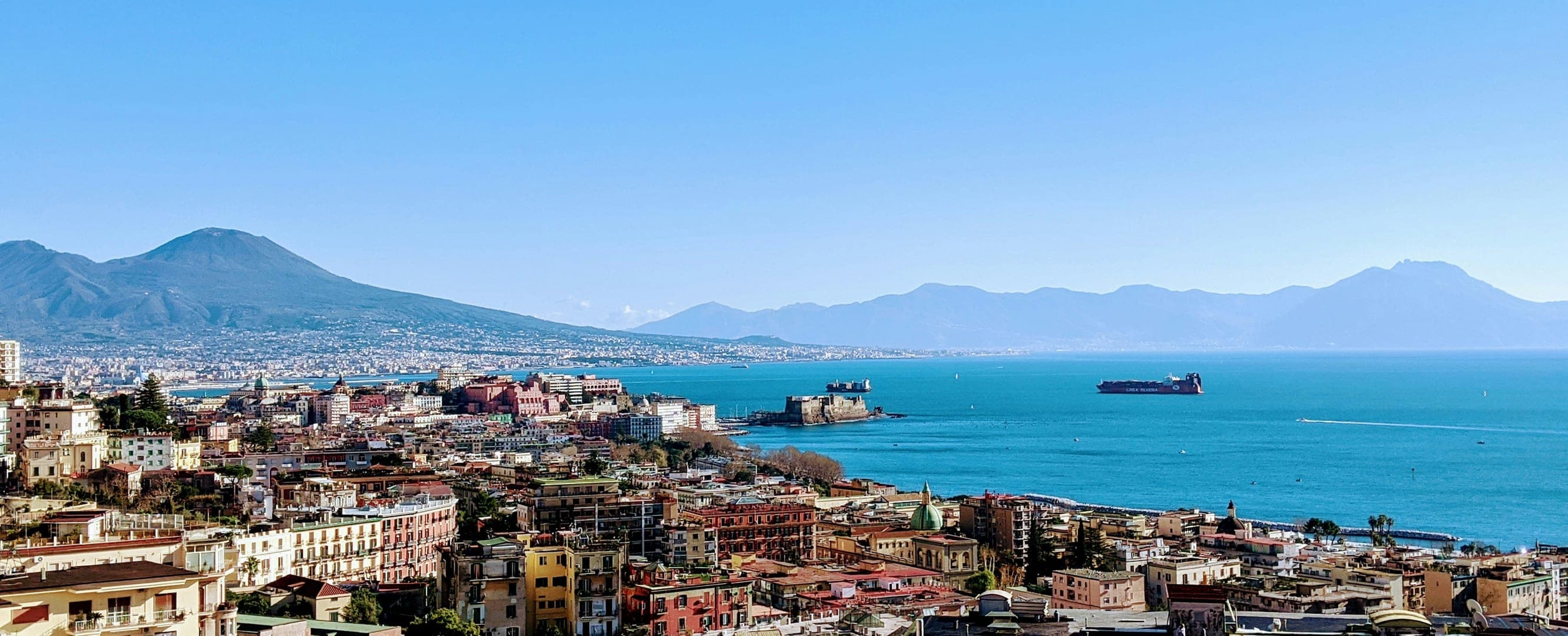
Fewer Neapolitans, and fewer homes they can reach
Naples still walks the street grid the Greek settlers of Neápolis drew. That continuity shapes its housing: the stock is old, dense, inherited inside families and rarely traded. The second fact is stranger. The city is losing residents, and it is getting harder to live in anyway.
Owning is the Neapolitan default, as it is across the Italian south. Roughly 65% of households own the home they occupy and about 30% rent. Public landlords, the city and the regional public-housing agency ACER Campania, hold around 5% of dwellings, some 23,000 flats of edilizia residenziale pubblica, the Italian public-rental tier usually shortened to ERP. Private landlords let about 25% of the stock. A last 5% occupy their home under no market tenure at all. ISTAT, the national statistics institute, files them as altro titolo: usufruct, or a flat lent for nothing by a relative. In a city built on extended families that column is real. What the list lacks is a cooperative tier. The catalogue records no cooperative share for Naples at all, which for a European city this size is close to unique.
- Owners
- Owner-occupier65.0%
- Renters
- Public & non-profit rental5.0%
- Cooperative0.00%
- Private rental25.0%
- Other5.0%
- Usufruct / free use5.0%
Social housing in Italy is a rule attached to a dwelling rather than a tenure of its own, and it covers about 5.5% of Naples dwellings. That runs above the municipal share because a thin layer of privately built edilizia residenziale sociale, affordable housing at a capped rent, sits inside the private slice. Demand runs on another scale. Campania is the only Italian region with one public-housing register for every municipality. When it opened the 2026 round, 45,726 households applied, 44% more than in 2022. 9,179 of those applications came from the city of Naples.
Climb from the regulated floor to the open market and the price sextuples. Members of Italy’s undivided-ownership cooperatives pay around €5.50 per square metre. Across the whole Naples stock the median sits at €13.20. A newly signed lease asks €15.50, a furnished one €18.85 gross, and a serviced bills-included flat €26. The regulated floor moved too. From June the city recalculated its own ERP rents on updated income tests, producing rises of 41% to 273% for more than 21,000 tenant households.
- Cooperative (national proxy)
- All-stock median
- New contract
- Furnished (gross)
- Serviced, bills included
Monthly rent per square metre. Cooperative rent is a national undivided-ownership proxy; the remaining tiers are Naples market observations.
Empty space is not scarce here, which is what makes the squeeze odd. The 2021 census found 19.3% of dwellings unoccupied, roughly 95,000 homes. Offices are slack too. 13.5% of a stock of roughly 2.95 million square metres stands idle, or 398,769 square metres of empty floor. Much of it sits in the Centro Direzionale, the towered business quarter the city has been trying to repopulate for years. A European Parliament study of how member states regulate short lets finds the data on that pressure thin everywhere, so Naples commissioned its own.
What it found is damning. Airbnb listings across the municipality went from 1,288 in 2016 to 10,760 in 2024, a rise of 735%. Whole flats made up 66.5% of them, 7,155 homes. Around 90% sat in the central districts, where the council’s report found one residential flat in seven let entirely to visitors. Filtering for listings that behave like permanent lets, the catalogue puts 3,384 dwellings in full-time short-let use today.
None of this is driven by newcomers. Naples is shrinking. The province lost 33,529 residents between 2022 and 2026, the steepest fall of any province in Italy, and the city’s count has now declined for twelve years running from a registered 913,462 people. Nor is supply filling the gap: Italy finishes fewer dwellings per head than any other country Euroconstruct tracks. The shortage is compositional. Homes are leaving the residential market faster than Neapolitans are leaving the city.
The cost is unevenly spread, and it no longer stops at the poorest. The catalogue’s rent-to-income estimate puts housing costs at 52.1% of a typical renting household’s income. In the Quartieri Spagnoli a renovated studio now reaches €850 a month; around the Duomo, purchase prices average €3,000 per square metre and touch €4,000 near Piazza Bellini. Those are teacher-and-nurse prices on southern Italian wages. The politics has followed: a march crossed the centre in February 2026 under the slogan la casa sì, gli sfratti no. Research on how housing became an asset class across southern Europe places Naples in a regional pattern rather than a local accident.
On short-let supply we have comfortably overtaken Venice on the platforms. In Naples the phenomenon is completely unregulated and the growth rates are very, very high.The cooperatives Naples built, and the one kind it never did
Italian housing cooperatives come in two legal shapes, and only one of them leaves anything behind. A cooperativa a proprietà divisa, a divided-ownership cooperative, builds flats and then transfers them to members as ordinary private owners, dissolving itself into the market once the keys change hands. A cooperativa a proprietà indivisa, an undivided-ownership cooperative, keeps the building in collective hands and grants each member a lifelong right to occupy at a cost-based charge. Members buy in through a share rather than a mortgage, which is why that charge sits so far below the market. The national arithmetic shows how little of the second kind survives: Legacoop Abitanti, the national federation founded in 1961, counts over 330,000 homes built by its members against only about 40,000 still held undivided.

Naples never had the cooperative wave that northern and central Italian cities did. Its great housing expansions were state programmes. The city approved a Piano per il recupero urbano delle periferie, a plan to repair the historic cores of its outer districts, in April 1980. Seven months later the Irpinia earthquake struck, and that plan was executed instead through Law 219/1981 and its Programma Straordinario di Edilizia Residenziale, the extraordinary public-housing programme for the quake zone. The PSER built Scampia, the eastern estates of Ponticelli and the blocks of San Giovanni a Teduccio at speed. Where Bologna or Milan answered a housing emergency with cooperatives, Naples answered it with a commissioner, and the habit stuck.
Cooperative energy in Naples today is entirely real and almost entirely outside housing. It sits in the community cooperatives of districts such as the Rione Sanità, which run catacombs, museums and neighbourhood services, and in the network of buildings the city recognised as urban commons. European research on community-led adaptive reuse maps that arrangement closely. The trouble is that each cluster lacks what the others hold. Community cooperatives have legitimacy and no balance sheet for bricks. Federations have the balance sheet and no local pipeline. The commons have buildings and no tenure.
The federations are trying to change that from above. Legacoop Abitanti has put a national proposal on the table for 20,000 capped-rent homes over ten years costing close to €5 billion, two-thirds of it private money. A scoping review of cooperative housing models and a survey of the policies that keep resident-run homes affordable agree on the precondition. It is public land, a public guarantee and an equity cap, wired in before the first brick. Campania has just written its first instrument that comes close.
National need is estimated at 50,000 dwellings. Our vision is a multi-year programme of social housing for long-term rent, to build 40% of that, meaning 20,000 units, aimed at the metropolitan cities.Seventy per cent, and what a threshold can carry
Gaetano Manfredi, a former rector of the Federico II university, has led Naples since 2021. Housing sits with his deputy mayor and planning assessor, Laura Lieto. Their headline instrument arrived in February 2026: the PiCQuA, or Piano Comunale per la Qualità dell’Abitare, a municipal plan setting out short, medium and long-term answers to housing distress. Under it the city’s planning service is running co-housing schemes, homes for young people, a solidarity condominium, confiscated buildings converted to housing and refuges for women escaping violence.
The levers are split three ways and the city holds the weakest. Naples allocates land, runs the planning code and manages its own ERP stock. Campania writes the housing law and funds ACER. Rome sets the tenancy framework and the money. The Council of Ministers approved a national Piano Casa in 2026. The housing assessors of thirty Italian cities, Naples among them, wrote jointly to the government as the Alleanza Municipalista per il Diritto alla Casa. The plan, they said, leaned on money already committed to municipal regeneration. They asked for new, ring-fenced funding instead.
The instrument that actually opens a door for cooperatives is regional. In July 2026 Campania approved HO.P.E., its HOusing Programma Europeo, worth €245 million from the mid-term review of the 2021-2027 European regional development programme. Its first measure adds public housing by recovering existing public buildings. Its second funds maintenance and energy upgrading of the ERP stock, with €50 million earmarked for three Naples schemes. Its third finances edilizia residenziale sociale under article 5 of regional law 13/2022, and requires companies and cooperatives to co-invest. It is the first line in Campanian law a housing cooperative could actually draw on.
Against that, the city is also selling. The Patto per Napoli of 2022 kept the municipality solvent in exchange for higher local taxes and asset sales. Under it Naples has put 18,758 public housing units on a disposal list. The delibera creating Napoli Patrimonio SpA, the vehicle meant to run that disposal, collapsed in council in February 2026 when the majority lost quorum, after part of Manfredi’s own coalition walked out. The public tier is being renovated and privatised at once, by the same administration.
On vacancy the city has tried something no other Italian municipality has. On 15 September 2026 the council definitively approved delibera 374, a planning variant to protect the housing supply of the historic centre. Inside a perimeter where the plan’s zone A meets the UNESCO buffer zone, at least 70% of every building’s floor area must stay ordinary housing. That leaves at most 30% for short lets, moving regulation from the district to the condominium. Supporters concede the limits. It is not retroactive, so the flats already converted will not come back; they count toward each building’s ceiling. A policy menu on what actually returns empty homes to use would call this one instrument of many, and Naples has no vacant-homes tax to pair with it.
The larger vacancy is public and embarrassing. Presenting the national housing plan, the minister for European affairs, Tommaso Foti, said Italy holds 60,000 unusable public dwellings, of which roughly 30,000 are in Naples. That is more unusable public housing in one city than most European capitals own outright. Reuse is where the administration says the answer lies, in barracks, convents and former hospitals. Dutch research on what adaptive reuse can realistically deliver puts the ceiling at a tenth to a seventh of new supply.
- 1980[source]
Earthquake, and a plan repurposed
Naples approves a plan to repair its peripheral historic cores in April. The Irpinia earthquake in November redirects it into Law 219/1981 and the Programma Straordinario di Edilizia Residenziale, which builds Scampia, Ponticelli and San Giovanni a Teduccio.
- 2016[source]
Seven occupied buildings become urban commons
Delibera 446 recognises Villa Medusa, the ex Lido Pola, the ex OPG, the Giardino Liberato, Santa Fede Liberata, Scugnizzo Liberato and the ex Schipa as spaces of civic and collective use, giving self-organised communities a legal footing found almost nowhere else in Europe.
- 2022[source]
Patto per Napoli
The rescue agreement with the national government keeps the municipality solvent in exchange for higher local taxes and asset disposals, putting 18,758 public housing units on a sale list.
- February 2026[source]
PiCQuA adopted, Napoli Patrimonio stalls
The municipal housing-quality plan is approved in preliminary form. Weeks later the council loses quorum on the company meant to manage the disposal of public property, after part of the mayor’s own majority withdraws.
- April 2026[source]
The public-housing queue lengthens
Campania’s single regional register closes with 45,726 applications, 44% more than in 2022, of which 9,179 come from the city of Naples.
- July 2026[source]
HO.P.E. approved
Campania commits €245 million from the European regional development programme to public and social housing, including €50 million for three Naples regeneration schemes and a social-rental measure that requires cooperatives and companies to co-invest.
- 15 September 2026[source]
The 70% residentiality threshold
The council approves delibera 374. Within the historic-centre perimeter, at least 70% of every building must remain ordinary housing, capping short lets at 30% per building.
- 2027[source]
The America’s Cup arrives
Naples hosts the America’s Cup, with the Bagnoli-Coroglio clean-up carrying a further €1,218 million of cohesion funding on top of the €480 million committed from 2020. The regeneration timetable and the tourism timetable now share a deadline.
- 2028[source]
ReStart Scampia due to complete
The declared end point for the €159 million replacement of the Vele, with 433 energy-self-sufficient homes, a school, a civic centre and a neighbourhood park.
Climate and housing policy now share one budget line. Every major Naples scheme rebuilds to near-zero-energy standards rather than retrofitting, funded through the national recovery plan. A review of circular-economy strategies in social housing finds real cuts in waste, carbon and cost when reuse is designed in early. Work on how southern Italian agencies manage ageing social stock names the weaker link, which is maintenance capacity rather than capital. Lieto frames the environmental case as a land case: converting public buildings adds homes with zero soil consumption.
The argument runs along two fault lines. On short lets, Lieto says the variant governs tourism rather than curbing it, protecting the social mix and the right to housing inside the UNESCO perimeter. Mario Morra, Naples delegate of AIGAB, the Italian short-let managers’ association, calls it a regulatory construction that makes no planning sense. A city, he argues, cannot be planned block of flats by block of flats. On public property the split runs inside the governing coalition. The councillor Rosario Andreozzi told the chamber that Naples’ patrimony is not for sale and will not be broken up to suit market logic. Both fights turn on one question: whether a housing stock that already exists can stay in public or collective hands long enough to matter.
After more than thirty years away from the political agenda, thanks to pressure from the cities and the impulse of the European Commission, housing is returning to the centre of public policy.Demolition, and what comes after it
Naples is doing what most European cities stopped doing. It demolishes its own public housing and builds it back, with the residents kept in the frame. Some of what follows is wrecking balls followed by architects. The rest is the opposite: a civic tradition of taking abandoned buildings into collective use without waiting for permission.
ReStart Scampia is the one the rest of Europe watches. The Vele, the sail-shaped megastructures of the post-earthquake programme, are coming down: the Vela Gialla from March 2025, the Vela Rossa from December that year. In their place the city is building 433 energy-self-sufficient homes with a nursery, a school, a market, allotments and a civic centre, for €159 million of national recovery-plan, EU metropolitan-programme and peripheries money. The Vela Celeste, where a walkway collapse in July 2024 killed three people, is being kept and converted into services, the only physical witness left of what stood there. The friction is the timetable: families were moved out under mayoral orders across 2024, and the work runs to 2028.
Taverna del Ferro, in San Giovanni a Teduccio, applies the same method at smaller grain. The two residential stecche, the long slab blocks that define the estate, come down and 28 low-rise, energy-self-sufficient buildings replace them, funded at around €106 million from the recovery plan and the EU metropolitan programme. The brief distinguishes it. The city spent two years talking to residents before fixing the design, and set out to solve the height of the slabs and the loss of privacy between facing flats. Those are unusually specific objectives for a public-housing rebuild.
The Bipiani of Ponticelli are the oldest debt here: asbestos prefabs put up as a temporary answer to the 1980 earthquake and still occupied more than four decades on. The replacement is 104 seismically safe, energy-efficient homes plus an eco-park and a rebuilt street, at about €37 million. Nothing shows the gap between emergency and permanent housing more exactly than a temporary building with a forty-five-year tenancy.
The Real Albergo dei Poveri is the conversion with the longest shadow. Ferdinando Fuga’s eighteenth-century palace was built to house the destitute of the Kingdom of Naples and is among the largest buildings in Europe. €100 million of recovery-plan money is turning it into reading rooms of the Biblioteca Nazionale, exhibition space and a Pompeii annexe of the archaeological museum. The Rome practice ABDR has also designed a student residence of 180 beds. A poorhouse becoming student housing is a neat continuity, and those beds are the only part that adds dwellings.
The urban commons are the strand Naples invented and nobody has copied. In 2016 the council recognised seven occupied buildings as spaces of civic and collective use. They were Villa Medusa and the ex Lido Pola at Bagnoli, Santa Fede Liberata and Scugnizzo Liberato in the centre, and the ex Schipa. Two more were at Materdei: the Giardino Liberato and the ex OPG, a former judicial psychiatric hospital. The legal construction came out of the Ex Asilo Filangieri, which argued that self-governed collective management deserved recognition rather than eviction. Research on European urban commons and their governance is candid that the model can be co-opted as easily as honoured. Study of how civic spaces are financed for the long term names the binding constraint: the Naples commons have buildings, legitimacy and no capital.

La Paranza shows what happens when a district finds capital anyway. Formed by young residents of the Rione Sanità in 2006, the cooperative took over the Catacombs of San Gennaro. With the Fondazione di Comunità San Gennaro from 2014, it turned a neighbourhood the guidebooks skipped into a working local economy. La Sorte, the first community cooperative in the city, took the model into a second set of buildings in 2024. None of it is housing, which is both the point and the frustration. Naples has proved in one district that residents can hold and run collective property, and never applied the proof to homes.
Bagnoli-Coroglio is the scale test. The former Italsider steelworks site carries €1,218 million of cohesion funding on top of the €480 million committed from 2020, with Manfredi holding the commissioner’s role alongside the mayor’s. Housing is part of the programme rather than its purpose. The America’s Cup in 2027 has put a hard date on a clean-up that slipped for thirty years, and whether those homes end up affordable is the largest open question in Neapolitan housing.
Behind all of it the institutional layer is thin but no longer absent. Naples sits in Cities 4 Co-Housing, the URBACT network where European cities trade co-housing practice. Its first quarterly journal works through the community land trust mechanics, ninety-nine-year leases and resale caps, that Naples would need to hold any of this affordable. Cassa Depositi e Prestiti, the state investment bank, and Banca Etica supply patient and ethical capital nationally, and Coopfond recycles cooperative profits into new ventures. Fondazione Housing Sociale and DAR=CASA built the northern Italian templates for capped-rent cooperative management. Fairbnb.coop turns short-let commission back toward local projects, which in this city is no small idea. What Naples lacks is not proof that these work. It is a route from a recognised commons, or a community cooperative, to a building somebody can live in for life.
References
Statistics10Click on any number to see the source
Housing market
Tenure & affordability
Adaptive reuse & vacancy
Population & migration
From our library22
- The regulatory aspects of short-term rentals in the EU — Knowledge
- Housing crisis in Europe: Italy ranks last in new dwellings completed — Knowledge
- Housing as investment in Greece and Southern Europe - Private profit versus social value — Knowledge
- Legacoop Abitanti — Organisation
- Open Heritage - Community-Driven Adaptive Reuse in Europe: Best Practice — Knowledge
- Housing Needs and Cooperative Housing Models: A Scoping Review — Knowledge
- International policies to promote cooperative housing — Knowledge
- Tools to Deal with Vacant Housing — Knowledge
- Adaptive Reuse for Housing — Knowledge
- Circular economy strategies for the design of a social housing system: a PRISMA-based systematic review — Knowledge
- Process View to Innovate the Management of the Social Housing System: A Multiple Case Study — Knowledge
- Commons: Between Dreams and Reality — Knowledge
- Funding the Cooperative City: Community Finance and the Economy of Civic Spaces — Knowledge
- Cities 4 Co-Housing — Organisation
- URBACT — Organisation
- CITIES 4 CO-HOUSING - Quarterly Network Journal No.1 — Knowledge
- Cassa Depositi e Prestiti S.p.A. — Organisation
- Banca Etica — Organisation
- Coopfond — Organisation
- Fondazione Housing Sociale (FHS) — Organisation
- DAR=CASA Società Cooperativa — Organisation
- Fairbnb.coop — Organisation
Further sources25
- Variante per la salvaguardia dell’offerta abitativa nel centro storico — Comune di Napoli
- Variante urbanistica per la salvaguardia dell’offerta abitativa, ok in Consiglio comunale — NapoliToday
- Short-term rentals, Naples activates 30% threshold — Il Sole 24 Ore
- Napoli mette un freno a B&B e affitti brevi, ma basterà davvero? Il centro storico UNESCO è già alla mercè del turismo mordi e fuggi — Cronache di Napoli
- Il turismo si sta mangiando Napoli. Residenti e fasce deboli pagano il conto — Altreconomia
- HO.P.E., programma di housing per la Campania — Regione Campania
- Avviso ERP 2026: elenco dei comuni con numero di domande presentate — Regione Campania
- Boom di richieste per le case popolari: 45mila domande — NapoliToday
- ReStart Scampia — Comune di Napoli
- Taverna del Ferro — Comune di Napoli
- Bipiani di Ponticelli — Comune di Napoli
- Napoli 4 Co-Housing: i nuovi progetti del Comune per abitare insieme — Comune di Napoli
- Firmato il Protocollo d’intesa per Bagnoli-Coroglio — Comune di Napoli
- A Napoli 30mila alloggi pubblici non utilizzati: sono la metà di tutta Italia — NapoliToday
- Napoli Patrimonio, il rischio di mani private su case popolari e beni della città — NapoliToday
- Piano casa, scontro tra enti locali e governo: gli assessori vogliono un confronto — NapoliToday
- Aumento canoni case popolari Napoli 2026: rincari fino al 273% — Zon.it Napoli
- Cambia l’immobiliare a Napoli: fino a 850€ per un monolocale ai Quartieri — Metropolis
- Demografia Province 2026: crescita Nord, spopolamento Sud — Servizi Demografici
- Così rinasce il Real Albergo dei Poveri di Napoli — Artribune
- Legacoop, piano da 5 miliardi per 20mila case popolari in 10 anni — Il Sole 24 Ore
- A Napoli 7 spazi liberati diventano beni comuni — L'Asilo
- Al Rione Sanità nasce la prima Cooperativa di Comunità di Napoli — Vita
- Piano di recupero delle periferie 1980 e il Programma straordinario di edilizia residenziale — Comune di Napoli
- Centro direzionale — Comune di Napoli