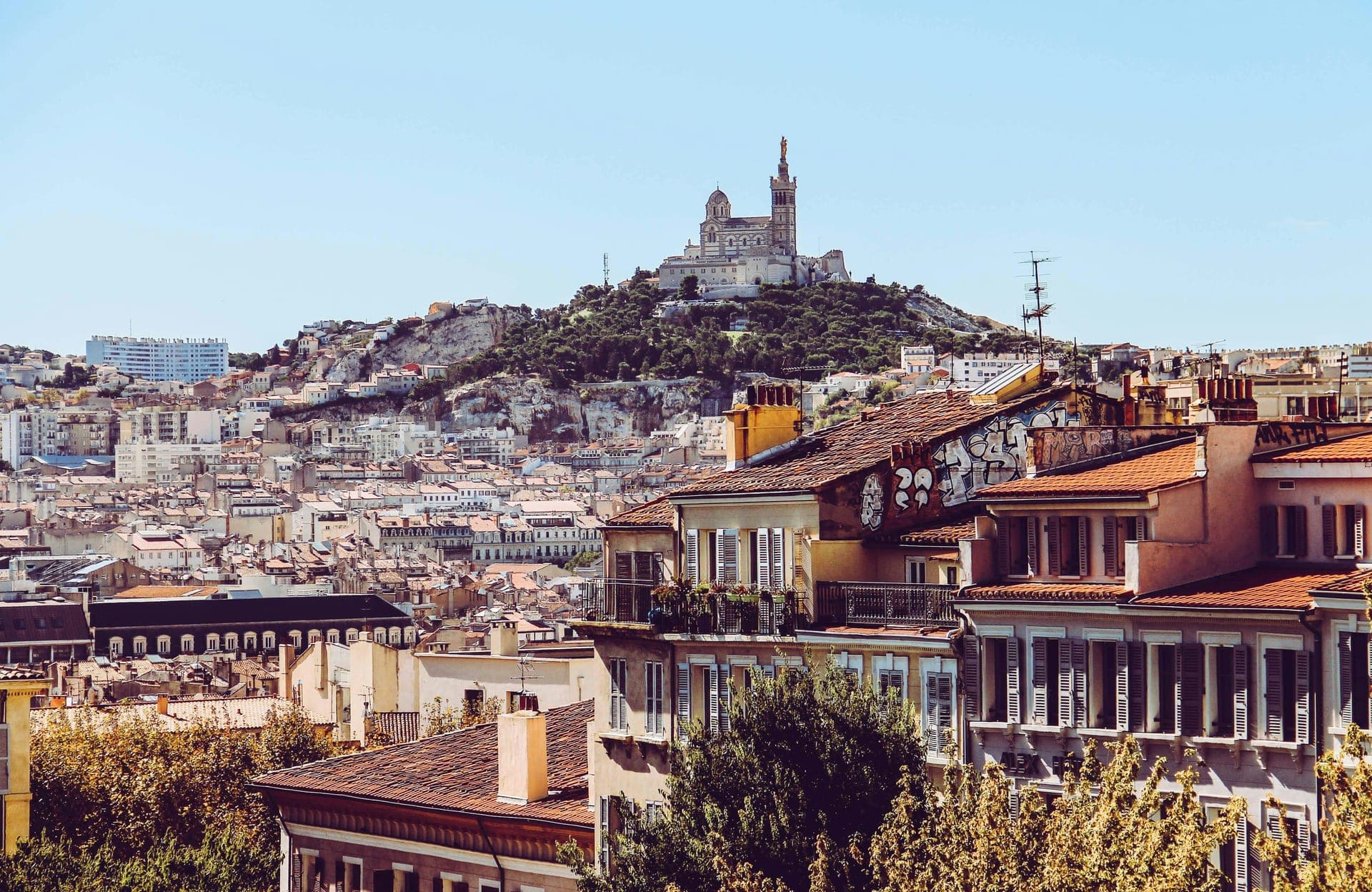
What 2,600 years of arrivals left standing
Marseille was a city before France was a country. Greek settlers from Phocaea founded Massalia on this bay around 600 BC. It has been taking in arrivals ever since, from Italy, Armenia, Algeria, the Comoros and Senegal. What grew out of that is not one urban fabric. It is 111 village-quartiers across 16 arrondissements, a national park at one edge and a working port at the other. Housing is where that inheritance is now fought over, because almost everything Marseille will live in for the next thirty years is already standing.
The tenure mix is unusual for a French city of this size. 43% of households own their home and 54.7% rent. That renter majority looks more like Berlin than like the French average. Public and non-profit landlords hold 21.8% of main residences, some 87,326 homes. They are counted under article 55 of the loi SRU, the 2000 act that sets a minimum social-housing quota for large communes. Private landlords let the remaining 32.9%. No cooperative slice sits beside those figures. French statistics record no cooperative tenure at all, because here the cooperative is a company form inside the social-housing system rather than a way of holding a home.
- Owners
- Owner-occupier43.0%
- Renters
- Public & non-profit rental21.8%
- Cooperative0.00%
- Private rental32.9%
- Unclassified2.3%
- Unknown / Other2.3%
That makes Marseille read differently from the German cities it gets compared with. There is no Sozialbindung here, no covenant riding on a private landlord's flat and expiring back into the market. A home is social because a social landlord owns it. The SRU tally is the broader count, adding subsidised ownership and hostel places. Either way the city sits under the 25% article 55 requires of it, and has done for a quarter of a century.
Rents sort the city into tiers that barely touch. A home in the social stock lets for about €6.15 per square metre a month before charges. The median across all stock is €13. A new lease signed today costs €13.50. Furnish the same flat and it asks €16. Let it serviced, cleaned and with no lease at all, and it reaches €23. Running costs add roughly €2.10 per square metre on top. Between the bottom rung and the top sits most of Marseille's housing argument.
- Social stock
- All stock (median)
- New lease
- Furnished
- Serviced, no lease (all-in)
Monthly rent per square metre, net cold except for the serviced tier, which is all-in. The social and market tiers are more than twice apart.
Empty space here is residential, not commercial. 7.7% of the housing stock stood vacant at the last census, 38,294 dwellings. Cérema, the state planning research agency, found 19,423 of them empty for more than two years. Offices tell the opposite story. Vacancy across the Aix-Marseille office market runs at 3.9%, about 176,324 square metres, tighter than almost any northern European city can claim. So Marseille cannot convert its way out of a shortage the way Brussels or Frankfurt might. Its empty buildings are already homes, left unsafe, disputed or too degraded to let. That is the harder problem, and a well-documented one across Europe.
Compared with what you find in comparable cities, there is nothing extraordinary about the vacancy here.People keep arriving faster than homes appear. 25,226 people moved into Marseille in one recent year. The metropolitan housing plan adopted in February 2024 answers with 11,000 new homes a year across 92 communes, 4,700 of them social. Marseille has not kept pace with its share. Between 2020 and 2022 the city produced 2,934 social homes against the 7,674 it had promised, 38% of target. The prefect opened the procedure that can put a commune in carence. Rents themselves are not capped as they are in Paris or Lille. Marseille sits in the zone tendue regime, which limits how far a rent may rise between tenancies but sets no ceiling on what it may be.
The squeeze reaches well past the poorest. 201,069 people in Marseille live under the poverty line, roughly 23% of residents against 15.4% nationally. The 3rd arrondissement is the poorest in metropolitan France, with 52% below it. Yet 85% of Marseillais qualify for social housing on income, which puts most of the working middle in the same queue as the poor. More than 50,000 households are waiting, and the average wait runs past five years. Housing costs overburden an estimated 37.3% of households. Across Europe, mayors surveyed by Eurocities now name housing more often than any other issue as their single top priority. The French version of that complaint is the gap between a strong legal right to housing and its enforcement.
What gives the Marseille version its edge is a date. On 5 November 2018 two buildings collapsed on the rue d'Aubagne in Noailles and eight people died. Answering a parliamentary question in March 2026, the government put the number of homes here considered indigne or severely degraded at more than 40,000. Every housing policy written since answers to that morning. Researchers working alongside residents in Belle de Mai have been documenting who gets heard in the process ever since. The question that follows is what a cooperative answer could look like in a country whose statistics have no box for one.
The cooperative that lives inside the HLM
Ask where Marseille's housing cooperatives are, and the honest answer is that most of them are companies rather than tenures. A société coopérative d'HLM is a cooperative enterprise that builds, sells and lets social housing. Its members own the firm. They are not necessarily the people living in its flats. A younger family sits beside it. The loi ALUR of 24 March 2014 restored two citizen-led forms. In a coopérative d'habitants, residents buy parts sociales, shares carrying a right to occupy rather than a title deed, and hold the building collectively. In a société d'attribution et d'autopromotion, a group self-develops and then divides the result.
A third device has grown faster than either. The bail réel solidaire (BRS) is a solidarity ground lease. The household buys the walls, an organisme de foncier solidaire (OFS, a non-profit land holder) keeps the ground beneath, and the resale price stays capped permanently. That pulls the purchase well under the open market. It is France's version of the community land trust, arrived at independently.
The habit here is old, and it was broken on purpose. On 13 January 1908 some 50 cooperatives of habitations à bon marché (cheap dwellings, forerunner of the HLM) founded their national federation in Paris. By 1940 there were 437 of them. Their signature product was location-attribution: a household rented from the cooperative and owned the flat outright once the loan was repaid. More than 400,000 families became owners that way. Laws in 1965 and 1971 abolished the mechanism. The movement then spent three decades recovering its powers, in 1983, in 1992 and finally through the SRU act of 13 December 2000. Nothing in the sector today reaches past that interruption without having been rebuilt around it.
What exists now is large, professional and almost invisible. Nationally, 162 cooperative HLM societies manage 208,744 social rental homes, count 107,758 members and produced 7,724 new units in a year. Around Marseille the live actors fall into three clusters, and they do not share a problem.
Grand Delta Habitat is the first kind, a cooperative HLM of collective interest based in Avignon. It holds roughly 20,000 homes across Provence and recently handed over 47 social flats on the avenue du Merlan. Its binding constraint is land. The second cluster is the vehicle such landlords built to relieve exactly that. Grand Delta Habitat, La Maison Familiale de Provence, Axédia and Arcansud created Coop Foncière Méditerranée in 2018, a shared OFS approved by the regional prefect in February 2019. Its constraint is the price of the plots it must buy first. The third cluster is citizen-led and very small. Habitat Participatif France has its seat in Marseille, and groups including Cohabitat 13, CORAIL and L'Annonciade are still finding one another and finding a site. Their constraint is time, measured here in years.

The distance left to travel is clearest from outside. The French government's own guidance notes that cooperatives hold 5% of Switzerland's stock, around 15% of Norway's and 40% of Oslo's. Set beside the resilience mature European cooperative sectors have shown, France's citizen-led wing is a rounding error, and the people inside it say so first. What is shifting is where the public levers point. The solidarity ground lease sits in the mayor's programme, the metropolis writes land mobilisation into its housing plan, and cooperative landlords are among the buyers for repaired buildings.
A city already built, and who holds which lever
Benoît Payan was returned as mayor on 22 March 2026 with 54.34% of the second round, and housing was the platform he ran on. It has four verbs. Produce, with €30 million of municipal money for social housing, the SRU quota treated as a commitment rather than a fine, and the solidarity ground lease used to widen ownership. Regulate, meaning rents, tourist lets and empty flats. Rehabilitate, which in practice comes first, because as the mayor puts it Marseille is a city that has already been built. Support, meaning rental intermediation, eviction prevention and priority for the most vulnerable. The city has built a housing directorate of 130 staff and referred some 200 cases to the courts.
Housing yourself with dignity is not a privilege, it is a fundamental right.Three levels hold different levers, and part of the city's recent history is an argument about that split. Paris holds the framework: article 55, the tenancy code, and the money moving through Anah (the national housing agency) and ANRU (the national urban-renewal agency). The Aix-Marseille-Provence metropolis has held the housing competence since 2018, yet adopted its first programme local de l'habitat only on 22 February 2024. Nicolas Isnard took its presidency for the 2026-2032 term. The city keeps the powers that matter in a crisis of dangerous buildings: evacuation orders, the permis de louer (a licence a landlord must obtain before letting in designated streets), and its own land. When the prefect raised carence, the mayor's reply pointed at the metropolis for shelving a housing plan in 2019. Prefects must sign the next round of carence orders by 30 December 2026.
The reply to the dangerous stock has no real precedent in France. The SPLA-IN is a state-backed development company set up in 2021 under the Marseille en Grand plan announced at the Pharo that September. It was handed four priority blocks of roughly 450 buildings and a fifth scattered block of about 60, over 500 in all, holding 2,500 homes. By the end of 2025 it owned 76 addresses, with works engaged, compulsory purchases launched and repaired buildings sold on to social landlords.
The money behind it is national. The urban-renewal programme has contracted €164 million of subsidy across 2,050 dwellings. Anah's yearly grant to the department rose from €19 million in 2019 to €75 million in 2025. On 24 December 2025 four decrees created ORCOD-IN operations, the heavy instrument for failing condominiums, at Le Mail, La Maurelette, Les Rosiers and Consolat. Those four cover 2,600 homes and 9,000 residents, with around €600 million of investment from all funders. Detection has been industrialised too, through 20 permis de louer perimeters and the Signal Logement portal, which has taken more than 12,000 reports since 2022.
Tourist lets got the sharper instrument. Since 1 January 2026 a resident may let a main home for 90 nights a year rather than 120. An owner converting a second home into a holiday flat must now compensate the city with housing elsewhere. Registration is compulsory and a breach can cost €50,000. Applications to change the use of family flats have fallen from more than 800 a year to fewer than 100, and about a fifth of those will be granted. The city still counts between 12,800 and 12,900 Airbnb listings. The European Parliament's review of short-term rental regulation describes this exact sequence, with city compensation rules arriving ahead of the EU data-sharing regime that will make them enforceable.
Climate rules now bite on the same buildings. France has barred the letting of class G homes since 2025, with class F from 2028 and class E from 2034. In a centre of old, poorly insulated stone buildings that is a supply question as much as an energy one. The metropolitan plan sets a target of 16,000 energy retrofits a year. Social and cooperative landlords are expected to carry that load, as they are across Europe. Office-to-home conversion, the fashionable answer elsewhere and a well-evidenced one for carbon, has little to work with where offices are close to full.
The disagreement is not about whether to act. Franck Allisio, whose National Rally list took 40.30% of the second round, put the opposing case to the housing minister in writing months before the election. The government's published reply answered with the inventory of instruments rather than a delivery date. Both readings survive. A metropolitan plan to treat 12,000 substandard homes over ten years is a real commitment. It is also slower than the rate at which buildings are failing. Residents' groups here have signed a pan-European manifesto arguing that people in housing emergencies should co-produce the response rather than be consulted on it.
Inadequate rehabilitation schemes, the lack of effective control over slum landlords and the slowness of administrative procedures are making the crisis worse.- 1995[source]
Euroméditerranée is launched
France's largest urban regeneration operation begins on 310 hectares by the port, later extended by 170 more. Budget of €7 billion, of which €5 billion private.
- 5 November 2018[source]
Rue d'Aubagne collapses
Two buildings fall in the Noailles quarter and eight people are killed. Enforcement against substandard housing across the Bouches-du-Rhône is rebuilt around the event.
- September 2021[source]
Marseille en Grand and the SPLA-IN
The President's Pharo speech makes substandard housing a national priority; the state creates the SPLA-IN to take on five blocks totalling over 500 buildings and 2,500 homes.
- 22 February 2024[source]
The metropolis adopts its first housing plan
The PLH 2023-2028 targets 11,000 new homes a year across 92 communes, 4,700 of them social, plus 12,000 substandard homes treated over ten years.
- 1 January 2025[source]
Class G homes may no longer be let
The first rung of the French energy-performance ban takes effect on the worst-rated dwellings.
- 24 December 2025[source]
Four failing estates placed under ORCOD-IN
Decrees cover Le Mail, La Maurelette, Les Rosiers and Consolat: 2,600 homes, 9,000 residents, around €600 million of investment.
- 1 January 2026[source]
Short-term lets capped at 90 nights
The limit on letting a main residence drops from 120 nights, compensation becomes compulsory for second homes and breaches can cost €50,000.
- 22 March 2026[source]
Benoît Payan re-elected
His list takes 54.34% of the second round and 73 of the 111 council seats, on a four-part housing programme.
- 30 December 2026[source]
Deadline for carence orders
Prefects must sign the orders closing the 2023-2025 SRU triennial review; a commune declared in carence can see its levy multiplied and lose its pre-emption right to the state.
- 1 January 2028[source]
Class F homes may no longer be let
The second rung of the energy-performance ban reaches a much larger slice of the private centre-city stock.
- 2033[source]
Ten-year substandard-housing target falls due
The metropolitan plan's commitment to treat 12,000 substandard homes runs to the end of its ten-year horizon.
- 1 January 2034[source]
Class E homes may no longer be let
The final scheduled rung of the ban lands on stock that most owners still regard as ordinary.
Milestones that set the terms of Marseille's housing policy, and the dates it has committed itself to next.
From the Radiant City to 12 flats in Saint-Mauron
La Cité Radieuse still stands on the boulevard Michelet, the most photographed housing block in France. Le Corbusier built it between 1947 and 1952 as state-funded reconstruction housing: 337 apartments in 23 layouts over 12 storeys, a shopping street halfway up and a school on the roof. UNESCO listed it in 2016. It is also a caution about scale. What followed were the grands ensembles of the northern districts, built fast, funded once and left to age. The projects that carry weight now are smaller, slower and owned differently.
Les Habeilles opened in May 2025 in Saint-Mauron, in the 3rd arrondissement. It is the first participatory building in Marseille let entirely as social housing. It holds 12 flats, from one room to five, over seven storeys on pilotis. Around 214 m² is shared: wide corridors, guest rooms, a laundry, terraces, a rooftop room and two ground-floor rooms open to the street. A two-room flat lets for €385 a month. Grand Delta Habitat carried it as landlord, and ministerial derogations on density and allocation rules were needed to make it lawful. It took 15 years from first meeting to first key, which is the number people quote when asked why there are so few.
Vision d'Aou sits at the other end of the same argument. On the Plan d'Aou plateau in the 15th arrondissement, Erilia, Demathieu Bard Immobilier and Ekinov are delivering 106 homes: 71 houses and 35 flats across 8,700 m². The site is 2.1 hectares of the last land left in a quarter under renewal for two decades. It is the first solidarity-ground-lease scheme sold inside a Marseille priority neighbourhood. The land stays with the solidarity land body. Households buy the buildings only, and the resale cap travels with the home rather than expiring. That is the feature separating this family of tenures from ordinary subsidised ownership.
Coco Velten put both halves of the problem inside one building. From 2019 a disused administrative block on the rue Bernard du Bois ran 80 emergency accommodation places beside 40 workshops, a canteen and an open garden, run by Yes We Camp, Plateau Urbain and Groupe SOS Solidarités on a temporary-occupation agreement. Of 186 residents, 115 left for a permanent home, and families stayed an average of 380 days. It closed in December 2023, and Marseille Habitat, the city's own landlord, bought the building. Its €10 million conversion keeps the 80 places and adds 16 social flats, a 250 m² solidarity canteen, social-economy workspace and a day centre for women and children. Reclaiming vacant space for people in housing emergency is a European practice. Here it produced a permanent building rather than a pilot.
La Friche la Belle de Mai has run the same manoeuvre on a bigger box since 1992, turning the old Seita tobacco works into a cultural quarter governed as a cooperative of collective interest. Its housing chapter is around 20 participatory social rental homes with the social landlord La Maison Familiale de Provence and the architects Kristell Filotico and Cécile Gaudoin. Belle de Mai is also where the Marseille Fairville Lab works, where residents, Un Centre Ville Pour Tous, APPUII and researchers from Aix-Marseille Université try to co-produce a local housing plan instead of being consulted on one. The barriers that stop such labs scaling are documented from the inside, and fragmented governance leads the list.
Hôtel du Nord is the city's oldest cooperative habit, and it has nothing to do with tenure. Founded on 1 January 2011 in the northern districts, it is a residents' cooperative in which inhabitants hold at least 51% of the voting rights. It runs guest rooms, walks and a school of hosts around heritage its members define themselves. It owns no homes. It matters because the cooperative reflex already exists in the parts of Marseille the housing debate rarely visits, and has held for well over a decade. Collaborative living in Europe has repeatedly grown out of exactly this kind of non-housing practice.
Euroméditerranée is where public money and climate targets meet. Launched in 1995 across 310 hectares behind the port and extended north by 170 more, it carries Thassalia, the first marine geothermal plant in Europe, heating and cooling buildings from the sea. It is also the one place in the city where housing is built at volume rather than repaired. That makes it the test of whether a city of small, hard-won projects can also do scale, which is the question the European housing sector keeps returning to.
Put these on one map and they do not add up to a housing system. They read as proofs, each one small and each one expensive in years. A social landlord can hand over a building its tenants helped design. Land can be taken off the market on a plateau in the north. A disused office can shelter 80 people while it waits to become homes. A national federation for participatory housing can be run from here. A city founded 2,600 years ago by people arriving from the sea has never had one answer to who gets to stay. It now has more working answers at once than at any time since Le Corbusier put a school on a roof.
References
Statistics16Click on any number to see the source
Housing market
Tenure & affordability
Adaptive reuse & vacancy
Population & migration
From our library17
- Eurocities Pulse Mayors Survey 2025 — Knowledge
- Tenth Overview of Housing Exclusion in Europe — Knowledge
- Report of the HOUS mission to Paris, France — Knowledge
- Tools to Deal with Vacant Housing — Knowledge
- Fairville - Data collection for inequalities’ impact analysis on political participation and democratic quality — Knowledge
- Housing Cooperatives in Europe - Resilience and Adaption to Changing Need — Knowledge
- Community Land Trusts in Europe: State of the Sector Report — Knowledge
- Habitat Participatif France — Organisation
- Towards Collaborative Living — Knowledge
- Urban Community Land Trust in Europe — Knowledge
- The regulatory aspects of short-term rentals in the EU — Knowledge
- Climate adaptation in public, cooperative, and social housing in Europe — Knowledge
- Conversion of offices into affordable housing — Knowledge
- Co-producing routes out of the housing emergency - A Manifesto for Just and Democratic — Knowledge
- Fairville - Barriers and Emerging Pathways to Scaling Co-production: A perspective from the Fairville Labs — Knowledge
- Reclaiming Vacant Spaces to Tackle Housing and Homelessness Crises in Europe — Knowledge
- The State of Housing in Europe 2025: Trends in a Nutshell — Knowledge
Further sources26
- Marseille — Wikipedia
- Unité d'habitation, Marseille — Wikipedia
- Euroméditerranée — Wikipedia
- 2026 Marseille municipal election — Wikipedia · March 2026
- Written question 9815: substandard housing in Marseille, and the government's reply — Assemblée nationale · 31 March 2026
- Programme local de l'habitat 2023-2028 — Métropole Aix-Marseille-Provence · 22 February 2024
- 37,475 dwellings currently vacant in Marseille, according to the latest INSEE data — Marsactu · 17 January 2024
- 201,069 people in Marseille live below the poverty line — Marsactu · December 2024
- Payan's reply to the prefect on social housing puts the metropolis in the frame — Marsactu · May 2023
- Marseille tightens the screw on tourist lets: 90 nights maximum for a main residence — ICI Provence (Radio France) · 1 January 2026
- More than five years' wait on average for social housing in Marseille — ICI Provence (Radio France) · 16 June 2025
- Paris, Lyon, Marseille: what the new mayors plan for housing — Sud Habitat · 2026
- HLM cooperatives: key figures 2024 — Coop FR · 2024
- A little history of the HLM cooperatives — Fédération nationale des sociétés coopératives d'Hlm
- Participatory housing: a legal framework for living differently — Ministries for Ecological Transition and Housing
- Energy performance diagnosis and the rental bans attached to it — Ministries for Ecological Transition and Housing
- Like a family: inside the first participatory building in social housing — Basta! · 2025
- Erilia, Demathieu Bard and Ekinov launch 106 solidarity-lease homes at Plan d'Aou — TPBM · 28 March 2023
- Marseille Habitat sets out its plans for the building after Coco Velten — Gomet'
- Hôtel du Nord, coopérative d'habitants — Hôtel du Nord
- Coop Foncière Méditerranée, organisme de foncier solidaire — Fédération des Coop'HLM · 2022
- Marseille Fairville Lab — Fairville (Horizon Europe)
- SRU 2023-2025 review: prefects told to combine firmness and flexibility — TPBM · 2026
- 31st report on the state of housing exclusion in France — Fondation pour le Logement des Défavorisés · 29 January 2026
- Grand Delta Habitat delivers 47 social rental homes in Marseille — Les Coop'HLM
- Eurocities Pulse city monitor: where housing sits on mayors' priorities — Eurocities · 2026