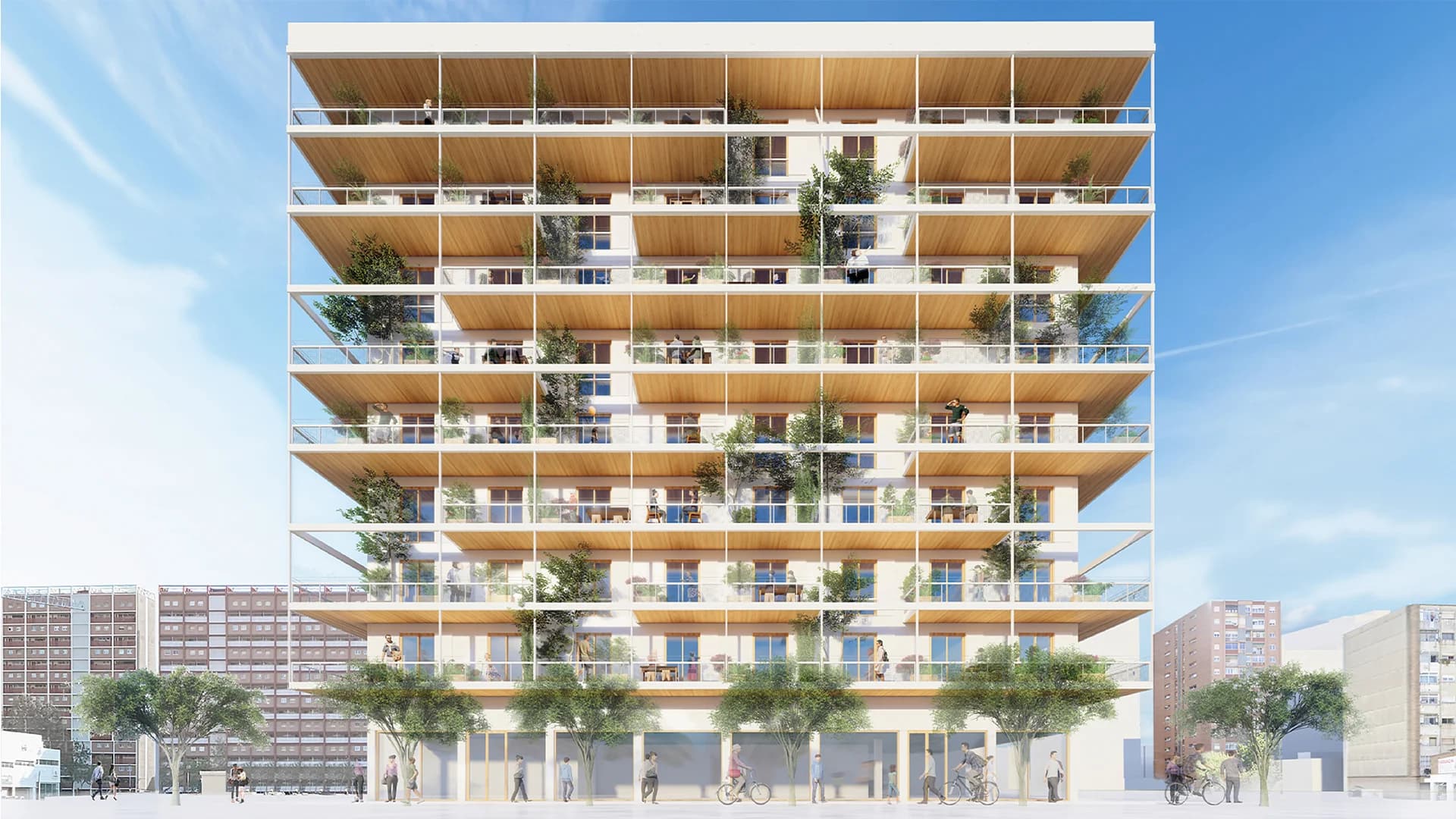
"Terrazas para la vida" is an innovative social housing project designed by Urbanitree and constructed by Soriguè in the Verneda i la Pau neighborhood of Sant Martí, Barcelona. The eight-story building comprises 40 affordable apartments and won a competitive bid launched by Barcelona's Municipal Housing Institute during the COVID-19 pandemic.
The project prioritizes sustainability and speed of construction through its use of cross-laminated timber (CLT) structural system, reducing construction time by approximately 40-50% compared to traditional methods. Built on a concrete base, the building features industrialized wooden construction that minimizes carbon emissions while maintaining architectural quality.
A defining characteristic is the spacious terraces that extend up to 1.8 meters with varying dimensions, creating dynamic facades and providing residents with outdoor living spaces. These terraces are suspended from the roof structure rather than cantilevered to reduce thermal bridges.
The rooftop hosts a solar greenhouse spanning over eight meters in height, enabling on-site food production and energy generation through photovoltaic panels. A ground-floor community space, originally planned as a fabrication lab, serves as a gathering point for residents.
The design responds to contemporary urban challenges by addressing climate change, housing shortages, and quality of life concerns. All apartments feature natural light and cross-ventilation, while the project demonstrates viable approaches to low-emission construction through wood industrialization, influencing future residential developments in Spain.