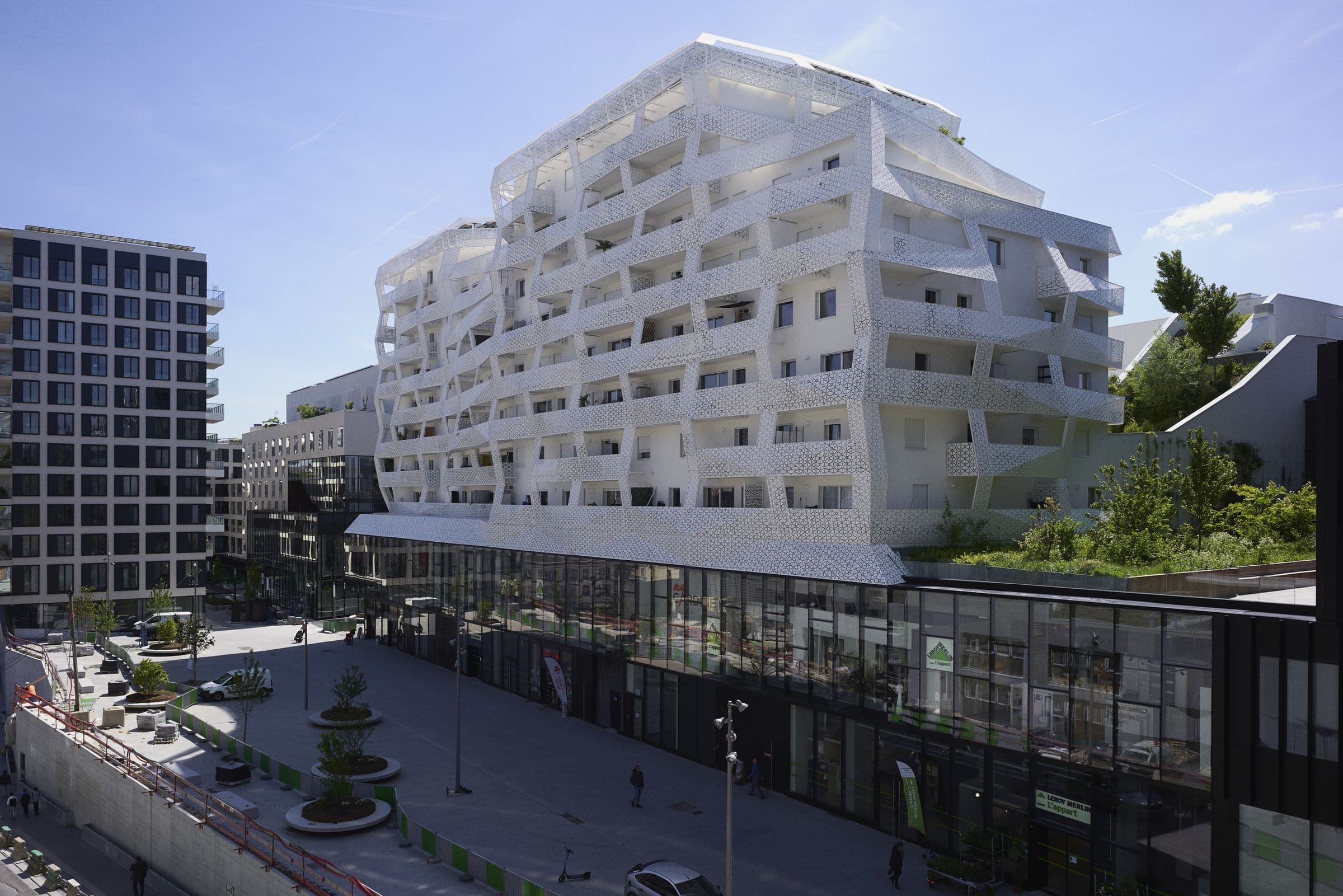
Clichy-Batignolles is a groundbreaking eco-district urban regeneration project located in the 17th arrondissement of Paris, France. Developed by Paris & Métropole Aménagement, a public company owned by the City of Paris, the project transforms a former SNCF railway yard into a mixed-use community spanning 54 hectares (133 acres). Begun in 2002, the ambitious development was designed to serve as a model for sustainable urban development.
The district features contributions from multiple internationally recognized architecture firms, including Avenier Cornejo Architectes, Nicolas Laisné Architectes, SAM architecture with Querkraft, and TVK, among others. The master plan centers around Martin Luther King Park, one of Paris's largest parks, creating a vibrant urban landscape with residential, commercial, cultural, and recreational spaces.
The housing development includes diverse accommodation types: apartments for first-time buyers, rent-controlled units, social housing, student residences, and a nursing home. Building heights reach up to 50 meters, carefully modulated to transition between historic Haussmannian architecture and contemporary design. The project prioritizes sustainability through strict energy standards, with heating energy consumption limited to 15 kilowatt-hours per square meter, following Passivhaus building standards. Features include 6,500 square meters of green spaces within housing blocks and 26,000 square meters of green roofs.
The development incorporates multiple uses including shops, cultural centers, a seven-screen multiplex cinema, and community facilities. Originally slated for completion in 2020, Clichy-Batignolles represents one of Paris's most ambitious contemporary urban projects, combining dense development with environmental responsibility and social inclusivity.