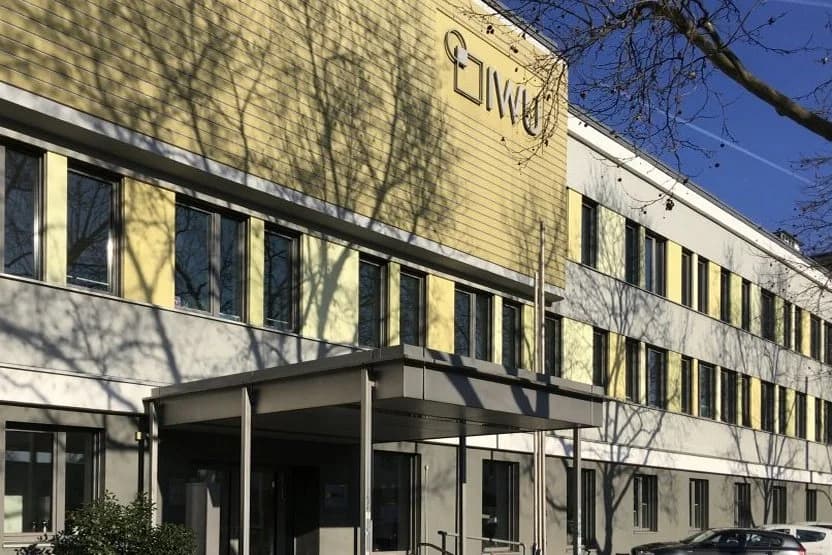
The Institut Wohnen und Umwelt (IWU) is a non-profit research organisation headquartered in Darmstadt, Germany. Established in 1971 by the Hessian state government, its shareholders are the State of Hesse and the City of Darmstadt. IWU maintains a staff of approximately 40, drawn from disciplines such as architecture, engineering, sociology, law, economics, and urban planning. The institute’s library holds around 44,000 volumes and 160 journals, supporting an output of roughly 60 scientific publications annually.
IWU's work centres on applied and fundamental research related to housing, urban development, energy efficiency, and climate protection. Historically, it has investigated urban development, the modernisation of housing, citizen participation, and social aspects of housing. Since the mid-1980s, IWU has addressed energy consumption in buildings, including the design of low-energy and passive houses and the development of tools to assess thermal standards.
Each year, about 40 to 50 research projects are undertaken. Recent projects include the monitoring of Germany’s building stock, the modelling of climate transformation scenarios for residential areas, and the assessment of energy efficiency and retrofitting strategies. IWU is also involved in modelling future housing needs, analysing housing market access for lower-income households, and studying the legal and regulatory frameworks affecting housing.
The organisation's practical impact is reinforced by its collaboration with public authorities from the municipal to EU level and by its emphasis on deriving policy recommendations from empirical analysis and modelling.