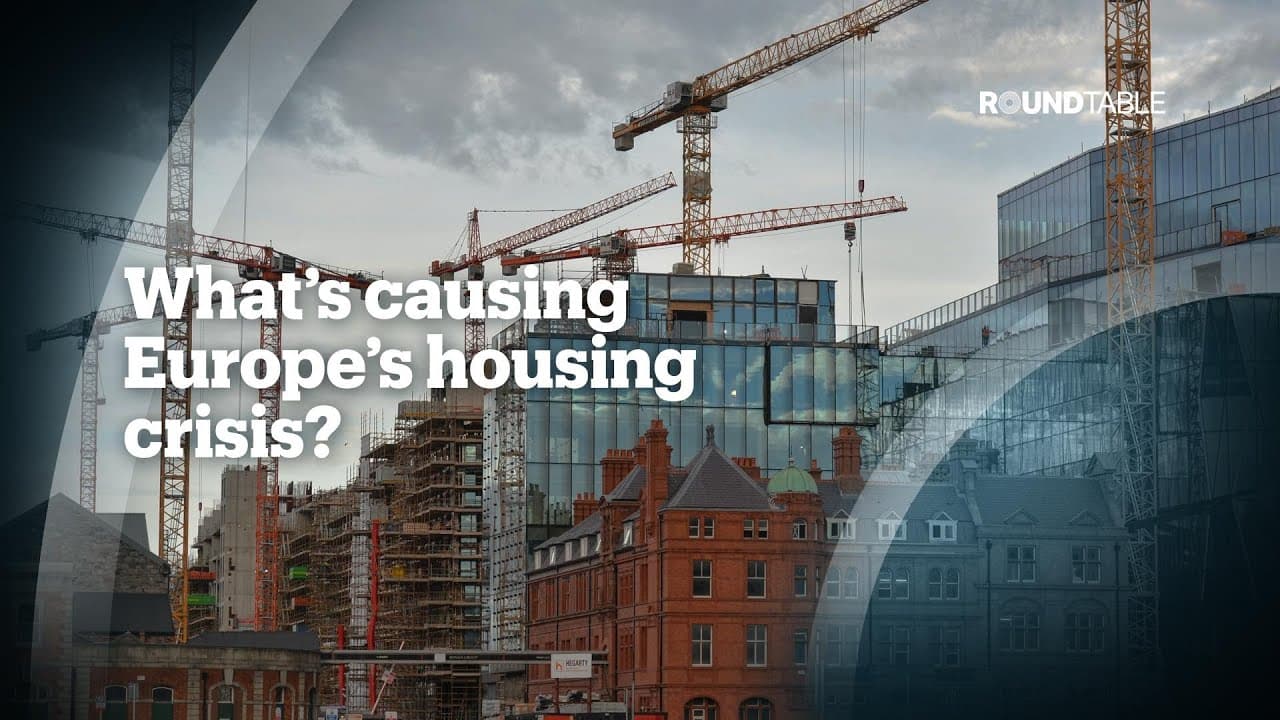
Resource context
“What's causing Europe’s housing crisis?” is a Roundtable video (Roundtable / TRT World on YouTube) featuring housing-sector and policy experts Sorcha Edwards (Secretary General, Housing Europe), Manjinder Kaur Atwal (Director of Housing & Property Litigation, Duncan Lewis Solicitors), and Rory Hearne (Associate Professor in Social Policy, Maynooth University; author of “Gaffs: Why no-one can get a house”). It examines drivers and impacts of the housing affordability crisis across multiple European countries, drawing on comparative data and on-the-ground examples.
Scale of price and rent inflation
A central data point discussed is the divergence between housing costs and incomes. Housing Europe figures cited in the conversation indicate that EU house prices were about 50% higher in Q3 2023 than in 2010, while rents rose by around 19% over the same period. The panel argues that this price/rent growth, combined with a slowdown in new home delivery, has intensified affordability pressures—especially in major cities where access to jobs, education, and transport concentrates demand.
City-level pressures and cost-of-living trade-offs
Examples from Lisbon and Prague illustrate how affordability stress intersects with local labor markets and energy costs. In Lisbon, the programme notes sustained protests about soaring rents and house prices and highlights households being priced out, including foreign workers living in tents on city outskirts. In Prague, the discussion points to a disconnect between local salaries and housing prices, with higher energy costs forcing some residents to choose between paying rent and staying warm. The transcript also notes that essential workers such as teachers, police, and firefighters may no longer be able to afford apartments in the city.
Social consequences for younger generations
The discussion frames the crisis as reshaping life chances for younger adults. It argues that rising rents and purchase prices are keeping first-time buyers and renters locked out, contributing to delayed household formation and reduced independence. In Ireland, Rory Hearne describes what they call a “generation stuck at home”: the share of 25–29-year-olds living in the parental home is described as rising from 35% (2012) to over 60% more recently, reflecting both rental unaffordability and barriers to home purchase.
Policy shift: reduced social housing investment and marketisation
A recurring explanation offered is the long-term retreat of governments from social/public housing provision, with increased reliance on private rental markets. Manjinder Kaur Atwal argues that the UK housing system needs “fundamental rebalancing” towards building new homes, particularly social homes, to address homelessness and overcrowding, while noting that private-sector rents can be high and property conditions can be poor. Sorcha Edwards similarly emphasizes that reduced investment in social housing has contributed to shortages across Europe. 🇧🇪 🇬🇧 🇮🇪 Country snapshots and system strains Belgium is presented as facing substantial unmet need for social housing: in Brussels, around half the population is described as eligible for social housing, while only about 6% are housed in it, with waiting lists exceeding the number of available units. In the UK, the programme describes growing homelessness caseloads and local authorities placing households in private rentals due to limited stock, while the welfare system is portrayed as lagging behind housing costs. In Ireland, the discussion links the crisis to “extreme marketisation” and investment-fund activity, with build-to-rent expansion and high rents cited as outcomes.
Housing as a human right and political risk
The panel links affordability to social stability and politics. Hearne argues for enshrining a human right to housing (defined in terms of affordability and security of tenure), aligning the concept with UN principles. Edwards notes that a large share of renters—46% in Europe, as cited—fear losing their home for economic reasons, and frames this widespread insecurity as a potential political shock affecting elections and social cohesion.
Directions discussed: public-good framing, new supply, and better use of existing stock
Across the conversation, proposed directions include treating housing as a public good comparable to healthcare and education, expanding social/public/co-operative or limited-profit housing options, and improving security and affordability in long-term renting. The discussion also points to the need for new construction alongside more effective use of existing buildings (including vacant homes and conversion opportunities), and highlights that while EU-level competence is limited, EU policies (for example on short-term letting transparency and state-aid rules) can indirectly shape national housing outcomes.