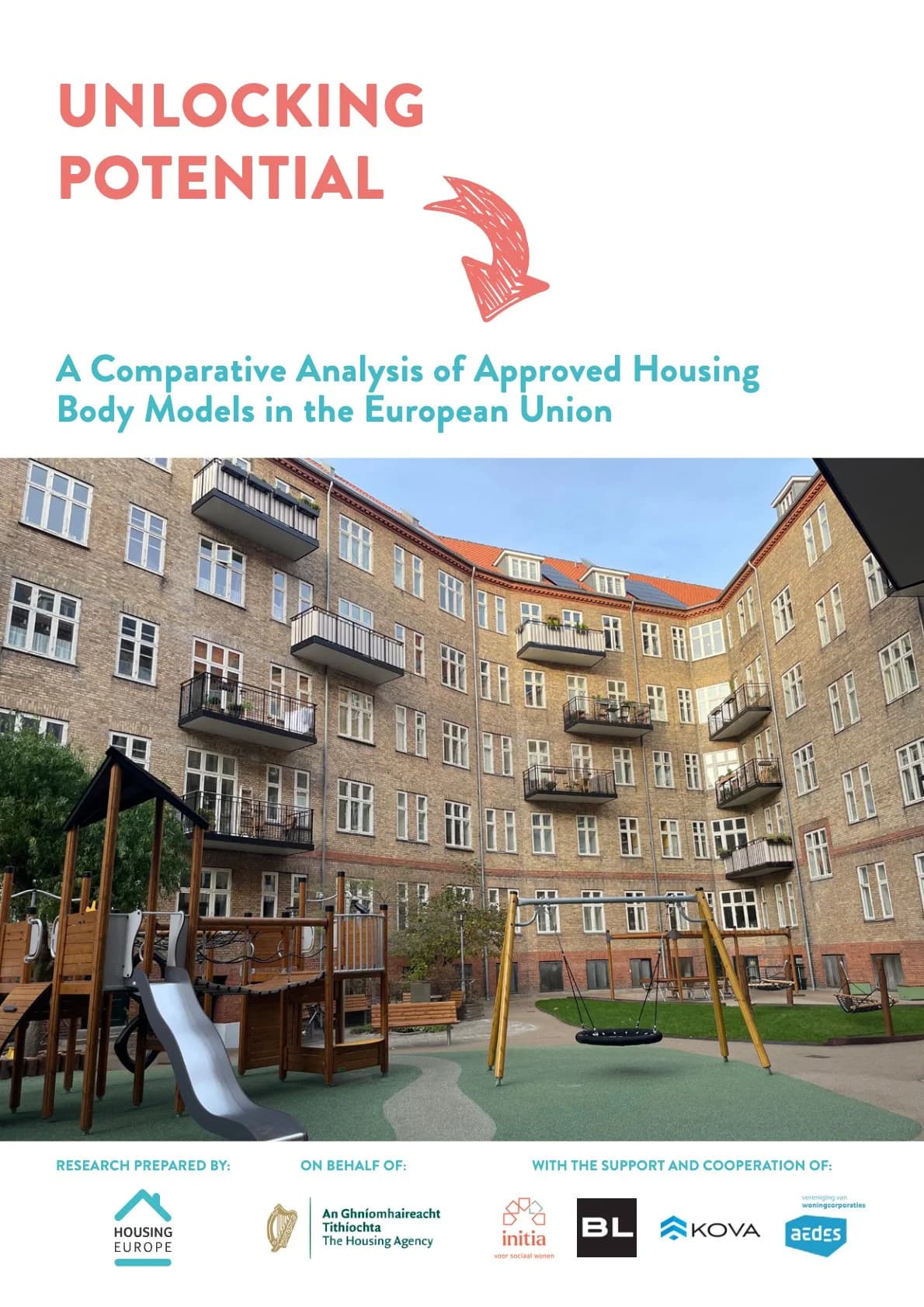
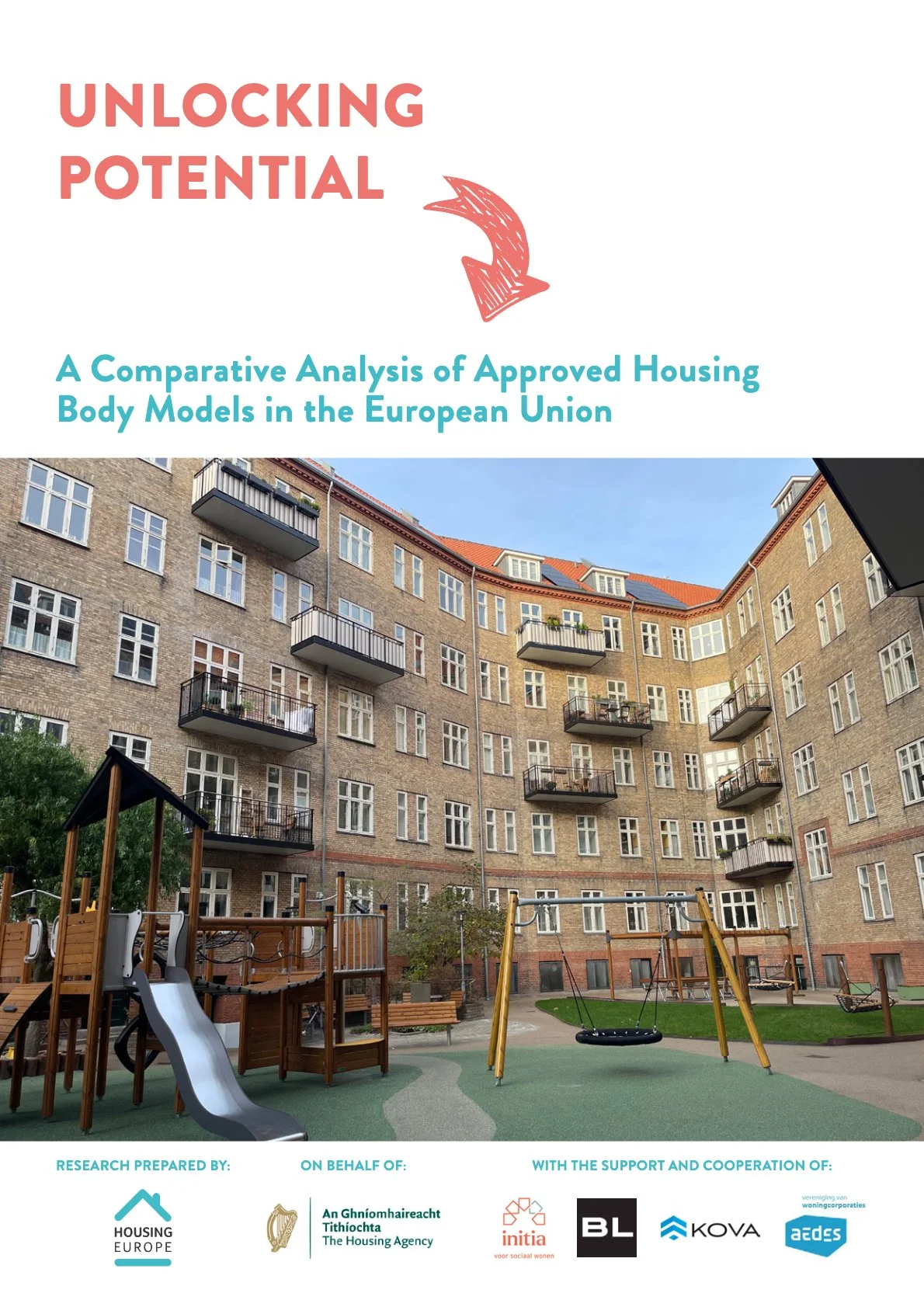
Overview of the Report
The document titled “Unlocking Potential – A Comparative Analysis of Approved Housing Body Models in the European Union” is a research report prepared by Housing Europe, a federation representing public, cooperative, and social housing providers across the EU. Authored by Dara Turnbull (Research Coordinator), Alice Pittini (Research Director) and Diana Yordanova (Communications Director), the study was commissioned by the Irish Housing Agency and submitted in October 2024. It aims to give policymakers a European perspective on how approved housing bodies (AHBs) operate in Belgium (Flanders), Denmark, Finland and the Netherlands, identifying practices that could inform Ireland’s housing strategy.
Scope and Methodology
The analysis covers four peer countries selected for their comparable economic development and EU membership. Data were gathered from national statistics, expert interviews (approximately 15 experts per country), and a structured questionnaire covering governance, strategic role, asset and tenant management, delivery methods and financing. The report combines quantitative tables (e.g., housing tenure numbers) with qualitative case studies of recent reforms, such as the forced mergers of Flemish social housing companies and Denmark’s public‑guaranteed mortgage bond model.
Key Housing Stock Figures
- Belgium (Flanders): 2.84 million dwellings, with 172 870 social rentals owned by housing companies and 159 885 leased. Social housing represents about 6 % of total housing stock.
- Denmark: 2.80 million total dwellings; non‑profit housing accounts for 20.1 % (≈560 000 units). The sector is largely funded through 100 % public development loans and municipal contributions.
- Finland: 3.32 million dwellings; cost‑based social rentals make up 15 % of the stock. Municipal Housing Companies (MHCs) own the majority of these units.
- Netherlands: 1.98 million dwellings; non‑profit housing holds roughly 25 % of the market, with a strong reliance on public‑guaranteed financing and a well‑developed tenant‑democracy model.
Governance Structures
All four countries require housing providers to be approved by municipal authorities, but the degree of public control varies. In Flanders, municipalities hold majority voting rights on the boards of newly merged social housing companies, ensuring direct local oversight. Danish non‑profit associations must be approved by at least one of the 98 municipal councils, yet operate independently with tenant‑majority boards. Finnish MHCs are arm‑length public entities owned by municipalities, allowing professional management while retaining public accountability. Dutch housing associations are largely autonomous, governed by mixed boards where tenants occupy a statutory majority of seats.
Strategic Roles and Tenant Participation
Tenant democracy is a hallmark of the Danish model, with tenants holding at least half of board seats and influencing budget and renovation decisions. Finnish providers must involve tenants in building‑level committees, granting them rights to information and voting on major works. In Flanders, recent reforms aim to increase tenant voice through the Visitation Council, though its future role remains uncertain. Dutch associations have long‑standing tenant representation, contributing to lower stigma and higher social mix.
Financing Mechanisms
Financing across the four cases blends public loans, state subsidies and limited private market participation.
- Flanders uses 100 % public development loans (interest‑free for 33 years) supplemented by interest‑rate subsidies and a “regional social correction” fund to cover deficits.
- Denmark relies on public loans with interest‑rate subsidies, state‑guaranteed mortgage bonds, and a revolving National Building Fund that absorbs cost overruns and supports deep renovations.
- Finland accesses low‑cost loans from MuniFin, backed by municipal guarantees, with an interest‑rate subsidy from the state when market rates exceed 2.3 %. Start‑up grants and land‑use agreements further reduce capital needs.
- Netherlands combines public loans, a 40 % construction cost subsidy for non‑profit projects, and tenant‑contributed equity, achieving a high degree of financial self‑sufficiency.
Sustainability and Energy Initiatives
All four systems integrate climate‑related targets. Flemish SHCs are installing solar panels through the Aster cooperative, aiming for 158 MWp capacity. Denmark’s National Building Fund finances energy‑efficient retrofits and supports the transition to low‑carbon building materials. Finnish providers benefit from the EU’s Energy Performance of Buildings Directive, with subsidies for energy‑saving upgrades. The Netherlands employs a “green financing” framework, linking loan terms to energy‑performance metrics.
Conclusions for Policy Makers
The comparative study highlights three transferable lessons for Ireland and other EU members: (1) embedding tenant democracy can improve social mix and reduce stigma; (2) public‑guaranteed financing, especially revolving funds like Denmark’s National Building Fund, enhances fiscal resilience while keeping rents affordable; and (3) coordinated land‑use planning combined with targeted subsidies accelerates the delivery of energy‑efficient social housing. The report underscores that while each model reflects national legal traditions, the shared emphasis on public oversight, sustainable financing and tenant participation offers a robust blueprint for advancing affordable, climate‑responsive housing across Europe.