Resource context (publisher and authors)
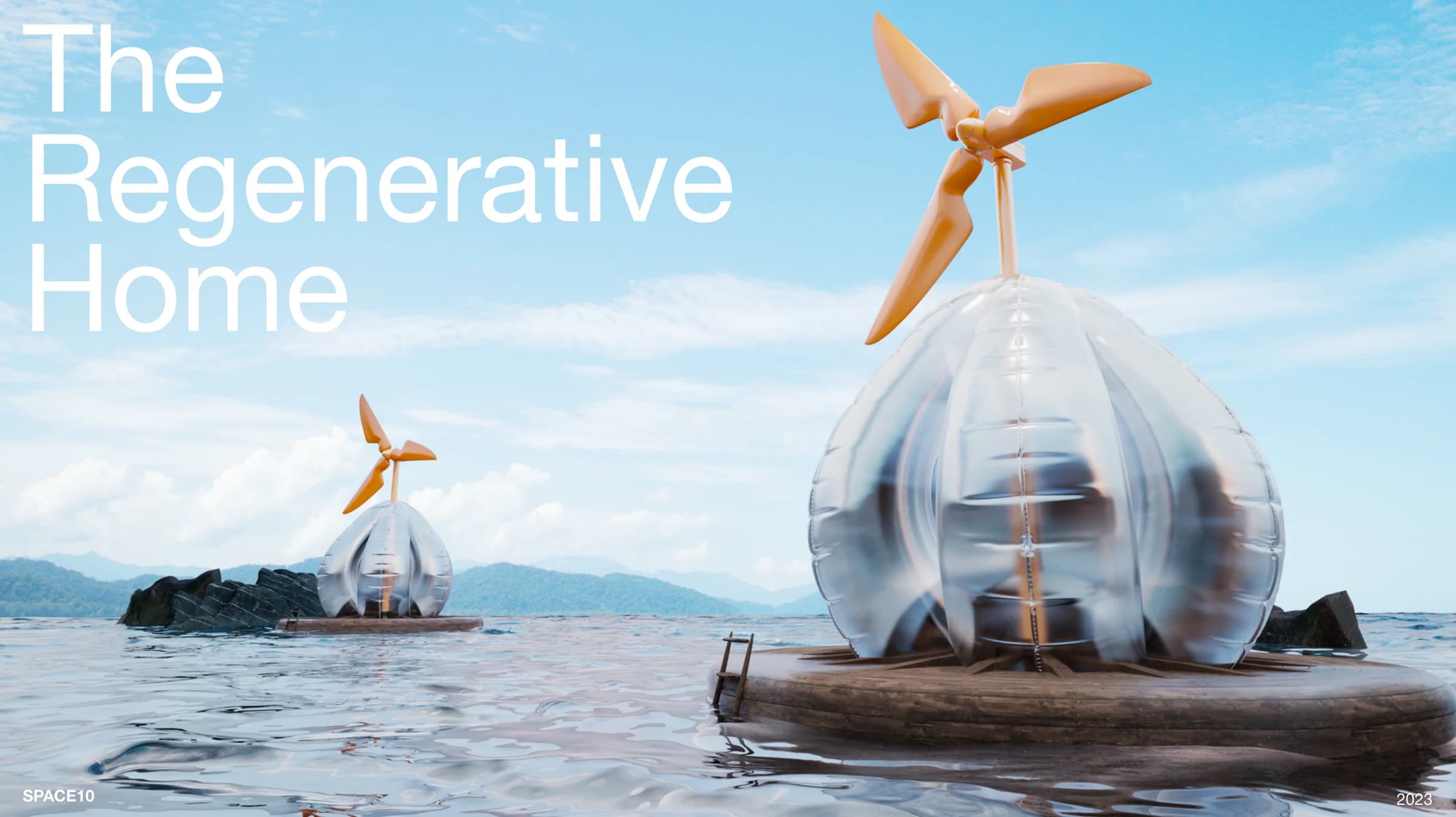
The Regenerative Home is a 2023 report by SPACE10, IKEA’s research and design lab focused on sustainable solutions for urban living. The resource frames the home as a key lever in Europe-wide sustainability transitions. The page lists the publisher as SPACE10 and does not name individual authors (recorded as “not named”).
Key problem framing and quantified impacts
The report highlights the scale of household-related impacts and uses headline figures to motivate action: residential homes account for 17–21% of global energy-related carbon emissions, and households generate 11% of global food waste. Against this backdrop, it asks how future homes can be designed and built to be better for both people and the planet.
From sustainability to a regenerative paradigm
Instead of focusing only on reducing harm, the report argues for a “regenerative” approach: homes should actively give back, close resource loops, and aim to produce more than they consume. The framing combines traditional knowledge with modern technologies, with an emphasis on changing everyday routines so that circular flows of materials, energy, and nutrients become normal parts of domestic life.
Four pillars used to structure the home system
The page summarises four core components used in the report’s structure. “Building” covers materials, retrofit potential, and the physical structure. “Energy” focuses on how homes generate, store, and use power. “Food” addresses household food systems, waste, and regenerative practices. “Belongings” looks at the objects people own, how they acquire them, and their lifecycle.
Building: retrofit, reuse, and natural materials
Among the highlighted insights, retrofitting existing buildings is positioned as a priority because it can extend building life, improve energy efficiency, and avoid emissions associated with demolition and new construction, while preserving embodied carbon. The report also promotes reuse of components and materials (“re-construct”) to reduce demolition waste and demand for new inputs. For new work and insulation, it points to locally sourced natural materials such as straw and clay, presented as abundant options that can return safely to nature at end of life.
Energy: integrate renewables and recover urban heat
The report’s energy recommendations include integrating solar and other renewable systems into the exterior and interior design so energy generation is planned from the start and can support off-grid power. It also highlights the potential to harness thermal heat from urban sources such as data centres and sewer systems, treating waste heat as a community resource that can reduce fossil fuel reliance and strengthen local grids.
Food and 🚽 sanitation: close nutrient loops at home
On food, the page notes the idea of “compost kitchens,” including composting food scraps from home-grown produce using countertop systems such as wormeries, to close the food-waste loop within the home. It also outlines “waste with benefits,” proposing redesigned sanitation systems that enable residents to turn human waste into fertiliser, supporting biodiversity and urban food production.
Belongings and 📡 data: local production, sharing, and collective action
To address consumption, the report highlights place-based production and local sourcing—from furniture to food—as a way to create jobs, preserve skills, shorten supply chains, and support regenerative business models. It also promotes “care and share” models such as shared ownership, as-a-service access, and community libraries to extend product lifetimes while maintaining access. Finally, it describes neighbourhood data networks intended to encourage regenerative behaviours and enable coordinated action in response to shifting resource and energy availability.