Overview of Study and Its Context
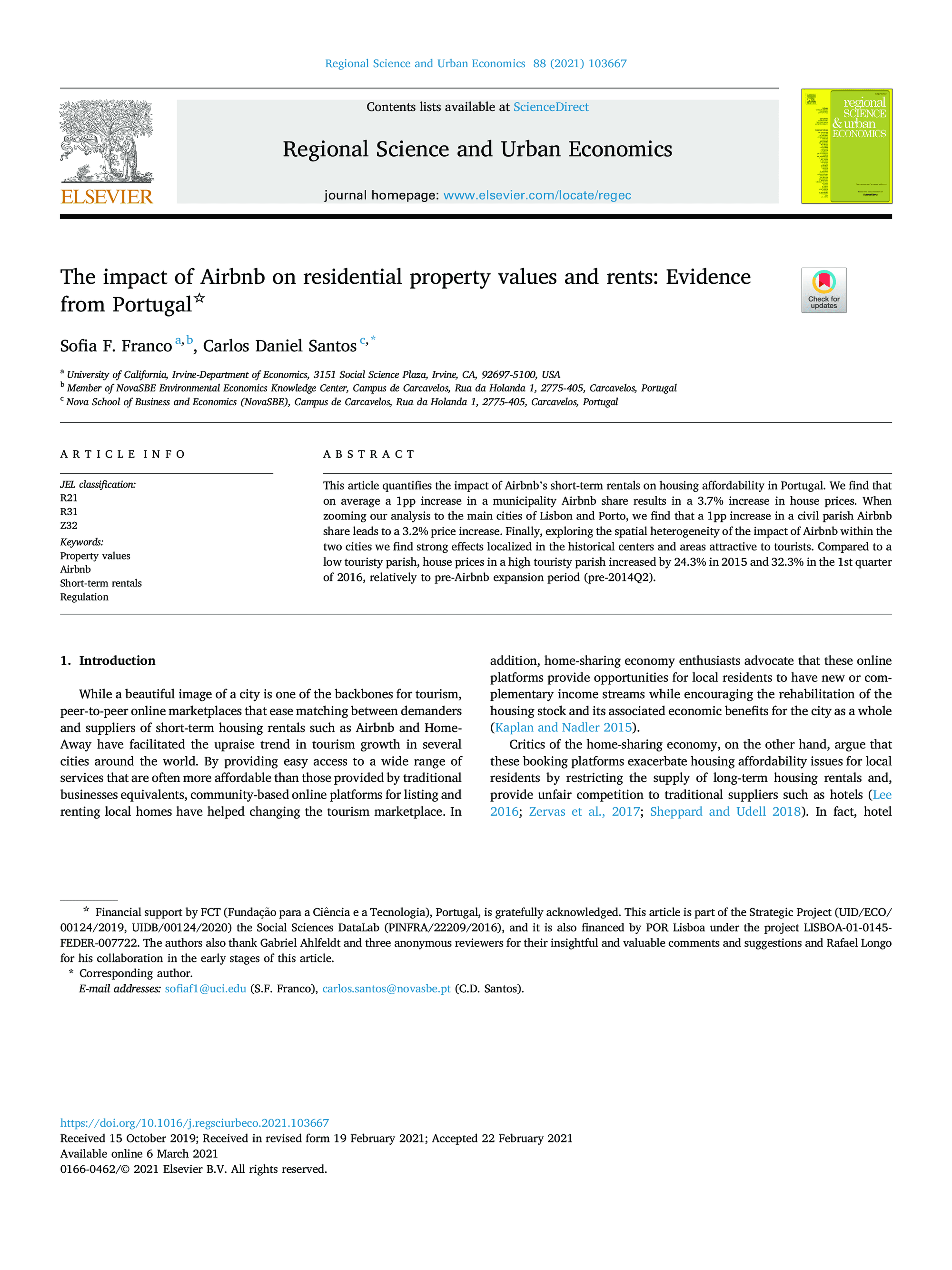
The article “The impact of Airbnb on residential property values and rents: Evidence from Portugal” is published in Regional Science and Urban Economics and authored by Sofia F. Franco (University of California, Irvine) and Carlos Daniel Santos (Nova School of Business and Economics, Portugal). The research quantifies how short‑term rentals listed on Airbnb affect housing affordability in Portugal, focusing on price and rent dynamics between 2012 and 2016.
Data Sources and Scope
The authors combine a comprehensive dataset of 44,411 Airbnb listings scraped in September 2016 with quarterly transaction‑price and rental‑price data for 106 mainland municipalities and 31 civil parishes in Lisbon and Porto. Additional information comes from the national short‑term‑rental registry (RNAL) and census statistics on dwellings, population, and building characteristics. Airbnb share is measured as the proportion of dwellings listed on the platform, ranging from 0 to 0.051 at the municipality level.
Core Findings on Property Values
A one‑percentage‑point (1 pp) increase in municipality Airbnb share raises house prices by 3.7 % on average (IV estimate). In Lisbon and Porto civil parishes, the effect is slightly larger at 2.9 % per 1 pp. High‑touristy parishes experience dramatic price spikes: house prices rose 24.3 % in 2015 and 32.3 % in Q1 2016 relative to the pre‑Airbnb period. The most affected six parishes saw an estimated 32.5 % price increase, driven by Airbnb shares of 11.2 pp.
Impact on Long‑Term Rents
The study finds no statistically significant effect of Airbnb share on long‑term rental prices. The authors attribute this to Portugal’s rent‑control phase‑out (2012–2017) and the limited exposure of the rental market to short‑term‑rental pressure during the sample period.
Methodological Approach
Two identification strategies are employed: (1) an instrumental‑variable (IV) design using the interaction of Google search trends for “Airbnb” with the 2014 Q1 Airbnb share as an exogenous shock, and (2) a difference‑in‑differences (DiD) analysis comparing high‑ versus low‑touristy civil parishes before and after the 2014 policy reform that simplified short‑term‑rental registration. Both methods confirm a robust positive relationship between Airbnb concentration and house‑price growth, while rent effects remain insignificant.
Spatial Heterogeneity and Policy Implications
Effects are concentrated in historic city centres and tourist‑attractive zones where housing supply is inelastic. The authors note that these price increases may stimulate building rehabilitation but also risk displacement of long‑term residents. Portugal has introduced tourist taxes (Lisbon 2016, Porto 2018) and stricter registration enforcement (2017) to mitigate housing‑affordability pressures.
Relevance for Sustainable Housing in Europe
For a pan‑European audience, the Portuguese case illustrates how rapid growth of platform‑mediated short‑term rentals can amplify housing price volatility in dense, historic urban areas. The evidence suggests that policy frameworks—such as registration requirements, tourist taxes, and targeted zoning—are essential to balance tourism benefits with the need for affordable, long‑term housing. The study’s methodology, combining granular Airbnb data with local market indicators, offers a replicable template for other European cities confronting similar sustainability challenges.