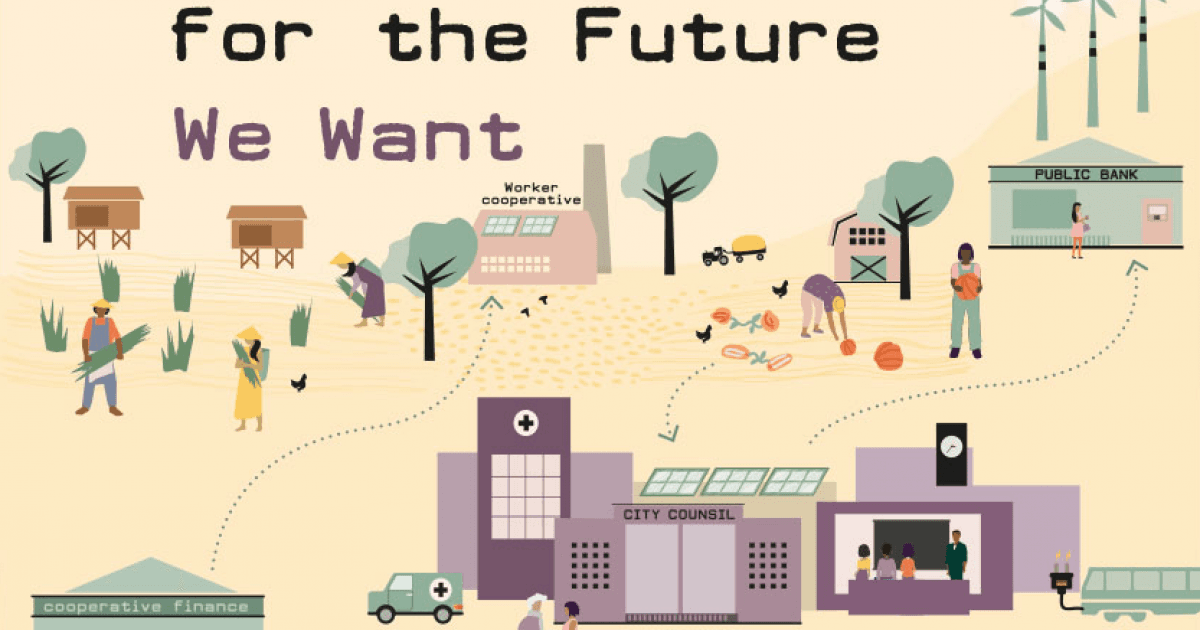
Context and publication
“Public Finance for the Future We Want” is a collaborative publication led by the Transnational Institute (TNI) together with The Democracy Collaborative and partner organisations working on economic transformation and social justice. The page lists TNI as the publisher and names a large group of contributing authors, including Lavinia Steinfort, Mary Mellor, Stewart Lansley, Duncan McCann, Milford Bateman, Benny Kuruvilla, Thomas M. Hanna, Ana Álvaro, Agnes Gagyi, Frank Vanaerschot, Thomas Marois, Oscar Reyes, Ludovic Suttor-Sorel, and Carla Santos Skandier (among others).
What the book argues is broken in today’s finance model
The resource situates its analysis in the post‑2008 period and challenges the idea that governments must primarily “leverage” private finance to solve inequality and environmental degradation. It argues that private finance has not solved these issues and has often intensified inequality by extracting value from public systems. One quantified claim highlighted is that privately financed public projects typically cost around 40% more than comparable publicly financed approaches.
Public money leaks and fiscal capacity
A central theme is that public sectors already command very large financial resources, but these are frequently constrained or diverted. The text highlights multinational corporate tax evasion as a significant drain, estimating annual public‑sector losses of roughly US$650 billion. Against narratives of scarce public capacity, the book points to the scale of public finance globally, emphasising the potential for redirecting these resources toward social goals.
Scale of public finance and public banking
The resource provides several headline figures: it cites 693 public banks worldwide with assets of about US$37.72 trillion. It also estimates total public finances—including central banks, multilaterals, pension funds, and sovereign funds—at around US$73 trillion, described as roughly 93% of global GDP. Within this framing, public finance is presented as a major, underused lever for funding equitable and low‑carbon transitions.
Funding climate and infrastructure without relying on private capital
A further quantitative claim is that public banks could raise the required US$90 trillion for climate infrastructure investment without needing private‑sector involvement. The resource uses this to argue for expanding and re‑orienting public banking and investment tools so that climate action and social priorities are funded on public terms rather than through profit‑maximising financing structures.
Links to housing, community wealth, and cooperative models
For a sustainable housing audience, the resource is relevant through its emphasis on community wealth building and cooperative, community‑owned institutions. It references the MOBA Housing Network in Central and South‑Eastern Europe as an example of cooperative housing activity, and discusses how “anchor institutions” such as hospitals and universities can support more resilient local economies—an approach that can align procurement, investment, and employment with housing affordability and local sustainability objectives.
Solutions proposed and EU relevance
The book’s proposed directions include democratising nationalised banks, strengthening social and solidarity economies, building community‑owned financial institutions, establishing public banking systems oriented toward climate infrastructure, and creating citizens’ wealth funds financed through increased taxation on private wealth. It also points to constraints from restrictive EU fiscal frameworks and argues for reforming fiscal rules to enable greater public investment in social and environmental priorities.