Overview of the Publication
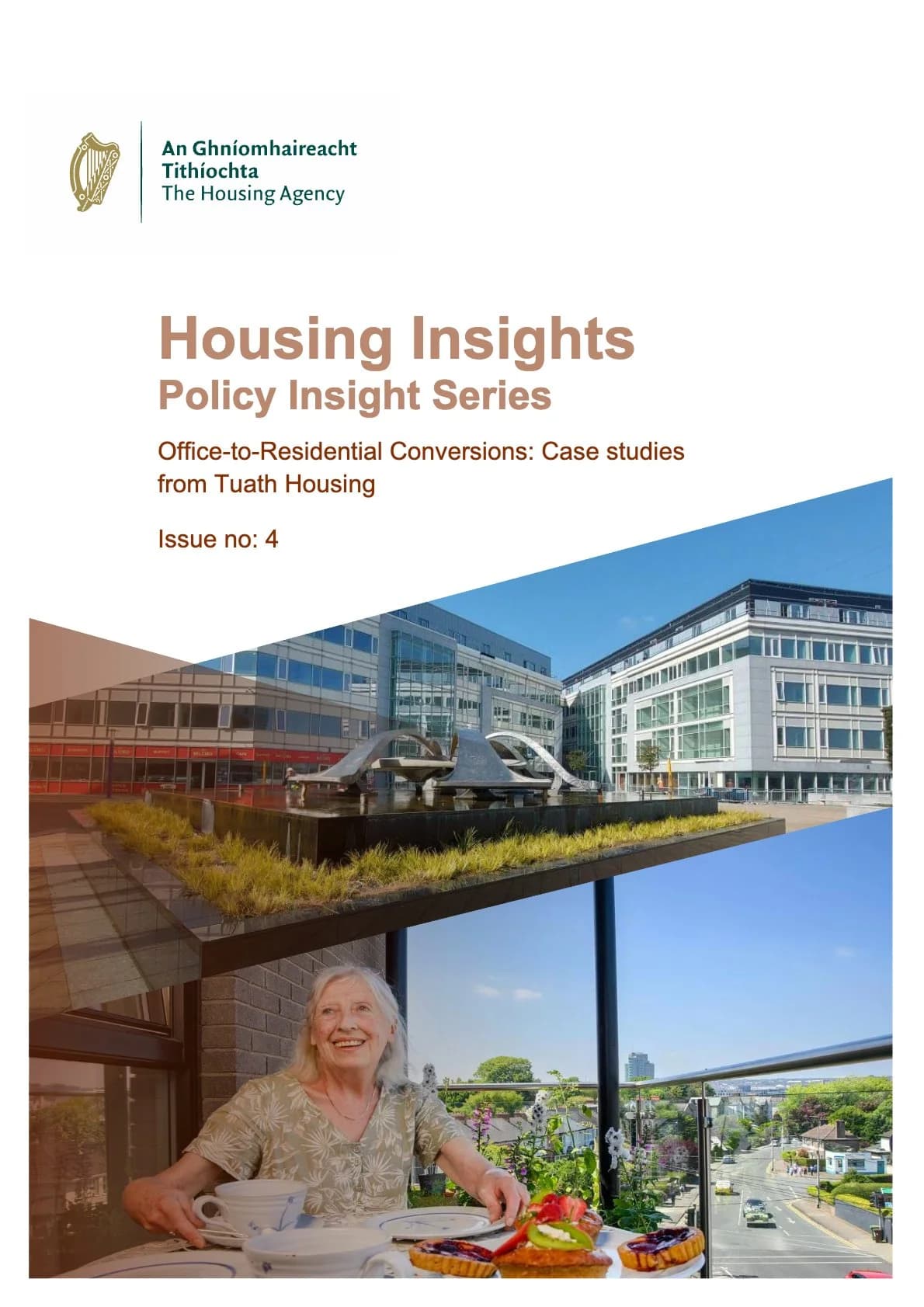
The Housing Agency, a government body partnering with the Department of Housing, Local Government and Heritage, produced this policy insight on office‑to‑residential conversions, authored by policy officers Nicola Turley and Roslyn Molloy. It presents two case studies from Tuairim Housing that illustrate how vacant commercial buildings were transformed into social housing, offering data on costs, carbon savings, and community outcomes.
Context of the Tuairim Housing Projects
Tuairim Housing delivered 86 homes at the Plaza Building in Dublin’s Park West Business Park and 35 homes at Springville House in Cork. Both sites were long‑vacant commercial premises repurposed to address rising housing demand, especially for older tenants and rightsizing needs. The projects were supported by local authorities, developers, and funding from the Department of Housing and AIB’s Social Investment Fund.
Financial Highlights and Cost Efficiency
The average development cost per unit was €309,000 at Park West Plaza and €353,000 at Springville House, notably lower than the €460,000‑plus typical for a mid‑range two‑bedroom apartment in suburban Dublin. This cost advantage stems from reusing existing structures, reducing land acquisition and site‑work expenses, and leveraging public‑private partnerships.
Carbon and Energy Performance Gains
Embodied carbon analyses show a 73 % reduction versus demolition‑and‑re‑build and a 62 % reduction compared with a new build of similar size. Energy ratings for the new homes are strong: Park West Plaza achieved 34 % A‑rated and 66 % B‑rated units, while Springville House recorded 20 A2‑rated and 15 A3‑rated apartments, translating into lower utility bills for residents.
Housing Supply Impact
A total of 121 new homes were created, delivering 86 apartments in Dublin and 35 in Cork. Park West Plaza now houses over 200 occupants formerly on Dublin City Council’s waiting list, while Springville House provides age‑friendly units for 60‑plus tenants, including single‑storey houses for additional accessibility.
Collaboration and Stakeholder Involvement
Success relied on coordinated action among Tuairim Housing, local councils (Dublin City and Cork City), developers (Harcourt Developments, MMD Construction), and funding bodies. Continuous dialogue secured planning permission, facilitated allocation of units to waiting‑list applicants, and ensured design adaptations met residential standards.
Design Solutions for Residential Conversion
Key interventions included adding a penthouse floor, creating internal garden rooms, upgrading staircases, installing sound‑proofing, individual heating metering, and providing communal amenities such as a community centre, gym, and children’s play area. Accessibility upgrades (lifts, code access, larger entrance doors) addressed the needs of older and mobility‑impaired residents.
Community and Well‑Being Outcomes
Resident feedback highlights improved safety, security, and a sense of belonging. Community spaces foster social interaction, and the presence of on‑site caretakers and security cameras enhances livability. The projects also revitalised local economies, with reopened retail outlets and further planning applications nearby.
Challenges and Viability Considerations
Financial risk remained with developers due to fixed‑price contracts, and rising construction costs pose threats to project viability. Nevertheless, the lower per‑unit cost and substantial carbon savings make conversions an attractive alternative to new builds, especially when sustainability metrics are incorporated into funding assessments.
Implications for Pan‑European Sustainable Housing
These Irish case studies demonstrate that office‑to‑residential conversions can deliver affordable, high‑performance housing while markedly reducing embodied carbon. The model offers a replicable pathway for European cities facing office vacancy, housing shortages, and climate targets, emphasizing the importance of multi‑stakeholder collaboration, adaptable design, and supportive policy frameworks.