Resource context
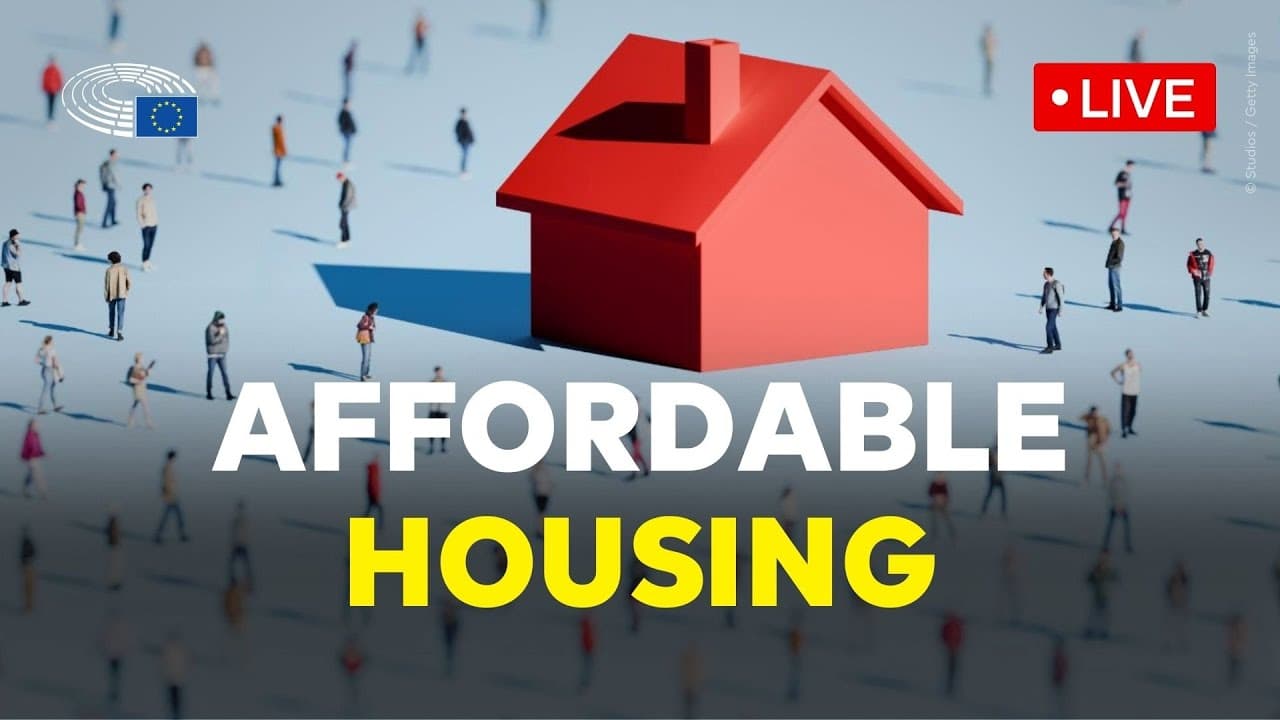
This resource, “How to solve Europe’s housing crisis”, is a video published by the European Parliament (YouTube) and captures a live debate hosted in Brussels. Speakers named in the video description and opening interventions include MEP Irene Tinagli (chair of Parliament’s special committee on the EU housing crisis) and European Commissioner for Energy and Housing Dan Jørgensen, alongside Borja Giménez Larraz, Oliver Röpke, Andres Jaadla, and Ioannis Tsakiris.
Why housing affordability is framed as an EU-wide crisis
The discussion describes housing affordability as both a social-justice and economic challenge across the European Union. Speakers link high housing costs to widening social and economic inequality, rising rent burdens for lower-income households, and reduced disposable income for education, wellbeing, and basic financial security. The debate also emphasizes impacts on labour mobility, arguing that high rents can prevent people—especially younger workers—from taking jobs or training in high-cost cities and can make it harder for employers and local authorities to attract essential workers.
Key data points cited in the debate
Several figures are highlighted to illustrate severity: in 2023, around 1 in 10 Europeans spent 40% or more of disposable income on housing and related costs. The opening remarks also cite an estimate of about 400,000 children in Europe affected by homelessness (including street homelessness, night shelters, and temporary accommodation). Energy affordability is connected to housing conditions, with a figure of 47 million people in the EU reported as unable to afford heating their homes in 2023.
Main drivers discussed: demand pressures, supply constraints, and market dynamics
Speakers describe multiple, intertwined causes. Demand pressures include tourism, student and labour mobility, and the growth of short-term rentals in some cities. Housing is also described as being “financialised”, with residential real estate increasingly treated as an investment asset, including units kept vacant, while housing stock—especially in cities—remains limited. The debate also notes limited social-housing supply relative to need and points to construction-sector constraints and permitting timelines as additional bottlenecks.
Policy and investment tools highlighted, with an emphasis on sustainability
The discussion references existing EU-level funding instruments (including recovery and resilience funding and cohesion funds) while noting that current investment is described as insufficient relative to the scale of the challenge. The European Investment Bank is presented as expanding financing for sustainable and social housing, including work toward a pan-European investment platform. Renovation and energy efficiency are presented as dual-purpose measures: lowering emissions and reducing household energy bills, alongside calls for “decent, accessible, durable” homes connected to services and infrastructure.
Governance approach and next steps described
A recurring theme is coordinated action between EU institutions, member states, and local and regional authorities, with structured dialogue involving housing providers, tenants’ associations, cooperatives, banks, construction actors, social services, researchers, and citizens. The European Parliament’s special committee and the Commission’s housing task force are presented as vehicles to map needs, assess speculation and short-term rentals, and develop an affordable housing plan, including consultations and expert input.