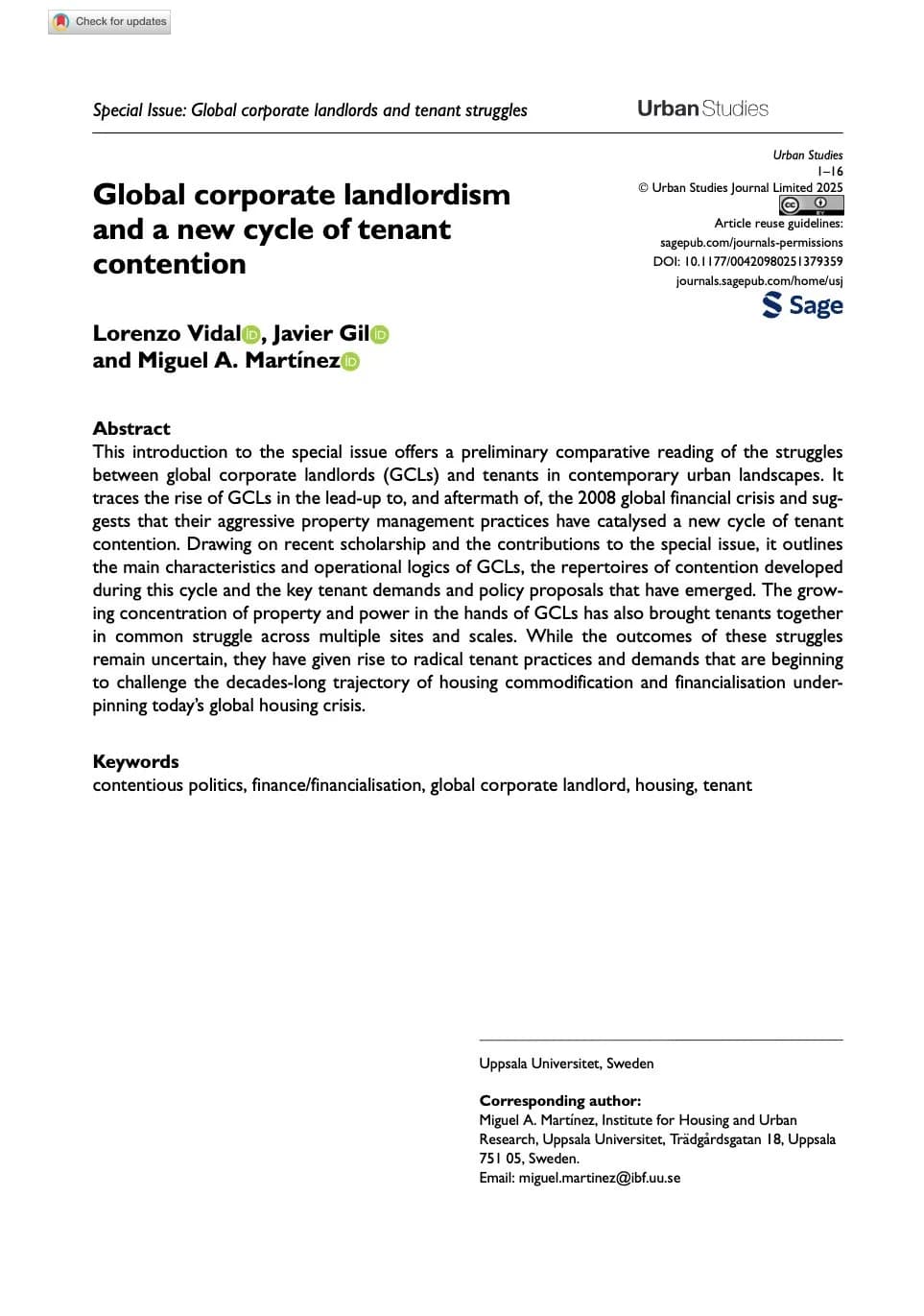
Overview of the Special Issue
The special issue, published in Urban Studies, brings together research on the rise of global corporate landlords (GCLs) and the new cycle of tenant contention they have sparked across Europe and beyond. Edited contributions examine comparative cases, theoretical frameworks, and policy responses, highlighting how aggressive property‑management practices of GCLs are reshaping urban housing markets and fueling collective tenant actions.
Publisher and Institutional ContextUrban Studies is a leading peer‑reviewed journal in urban sociology and geography, hosted by Sage Publications. The issue’s authors—Lorenzo Vidal, Javier Gil, and Miguel A. Martínez—are scholars affiliated with the Institute for Housing and Urban Research at Uppsala University, Sweden, bringing expertise in housing policy, urban politics, and financialisation.
Geographic Scope and Case Selection
The issue focuses on four European countries—Spain, Germany, the United Kingdom, and the United States as a comparative benchmark—while also referencing research from Canada, Australia, and the Global South. It documents how GCLs concentrate ownership in urban cores, with notable examples such as Berlin’s large‑scale portfolio owners, Barcelona’s rent‑strike movements, and London’s corporate landlord networks.
Financial Scale and Investment Sources
GCLs draw capital from institutional investors including pension funds, sovereign wealth funds, insurance companies, private endowments, and private‑equity firms. Post‑2008 financial crisis dynamics, such as quantitative easing and low‑interest rates, redirected vast sums into real‑estate assets, creating portfolios that span multiple countries. The issue cites that corporate landlords now manage millions of rental units and that asset‑manager‑driven funds often require liquidation within 7–12 years, driving short‑term profit motives.
Tenant Contention Repertoires
Research identifies three main tactics: anti‑eviction blockades, rent strikes, and multi‑building organising. Notable actions include Barcelona’s “Stay Put” campaign, Berlin’s expropriation referendum, and rent‑strike initiatives in San Francisco and Toronto. These tactics have scaled from building‑level protests to city‑wide and transnational networks, linking tenant unions with labour organisations and climate movements.
Policy and Legal Responses
Several European jurisdictions have introduced rent‑control measures, extended lease terms for large landlords, and mandated social obligations for owners of more than ten units. Examples include Spain’s rent‑reduction law for “large landlords,” Catalonia’s rent‑cap in stressed zones, and Denmark’s five‑year waiting period before rent increases after renovations. Legal innovations such as the Tenant Anti‑Harassment Ordinance (Los Angeles) and Tenant‑Right‑to‑Organise (San Francisco) illustrate attempts to curb harassment and empower collective bargaining.
Sustainable Housing Implications
The concentration of ownership under GCLs raises concerns for sustainable housing, as profit‑driven turnover can lead to reduced maintenance, energy‑inefficient retrofits, and displacement pressures. However, tenant mobilisation has also promoted climate‑just housing policies, advocating for energy‑efficiency upgrades tied to rent‑control provisions and demanding that corporate landlords internalise environmental costs.
Emerging Research Gaps
The issue notes limited scholarship on GCL activity in the Global South and calls for broader geographic coverage. It also highlights the need for interdisciplinary studies linking financialisation, environmental sustainability, and social justice to understand long‑term impacts of corporate landlordism on urban resilience.
Key Facts Summary
- GCLs source capital from pension funds, sovereign wealth funds, and private equity.
- Post‑2008 QE and low rates accelerated investment in rental housing.
- Corporate landlords manage portfolios spanning multiple continents, often exceeding millions of units.
- Tenant tactics: anti‑eviction blockades, rent strikes, multi‑building organising.
- Policy responses: rent caps, extended lease terms, social obligations for large landlords, anti‑harassment ordinances.
- Sustainable housing challenges include maintenance deficits and energy‑efficiency gaps, countered by tenant‑driven climate‑just demands. This concise synthesis provides pan‑European readers with factual insight into the dynamics of global corporate landlordism, tenant resistance, and the policy landscape shaping sustainable urban housing.