Resource context
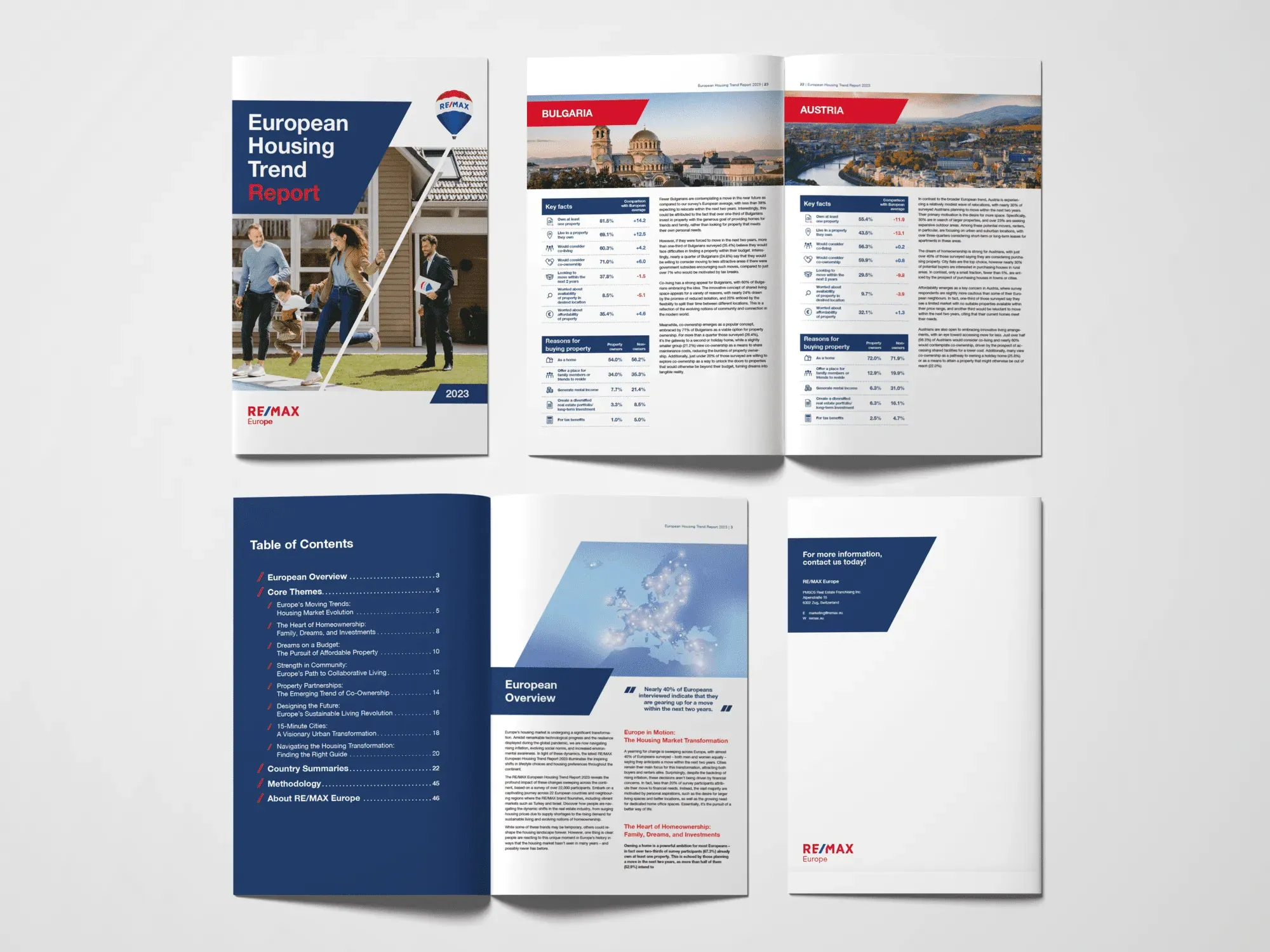
The European Housing Trend Report 2023 is a survey-based overview of housing preferences and market sentiment across Europe, published by RE/MAX Europe. It is authored by PIABO PR and draws on responses from more than 22,000 participants aged 18–65 across 22 countries, including Turkey and Israel. The report frames its findings around changing residential aspirations, housing affordability pressures, and emerging interest in alternative and more sustainable ways of living.
Mobility intentions across Europe
A central finding is that close to 40% of respondents plan to move within the next two years. The report characterises this mobility as being driven primarily by personal aspirations—such as seeking improved homes, neighbourhoods, or lifestyles—rather than by finances alone. At the same time, it notes that inflation and rising housing costs form a challenging background for these plans, shaping how people assess what is feasible.
Ownership levels and purchase ambitions
According to the report, 67.3% of respondents currently own a property, indicating that owner-occupation remains the dominant tenure across the surveyed countries. Alongside this, many non-owners express an intention to buy, with homeownership described as a goal shared across age groups. The report highlights affordability as a particularly significant obstacle for younger people attempting to enter the market.
Affordability pressures and trade-offs
Price increases and broader cost-of-living inflation are presented as key concerns. Around one third of respondents report worrying about finding affordable housing if they need to relocate soon. The report also points out a tension between budgets and preferences: even when affordability is a worry, many respondents are reluctant to compromise on their preferred location, suggesting that accessibility to well-connected places remains a high priority.
Co-living and shared ownership as responses
The report describes collaborative models—such as co-living and co-ownership—as increasingly attractive ways to address affordability constraints. More than half of respondents reportedly find co-living appealing, with motivations including cost sharing and the community benefits of living with others. The report positions these arrangements as practical options that can broaden access to housing while supporting social connection.
Sustainability features and the “15-minute city” idea
Sustainable living practices appear as a notable theme. The report notes uptake of eco-oriented home upgrades, including measures such as LED lighting and solar panels. It also references growing interest in the “15-minute city” concept, which centres on reducing travel needs by bringing essential services closer to where people live, linking convenience with lower commuting burdens.
Motivations and differences between countries
While personal reasons are emphasised as the main drivers for moving—such as seeking larger homes or more convenient locations—the report indicates that financial reasons remain important in some contexts. It also presents country-level comparisons on topics such as homeownership rates, urban versus rural preferences, and openness to new housing models like co-living and co-ownership, underlining that the European housing landscape is not uniform.
Overall picture
Taken together, the report depicts a housing environment where a substantial share of people anticipate moving, ownership remains widespread, and affordability concerns are significant. It highlights growing attention to shared living arrangements and sustainability-related upgrades as part of how households navigate costs and preferences across diverse European markets.